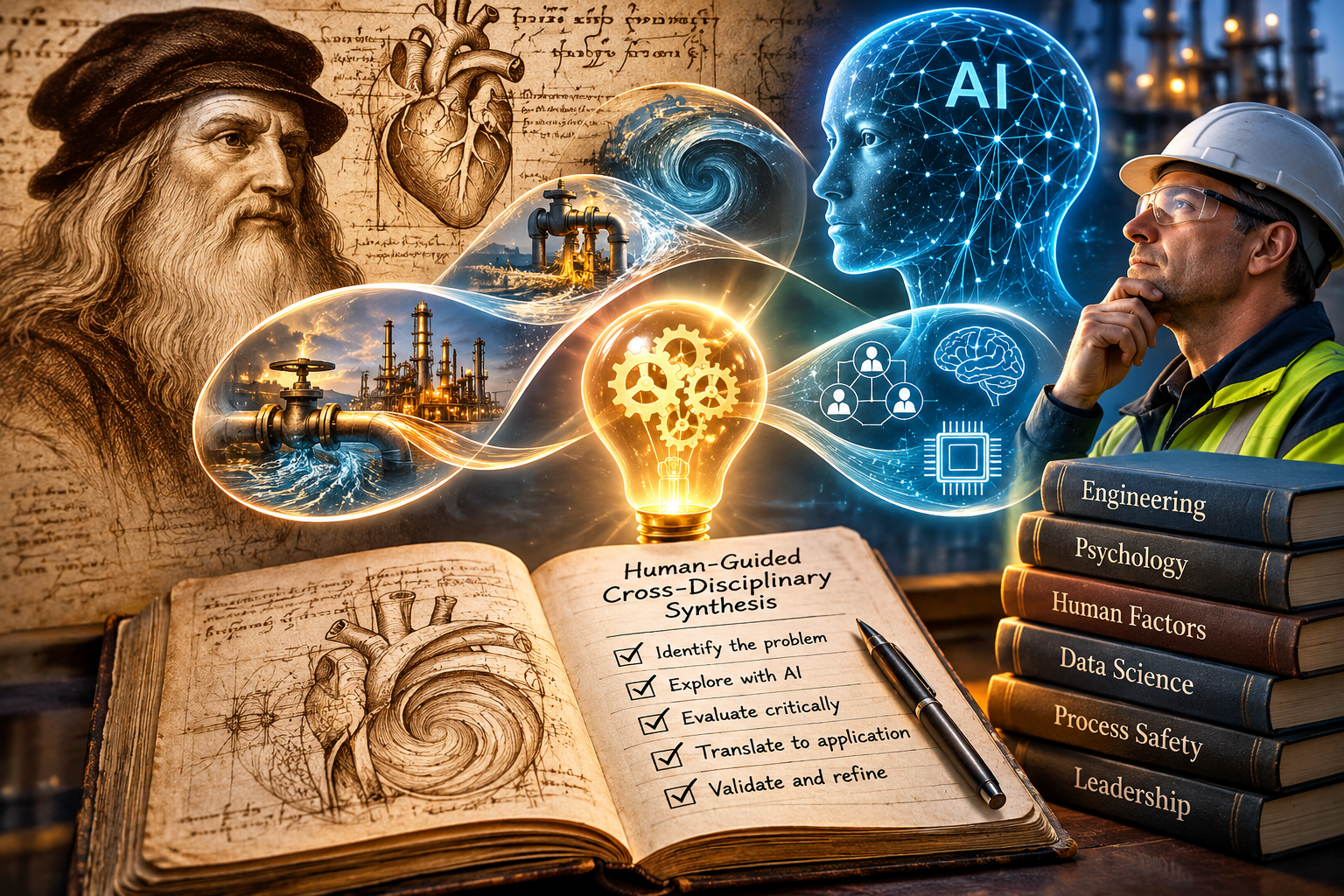
What Leonardo da Vinci Can Teach Us About Innovation in the Age of Artificial Intelligence
By Chet Brandon | LeadingEHS.com
Discovery at the Intersection of Disciplines
While reading Walter Isaacson’s biography of Leonardo da Vinci, I encountered an observation that caused me to reflect on the nature of human intelligence, scientific discovery, and the emerging relationship between human expertise and artificial intelligence.
Isaacson described how Leonardo’s studies of the human heart were informed by his knowledge of hydraulic engineering and his fascination with the movement of fluids. These seemingly unrelated interests enabled Leonardo to develop insights into cardiovascular function that would not be fully appreciated for centuries. This has been identified as one of Leonardo‘s most impactful discoveries. 
What struck me was his ability to recognize connections between different fields of knowledge and apply principles from one discipline to problems in another.
I have long been fascinated by this intellectual process. Throughout my career in environmental, health, and safety (EHS), operations, human factors, and organizational leadership, some of my most productive ideas have emerged from recognizing relationships between disciplines that are not typically considered together.
I’ve found that solutions to difficult industrial problems sometimes already exist, at least in principle, outside the field in which we are searching. The challenge is recognizing the connection and determining whether it can be applied.
This capacity for cross-disciplinary synthesis may become increasingly valuable as artificial intelligence transforms how professionals develop, evaluate, and apply knowledge. Recent scientific research suggests that combining human-generated analogies with AI’s ability to explore extensive bodies of information can significantly improve certain forms of technical problem-solving.
I believe this has important implications for EHS, operational performance, enterprise risk management, and organizational innovation.
Leonardo’s Lesson: Looking Beyond Disciplinary Boundaries
Leonardo approached the natural world with little regard for the boundaries we place between academic disciplines. His investigations ranged from anatomy and hydraulics to mechanics, geology, optics, and flight. Rather than treating these subjects as independent bodies of knowledge, he searched for common principles governing their behavior.
His investigation of the aortic valve provides a compelling example.
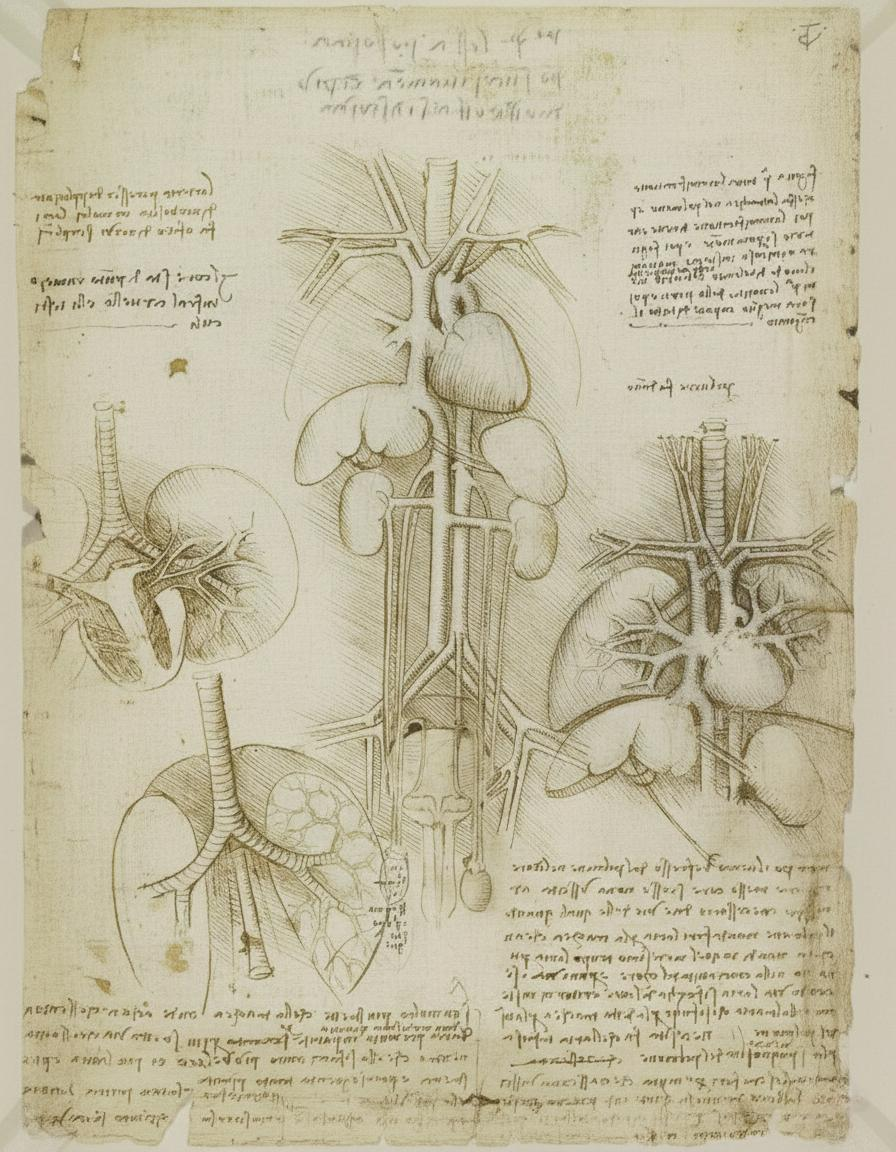
Leonardo da Vinci’s anatomical studies illustrate his remarkable ability to connect observations of the human body with principles from other disciplines, exemplifying the cross-disciplinary thinking at the heart of innovation.
Around 1512–1513, Leonardo investigated the structure and function of the aortic valve, developing a design for a glass model to study fluid movement. He described using water containing grass seeds to visualize swirling currents in the widened region of the aorta. His work correctly identified the role of these vortices in helping close the valve following each heartbeat, anticipating findings confirmed through modern research. [1, 2]
The intellectual leap was recognizing that principles he understood from hydraulic engineering could help explain the movement of blood through the human heart. Two very different systems shared an underlying physical mechanism.
Cognitive scientists describe this capability as analogical reasoning. Dedre Gentner’s research emphasizes that meaningful analogies depend on recognizing similar relationships and structures, even when the systems involved appear substantially different. [3]
The value of an analogy depends on whether the underlying relationship is genuine and transferable. An apparent similarity may prompt an investigation, but observation and testing determine whether it leads anywhere useful. Leonardo’s work illustrates how knowledge acquired in one field can create opportunities for discovery in another.
Scientific Evidence for Human-Guided AI Reasoning
In 2026, researchers R. Larraz and A. Corma published a study in Nature Communications titled “Human analogical guidance amplifies LLM performance through cross-domain knowledge activation.” Their findings offer an intriguing perspective on the potential value of human-directed reasoning in AI-assisted innovation. [4]
The researchers investigated whether a large language model could reconstruct the conceptual principles behind fluid catalytic cracking, an important petroleum-refining innovation introduced in the twentieth century.
The experiment simulated historical discovery by restricting retrieved reference information to knowledge available before the technology emerged. The challenge was to determine whether the model could connect existing engineering principles from different industries to arrive at the technological approach.
Without explicit analogical guidance, the model primarily explored familiar petroleum-engineering concepts. It proposed improvements to existing processes but generally failed to make the cross-domain connections required for the targeted solution.
When the researchers introduced structured analogies connecting the problem to principles from other engineering disciplines, the results changed dramatically. In the reported comparison, successful solutions increased from 10% of trials without explicit analogical guidance to 100% with guidance.
The experiments used Qwen-2.5-7B, a specific language model, within a controlled historical engineering reconstruction. The percentages should not be interpreted as a universal measure of how much human guidance improves AI performance. The broader research involved multiple experimental conditions examining knowledge access, analogical guidance, and the model’s internal processing.
An especially important finding was that the retrieved technical information remained constant between the compared conditions. The improvement was associated with directing the model toward relevant relationships among concepts already available in its context.
That finding caught my attention because it reflects an approach I have been using in my own professional writing and research.
I frequently begin with a connection I’ve recognized between fields, then use AI to explore the underlying principles, investigate related research, and challenge the possible application. The AI helps expand the investigation, but the initial direction often comes from professional experience and curiosity.
In my earlier article, Human + AI: The Power of Synergistic Collaboration [5], I explored how human cognitive resilience, contextual understanding, creativity, and ethical judgment can complement AI’s computational, analytical, and predictive capabilities. I argued that the greatest potential lies in a collaborative relationship where human expertise and machine intelligence reinforce one another through continuous feedback and learning. Cross-disciplinary synthesis takes that thinking a step further. Rather than simply combining complementary capabilities to improve existing decisions, we can deliberately use human experience to identify relationships across different fields of knowledge and direct AI toward exploring their potential applications. This creates an opportunity to move beyond improving how we perform established work and begin developing new solutions to persistent problems. I see this as a natural extension of my earlier argument about human–AI synergy, with potentially significant implications for EHS innovation and enterprise performance.
The research provides support for this approach, although it does not establish that our particular applications will produce comparable performance improvements.
From Professional Expertise to Enterprise Innovation
Professionals accumulate mental models through education, experience, observation, and the problems they encounter throughout their careers. Over time, those models can become useful well beyond the disciplines in which they originated.
An engineer familiar with reliability theory may recognize its relevance to organizational decision-making. A psychologist studying human behavior may identify principles that improve industrial training. A process safety professional may see how independent protection systems could inform the development of safeguards for autonomous AI.
These connections can open avenues of investigation that might otherwise be overlooked.
Artificial intelligence makes it easier to pursue them. It can help identify supporting research, examine unfamiliar technical fields, compare competing explanations, and develop potential applications. But the business value must eventually be demonstrated.
In manufacturing, the value of a new idea generally shows up somewhere tangible: fewer equipment failures, improved production reliability, better capital decisions, reduced operating losses, or stronger protection against catastrophic events. I’ve spent much of my career working in environments where an intellectually attractive solution means little unless it survives the demands of actual operations.
Consider organizational learning. Industrial companies invest heavily in incident investigations, audits, corrective actions, and training. Yet organizations continue to experience events resembling problems they have already investigated.
My earlier article, Seeing Risk Before It Hurts: An Example of How Predictive Analytics Are Redefining Safety [6], illustrates a potential application of this thinking. It combines industrial operating information, AI-assisted data integration, and causal modeling to explore how organizations might identify emerging risk conditions before injuries occur.
We often respond by improving procedures, increasing training, or strengthening communication. Those actions may help, but they don’t necessarily address the underlying problem of how knowledge moves through an organization.
What if we approached that challenge using principles from cognitive psychology and knowledge management rather than relying primarily on traditional EHS training methods?
AI-assisted systems could potentially identify relevant lessons from previous incidents and make them available when employees or managers encounter similar circumstances. Such an application would need to account for context, information quality, and the reliability of the recommendations.
If effective, the benefits could extend beyond safety performance to operational consistency, workforce development, and preservation of institutional knowledge.
This is where cross-disciplinary synthesis becomes relevant to enterprise leadership. A useful connection can produce a new capability, improve how resources are deployed, or reveal a risk that established methods have overlooked.
Applying Cross-Disciplinary Thinking to EHS
One area I’ve been exploring involves the relationship between industrial process safety and artificial intelligence governance.
Industrial control systems often employ independent protection layers designed to prevent failures in normal process control from producing catastrophic consequences. Safety instrumented systems are one example of this approach.
As AI systems become more involved in industrial decision-making, I began considering whether similar principles could inform independent supervisory mechanisms intended to detect or prevent unsafe AI-generated actions.
The connection is intriguing. A control system responsible for normal operations should not necessarily be the sole authority determining whether its own actions are safe. That principle has been embedded in industrial safety engineering for decades.
Could a comparable philosophy help address error propagation in multi-agent AI systems?
I’ve been investigating this possibility through work examining AI error propagation and independent supervisory safety channels.
There are significant differences between the two applications, however, and those differences matter. Industrial safeguards can often be designed around defined process variables, physical limits, and established failure modes. AI-generated decisions may involve ambiguous information, changing operating conditions, and failure mechanisms that are difficult to predict.
The analogy provides a starting point for research, but its practical value depends on whether the proposed safeguards can actually detect dangerous conditions and intervene reliably.
I explored this connection more directly in my article, Automated Reasoning for Human Error Detection in Industrial Operations [7], where I examined how principles from independent industrial protection systems might inform a supervisory reasoning layer for AI-generated decisions.
A second example involves my work on the Inherited Risk Ecosystem.
Traditional hazard assessments frequently emphasize individual hazards, initiating events, and associated controls. These methods remain essential, but operational risk is also influenced by relationships among equipment reliability, organizational conditions, human performance, and competing operational demands.
I began exploring whether concepts from systems thinking and human factors could help explain how these conditions interact and influence the risk experienced by individuals performing work.
The resulting framework considers how people may inherit risk from the broader operational environment, including circumstances outside their immediate control. The concept is being developed and examined through practical applications. Its ultimate value will depend on whether it improves our ability to identify meaningful risk conditions and direct preventive actions.
These examples reflect how I approach innovation. I encounter a problem, recognize a possible connection to another discipline, and investigate whether the underlying principles offer a useful way forward. Some connections will survive scrutiny. Others will not. That is part of the process.
Human-Guided Cross-Disciplinary Synthesis: A Practical Framework
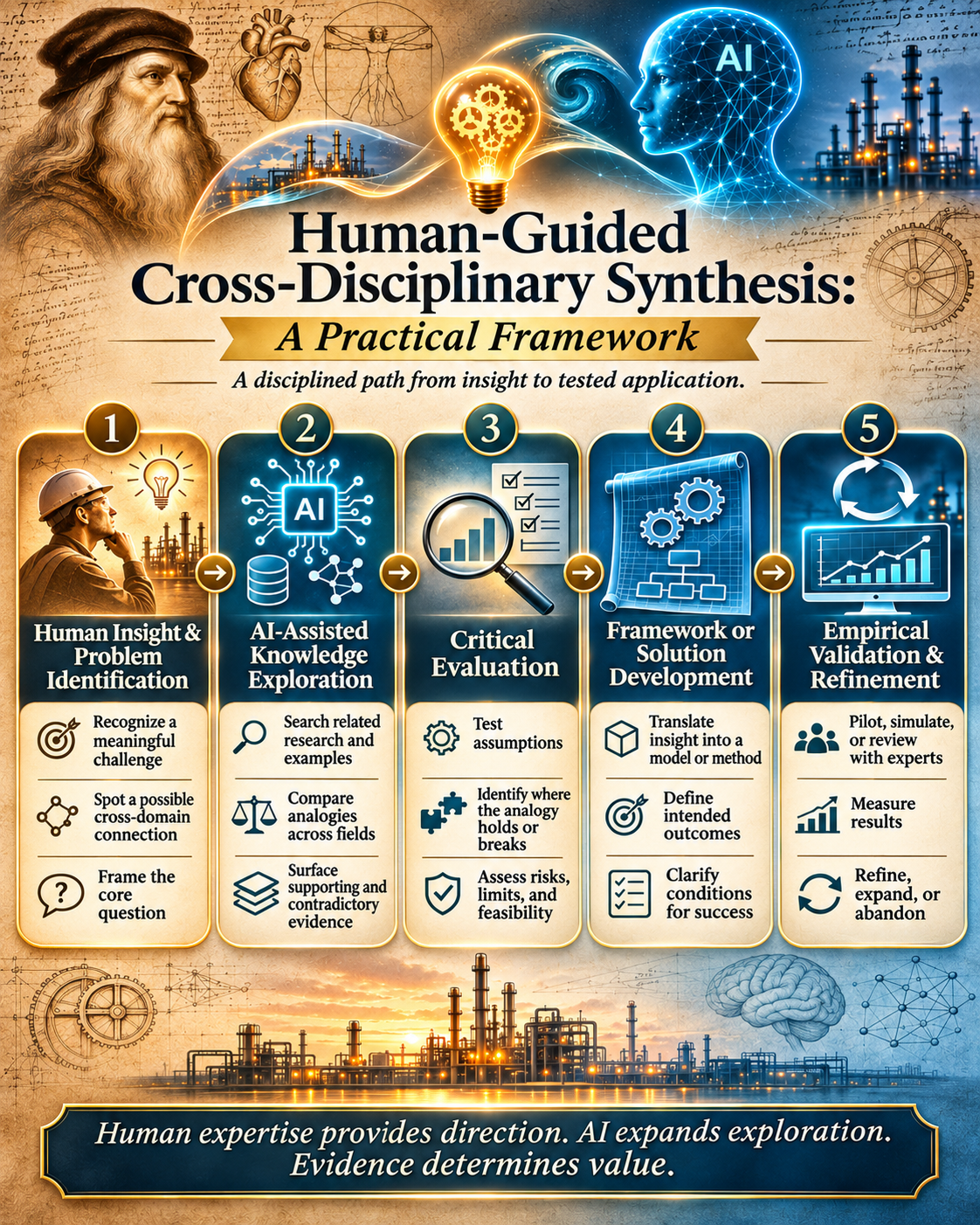
If cross-disciplinary reasoning can contribute to professional innovation, can we make the process more deliberate and repeatable?
I propose Human-Guided Cross-Disciplinary Synthesis as a practical framework for organizing this type of collaboration between experienced professionals and AI.
I am not proposing a new theory of human cognition. Analogical reasoning and knowledge transfer have long been subjects of scientific research. The contribution here is a structured method for applying those established principles to professional problem-solving with AI assistance.
The process begins with human insight and problem identification. An experienced professional identifies a challenge and recognizes that an approach from another discipline may offer a useful perspective. This often starts with a simple question: Have I encountered something elsewhere that operates according to similar principles?
The next stage is AI-assisted knowledge exploration. AI is used to investigate the proposed connection through technical literature, scientific research, historical examples, and related applications. The exploration should also consider alternative analogies that may be more appropriate.
Critical evaluation follows. The professional examines whether the apparent similarities reflect genuinely transferable principles. What assumptions are being made? Where do the systems behave differently? What evidence contradicts the proposed relationship?
Promising insights can then be translated into a method, model, operational practice, or testable hypothesis. The intended outcomes and conditions required for success should be clearly defined.
Finally, the proposed application must be subjected to empirical validation and refinement. Simulation, expert review, controlled pilots, or operational data can help determine whether the concept warrants further development, modification, or abandonment.
These stages are iterative. Testing may expose weaknesses that require revisiting the initial analogy or considering a different approach. For industrial applications, proposed solutions should also be evaluated for cost, implementation feasibility, operational consequences, and their potential to introduce new risks.
The objective is to create a disciplined process that moves from a promising intellectual connection to something that can be evaluated in the real world.
When a Good Analogy Becomes a Bad Decision
This is where I believe the greatest intellectual discipline is required. A compelling analogy can be wrong.
Two systems may resemble one another in important ways while differing in precisely the characteristics that determine whether a solution will work.
Consider the proposed relationship between industrial safety instrumented systems and independent AI supervisory channels.
In industrial process safety, independence is not simply a matter of installing another device or control system. It requires careful consideration of common-cause failures, dependencies, reliability, and the ability of a protective function to respond when needed.
The same problem would arise in an AI application.
Suppose an AI supervisor and the system it monitors depend on the same training data, reasoning architecture, or information source. Both might make the same incorrect judgment. A seemingly independent supervisory channel could therefore fail at precisely the moment it is needed.
The industrial analogy identifies the importance of independence. It does not establish that independence has been achieved. That distinction is fundamental.
AI introduces another complication: it can produce persuasive arguments supporting an analogy even when the underlying relationship is weak. It may overlook contradictory evidence or reinforce assumptions embedded in the questions it receives.
The professional directing the investigation can make the same mistake by becoming too attached to an attractive idea.
I think this is one of the most important safeguards in human–AI collaboration: deliberately asking the system to challenge the proposed connection.
What would make the analogy invalid? Which assumptions are weakest? What alternative explanation is more plausible? What test would distinguish a useful principle from a superficial similarity?
The National Institute of Standards and Technology’s AI Risk Management Framework emphasizes validity, reliability, measurement, and appropriate oversight as important elements of trustworthy AI systems. [9]
Those principles should inform any effort to translate AI-assisted reasoning into high-consequence industrial decisions.
The real test comes when an idea encounters operational reality. Can it improve a decision, strengthen a safeguard, or prevent a failure? If not, the analogy may be interesting without being useful.
What This Means for Professional Expertise
One concern surrounding artificial intelligence is that increasingly capable systems will diminish the value of accumulated professional knowledge and experience.
I see another possibility.
As AI makes information easier to access, experienced professionals may become increasingly valuable for their ability to recognize meaningful relationships, identify worthwhile problems, and direct the investigation of new solutions.
This requires more than familiarity with AI technology.
A professional who understands operations, engineering, psychology, business strategy, and emerging technologies has a broader range of mental models from which to draw.
But broad experience alone is insufficient. It takes curiosity to explore unfamiliar disciplines, sound judgment to recognize useful connections, and humility to abandon ideas that do not withstand scrutiny.
Research published in Design Science in 2026 provides additional evidence of the potential value of structured human–AI collaboration. Kokate and Onkar studied AI-supported analogical ideation involving 24 undergraduate design students. Groups using the researchers’ support tool generated ideas that received higher expert evaluations than those produced by comparison groups. [8]
The study concerned design ideation rather than industrial operations, and its findings should be interpreted within that setting. Still, it adds to the growing body of research examining how deliberate interaction between humans and AI can support creative problem-solving.
For EHS leaders, I believe the implications extend to how we develop our own capabilities and those of future professionals.
Technical depth remains essential. But we should also encourage exposure to other fields, particularly engineering, organizational psychology, economics, data science, human factors, and business management.
Some of the most consequential advances in safety practice have drawn upon knowledge developed elsewhere. There is little reason to believe that will change.
What may change is our ability to discover and investigate those connections.
Returning to Leonardo
Leonardo da Vinci worked without computers, artificial intelligence, or access to the enormous scientific literature available today. His tools were observation, experimentation, drawing, mathematics, and an extraordinary curiosity about the natural world.
Yet his investigations demonstrate an approach to discovery that remains relevant more than five centuries later.
He recognized that knowledge developed while studying one system could illuminate the behavior of another.
AI now gives us the ability to investigate these connections across an enormous range of accumulated knowledge.
My experience has convinced me that some of the most consequential ideas emerge when we look beyond the boundaries of our own disciplines. Leonardo demonstrated the power of that approach centuries ago. Artificial intelligence now allows us to explore those connections with a breadth of knowledge that would have been unimaginable to him.
The opportunity for EHS professionals is substantial. We can continue applying established methods to familiar problems, while also examining what engineering, psychology, computer science, and other disciplines might teach us about challenges that have resisted conventional solutions.
I find that second possibility especially compelling.
Some of the most promising directions in my own work have begun with a simple observation: a problem in one field looks remarkably similar to something I encountered in another. AI has made it much easier to investigate whether that connection is meaningful.
But the responsibility remains ours to determine whether the resulting ideas actually work.
References
- Isaacson, W. (2017). Leonardo da Vinci. Simon & Schuster.
- Royal Collection Trust. (n.d.). The aortic valve (RCIN 919082). https://www.rct.uk/collection/search#/919082
- Gentner, D. (2025). Analogy. In M. C. Frank & A. Majid (Eds.), Open Encyclopedia of Cognitive Science. MIT Press. https://doi.org/10.21428/e2759450.fed73a94
- Larraz, R., & Corma, A. (2026). Human analogical guidance amplifies LLM performance through cross-domain knowledge activation. Nature Communications, 17, Article 4822. https://doi.org/10.1038/s41467-026-70873-7
- Brandon, C. (2025, November 2). Human + AI: The power of synergistic collaboration. LeadingEHS.com. https://leadingehs.com/2025/11/02/human-ai-the-power-of-synergistic-collaboration/
- Brandon, C. (2026, January 11). Seeing risk before it hurts: An example of how predictive analytics are redefining safety. LeadingEHS.com. https://leadingehs.com/2026/01/11/seeing-risk-before-it-hurts-an-example-of-how-predictive-analytics-are-redefining-safety/
- Brandon, C. (2026, April 11). Automated reasoning for human error detection in industrial operations. LeadingEHS.com. https://leadingehs.com/2026/04/11/automated-reasoning-for-human-error-detection-in-industrial-operations/
- Kokate, R., & Onkar, P. (2026). Analogical reasoning with large language models: A co-creative framework and benchmarking of LLMs in design ideation. Design Science, 12, e4. https://doi.org/10.1017/dsj.2025.10044
- National Institute of Standards and Technology. (2023). Artificial Intelligence Risk Management Framework (AI RMF 1.0) (NIST AI 100-1). https://doi.org/10.6028/NIST.AI.100-1


