
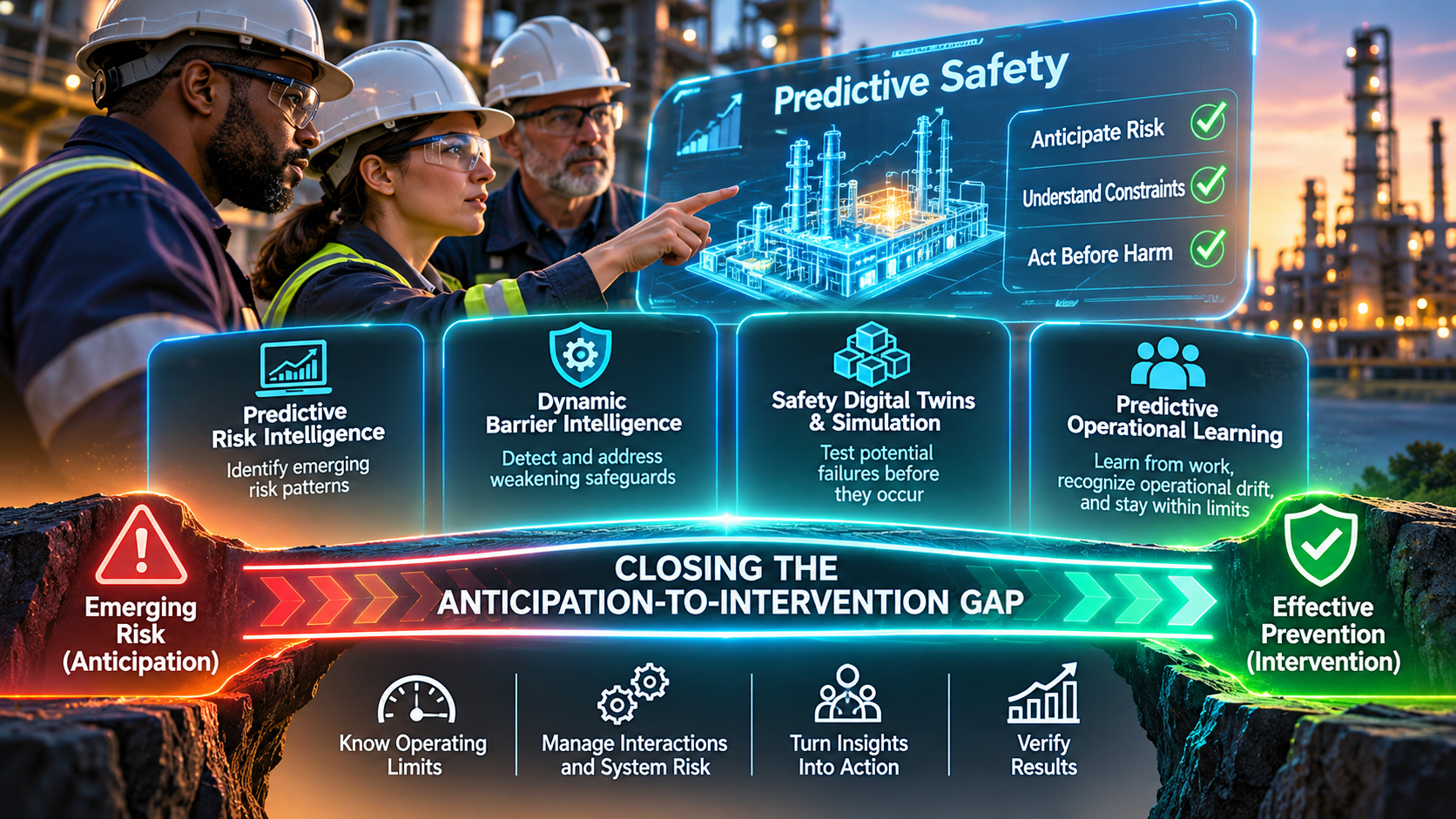
How AI, emerging technologies, and operational intelligence are transforming our ability to anticipate risk and prevent serious incidents.
By Chet Brandon, CSP, CHMM
I’ve heard a variation of the same frustration from several CEOs and senior business leaders following serious workplace incidents. Their safety teams can explain what happened. They can reconstruct events, identify contributing factors, prepare detailed investigations, and recommend corrective actions. Often, they do this exceptionally well. Yet the question executives increasingly want answered is different: “Why couldn’t we see this coming and prevent it?”
It’s a reasonable question, although not always a fair one. Safety professionals operate in complex environments where resources are constrained, information is incomplete, human behavior varies, and operational conditions change continuously. Not every incident is foreseeable, even with a well-designed management system.
Still, the question exposes an important limitation in how many organizations approach safety. We have invested heavily in systems that document what went wrong, but have we made a comparable investment in understanding what might go wrong next?
The opportunity is not to abandon incident investigations, compliance assurance, or traditional safety management. These remain essential. It is to expand our capabilities beyond retrospective analysis and make safety a more effective contributor to forward-looking operational decisions.
Why Safety Remains So Reactive
Much of the information collected by safety organizations originates from something that has already happened: an injury, a near miss, an inspection finding, a regulatory violation, or a failed audit. These events generate information that is relatively easy to categorize, investigate, and report. Over time, organizations have built increasingly sophisticated management systems around this information.
Even many conventional leading indicators, such as training completion, observations conducted, and inspections performed, measure activities rather than the effectiveness of risk controls. A facility can achieve every safety activity target while operating with serious vulnerabilities that remain largely invisible to management.
Resource limitations reinforce this reactive orientation. EHS teams are frequently stretched across regulatory compliance, investigations, training, audits, reporting, and daily operational support. An incident creates immediate demands from executives, regulators, employees, and sometimes the public. Anticipatory risk analysis competes for those same resources but rarely commands comparable urgency.
Human variability makes the challenge more complicated. Equipment deteriorates, production pressures change, experienced employees retire, and people routinely adapt established procedures to accomplish their tasks. These adaptations are not necessarily evidence of poor safety behavior. Often, they are how complex operations continue functioning despite imperfect processes and systems.
The challenge is recognizing when these adaptations, combined with changing operational conditions, begin to exceed the capacity of existing safeguards to prevent harm.
Organizational structures can also conceal emerging risks. Maintenance may recognize declining equipment reliability while operations sees recurring process interruptions. Supervisors may understand staffing or competency gaps, while EHS has documented a series of relatively minor incidents. Individually, these signals may not appear alarming. Together, they may describe a deteriorating risk environment.
Perhaps the most dangerous limitation is our tendency to interpret the absence of incidents as evidence that risks are adequately controlled. A facility can operate for years without a major incident despite deteriorating safeguards, equipment deficiencies, or unsafe operational dependencies.
This is especially important when considering serious injuries, fatalities, and major process safety events. Their relatively low frequency makes historical injury statistics an imperfect measure of the conditions that could produce catastrophic outcomes.
Moving From Leading Indicators to Risk Intelligence
Leading indicators have been promoted for decades, and for good reason. They provide information about preventive activities before injuries occur. But the next advancement requires more than expanding the number of metrics.
Consider how a facility evaluates electrical safety performance.
The traditional approach might measure completion of electrical safety training, the number of electrical inspections conducted, and the percentage of corrective actions closed. These measures provide useful information but limited assurance that critical electrical hazards are effectively controlled.
A more advanced approach would examine whether equipment conditions are deteriorating, whether protective devices are being maintained and tested, whether temporary power arrangements are increasing, and whether employees routinely encounter conditions that challenge established safeguards.
That is a different kind of information. It tells management something about the condition of risk rather than simply the completion of safety activities.
I would describe this capability as risk intelligence: the ability to integrate operational information, evaluate changing conditions, identify vulnerabilities, and support decisions that reduce the likelihood or consequences of adverse events.
An important part of that intelligence is understanding the boundaries within which operations remain safe. Equipment design, operating parameters, engineering controls, procedures, and workforce capabilities establish expectations about how work can be performed without unacceptable risk.
Recognizing when these conditions are changing provides an opportunity to intervene before control is lost.
We may never be able to reliably predict the precise circumstances of the next serious incident. But we can become considerably better at recognizing the conditions that make such events possible.
Four Emerging Approaches That Could Fundamentally Change Safety Prevention
Advances in artificial intelligence, industrial connectivity, simulation, and systems analysis are creating opportunities to detect emerging weaknesses and evaluate their consequences before they produce harm.
Four approaches deserve particular attention because they address different shortcomings in traditional safety management.
1. Predictive Risk Intelligence: Using AI to Recognize Conditions That Precede Failure
Most companies have considerably more information about their operational risks than they realize. The problem is that this information is scattered across systems designed for different purposes.
EHS maintains incident reports, observations, and audit findings. Maintenance tracks equipment failures, work orders, and deferred repairs. Engineering manages equipment reliability and design changes. Operations monitors process deviations, production performance, and staffing. Human resources holds information about workforce turnover, qualifications, and training.
These systems rarely communicate effectively, and the relationships among their information are even less frequently examined.
Artificial intelligence, particularly machine learning and natural language processing, offers an opportunity to change this. Rather than analyzing individual datasets in isolation, organizations can begin identifying combinations of conditions associated with operational deterioration and elevated risk.
Consider a chemical manufacturing operation where several changes are occurring. Maintenance backlogs are increasing, equipment is experiencing more frequent process interruptions, experienced operators are being replaced, and production targets are rising.
None of these developments necessarily predicts an incident on its own. Their interaction, however, may indicate that the operation is becoming less stable and that existing controls are being placed under increasing demands.
Machine learning can identify nonlinear relationships and combinations of variables that conventional statistical analysis may overlook. Natural language processing can extract recurring concerns from inspection comments, incident narratives, maintenance notes, and employee reports. Anomaly detection can identify departures from established operating patterns, sometimes before predefined limits are exceeded.
Temporal modeling adds another dimension by examining how conditions evolve. Rather than evaluating a maintenance backlog as a single number, an analytical system could examine its rate of growth, the equipment affected, and its relationship to other operational changes.
A 2025 systematic review by Armenteros-Cosme and colleagues examined AI and machine learning applications in occupational risk prediction and prevention. A 2026 review by La Torre and colleagues explored additional applications involving hazard detection, monitoring, and decision support. Both provide useful evidence of the developing field while highlighting limitations involving data quality, implementation, and model reliability.
The application I find especially promising is recognizing similar risk patterns across geographically dispersed facilities. A global manufacturer may have several plants experiencing variations of the same underlying weakness, but no individual location has enough information to recognize the broader pattern.
I explored a more specific application of this concept in my earlier article, Seeing Risk Before It Hurts: An Example of How Predictive Analytics Are Redefining Safety. There, I outlined a predictive injury prevention system that would integrate computer vision, EHS records, maintenance information, employee observations, and operating data to recognize emerging risk conditions. The proposed approach uses AI to organize and synchronize these data streams, then applies structural equation modeling (SEM) to examine relationships among underlying risk drivers, including unsafe conditions and behaviors, equipment deterioration, and operational stress. The objective is to move beyond identifying correlations toward developing a more useful understanding of how risk accumulates and which interventions may reduce it. While the concept remains in development and requires pilot testing and validation, it illustrates how predictive analytics could provide operations and EHS leaders with actionable risk intelligence while there is still time to intervene (Brandon, “Seeing Risk”).
Enterprise-wide analysis could identify those relationships and prompt targeted reviews before serious failures occur.
There are substantial technical limitations. Serious incidents are relatively rare, reporting practices vary, and historical data may omit the very conditions that matter most. Statistical relationships also do not establish causation. A model associating overtime with incidents, for example, may be detecting fatigue, production instability, maintenance emergencies, or several interacting factors.
These findings require investigation by people who understand the operation.
I would rather have an AI system identify a handful of credible emerging vulnerabilities that lead to effective intervention than produce hundreds of impressive-looking risk scores that no one knows how to use.
Imagine telling a CEO that analysis has identified deteriorating equipment reliability, recurring process deviations, and weakened controls across three facilities—and that engineering and operations teams are already addressing the underlying conditions.
That is the kind of intelligence executives need.
2. Dynamic Barrier Intelligence: Recognizing When Critical Safeguards Are Weakening
Safeguards degrade. Equipment ages, maintenance is deferred, protective devices are bypassed, procedures become outdated, and operational changes can undermine assumptions made during earlier risk assessments.
Dynamic barrier management and real-time risk assessment seek to make these changes visible as they occur.
The engineering foundations are well established. Bowtie analysis, Layers of Protection Analysis, and other risk assessment methods identify safeguards intended to prevent hazardous events or mitigate their consequences. Newer capabilities allow organizations to connect those models to current operating information.
Consider a manufacturing process involving a high-pressure vessel containing hazardous chemicals. Its protection may depend on operating controls, alarms, independent shutdown systems, pressure relief devices, inspection programs, and emergency response capabilities.
A conventional assessment might determine that the system is adequately protected based on the design and presence of these safeguards. Periodic inspections provide additional assurance.
But equipment and operating conditions do not remain static between assessments.
Is a protective instrument overdue for testing? Has a shutdown system been temporarily bypassed? Are operating parameters approaching established limits? Have inspection findings identified deterioration? Are maintenance deficiencies accumulating around equipment essential to preventing loss of containment?
When this information is connected to the facility’s barrier model, management can develop a more current understanding of its protective capability.
More sophisticated approaches use probabilistic models, including Bayesian networks, to evaluate how equipment conditions and dependencies among safeguards may influence risk. These estimates depend heavily on model assumptions and the quality of available information.
Research by Yuan, Reniers, and Yang describes an integrated framework for dynamic safety and security barrier management in chemical process operations. The work builds on established approaches to process safety performance measurement, including those described in IOGP Report 456.
The practical value is straightforward. Instead of discovering during an audit that several important safeguards have been compromised, operations leadership could receive earlier warning that protective capability is deteriorating.
That warning should lead to defined decisions.
If a critical shutdown function becomes unavailable, established requirements might call for an engineering review, temporary controls, operating restrictions, or a controlled shutdown. Those decisions must reflect the specific equipment, applicable requirements, and established risk criteria.
This approach focuses on something more tangible than predicting rare injuries. It evaluates the condition of safeguards that protect people and facilities from serious consequences.
An organization that knows which critical controls are weakening is better positioned to act before a process upset becomes a major event.
3. Safety Digital Twins and Counterfactual Simulation: Testing Potential Failures Before They Occur
Digital twins are already used in industry to represent physical assets, evaluate equipment performance, support maintenance, and optimize production. Their potential safety applications go further.
A sufficiently developed safety-oriented digital twin could integrate equipment characteristics, process conditions, engineering safeguards, and operating constraints to examine how a system might respond to emerging failures.
Consider a chemical manufacturing facility planning to increase production by 20 percent. A conventional management-of-change review would examine design limits, procedures, equipment capacity, and potential hazards.
A digital simulation could complement that review by evaluating combinations of process disturbances, equipment degradation, cooling limitations, and protective system failures. Engineers could identify scenarios that produce unacceptable operating conditions and determine where additional safeguards are warranted.
Counterfactual analysis allows the organization to evaluate conditions that have not yet occurred.
What happens if a cooling system loses capacity while production rates are elevated? What if an emergency shutdown function is unavailable during a process upset? How much operating margin remains if critical equipment deteriorates? Which engineering modification provides the greatest improvement in protective capability?
Engineers have addressed these questions for decades through hazard analyses, reliability studies, and simulation. Digital twins can potentially make that work more responsive to current operating conditions and allow a broader range of scenarios to be examined.
AI-assisted modeling may further accelerate scenario generation, sensitivity analysis, and comparisons of proposed interventions.
Research by Zio and Miqueles examined digital twin applications in safety analysis, risk assessment, and emergency management. Ma and Zou subsequently explored digital twin technologies and potential safety applications across high-risk industries.
These developments are promising, but the distinction between a technically possible application and a proven industrial capability matters.
A digital twin can reproduce only what its model is capable of representing. Incomplete equipment information, inaccurate operating data, or flawed assumptions can produce misleading results. Models developed for production optimization are not automatically suitable for safety-critical decisions.
For high-consequence applications, engineering validation and independent review remain essential.
Where the investment can be justified, however, the potential business value is considerable.
Before approving a major production increase, process modification, or maintenance deferral, executives could examine modeled effects on safety margins alongside expected impacts on capacity, reliability, and cost.
This makes safety an integral part of evaluating operational choices rather than a separate review conducted after those choices are largely settled.
4. Predictive Operational Learning: Understanding Work and Recognizing the Erosion of Operating Limits
Technology can reveal relationships that would otherwise be difficult to detect. But some of the earliest indications of deteriorating operational conditions are already known to the people performing the work.
An operator may notice that equipment is becoming less reliable. A maintenance technician may recognize that a temporary repair is becoming permanent. A supervisor may see that staffing changes are increasing reliance on inexperienced employees. Workers may gradually adopt informal methods to compensate for procedures that no longer reflect actual operating conditions.
These observations do not always result in formal safety reports. Yet they can reveal important changes in how the operation is functioning.
Human and Organizational Performance, Learning Teams, and resilience engineering provide methods for understanding normal work, the adjustments people make, and the conditions that support reliable performance.
New analytical capabilities could make these insights more useful across larger organizations.
Imagine regularly gathering observations from operations, maintenance, engineering, and frontline employees about equipment reliability, procedural usability, work complexity, and conditions that make tasks difficult to perform safely.
AI-assisted analysis could organize these observations, identify recurring themes, and recognize similar concerns across multiple facilities. Systems-based methods such as Systems-Theoretic Process Analysis could help teams examine how organizational decisions, technical conditions, and human adaptations interact to create hazardous situations (Leveson and Thomas).
But collecting weak signals is only part of the opportunity. We also need to understand what those signals tell us about the condition of the operation.
This is where predictive operational learning connects directly with Operational Integrity and the concept of the operating envelope.
In my earlier article, Operational Integrity: The Operating Model Heavy Manufacturing Needs, I described an integrated management approach involving the operating envelope, operational discipline, operational reliability, operational resilience, and leadership cadence (Brandon).
Every industrial operation has boundaries defined by equipment design, process parameters, engineering safeguards, workforce capabilities, operating procedures, and regulatory requirements.
Some limits are explicit and measurable, such as temperature, pressure, equipment capacity, or chemical concentration. Others involve more complex assumptions about staffing competency, maintenance condition, procedural effectiveness, and the availability of critical controls.
Employees and operational leaders need to understand those limits, recognize when conditions are approaching them, and know what actions are required to maintain safe operation.
Consider a manufacturing process experiencing recurring equipment interruptions. Experienced operators may have developed informal adjustments that allow production to continue. Those adaptations may appear reasonable, particularly if they have been successful for years.
But are they keeping the process within its intended operating envelope? Are they compensating for equipment deterioration or bypassing safeguards incorporated into the original design? Has the organization gradually accepted conditions that would once have triggered an engineering review?
These are questions that conventional incident statistics cannot answer.
Repeated procedural workarounds, growing dependence on individual experience, and declining equipment reliability may indicate operational drift. Over time, the organization can normalize conditions that reduce its ability to control serious hazards.
Learning from normal work helps identify those changes. IOGP’s Learning from Normal Work provides practical guidance for examining everyday operations and converting observations into improvements.
The challenge is to turn those observations into an understanding of where operating boundaries are being approached or crossed.
Industrial operations need employees who can respond intelligently to unexpected conditions. But flexibility should not become a substitute for reliable equipment, effective safeguards, and sound operating procedures.
Knowing the operating limits, recognizing when those limits are being challenged, and acting before they are exceeded should become fundamental capabilities of predictive safety.
A Predictable Injury: What We Could Have Recognized Before It Happened
An incident from my experience leading safety in the automotive industry illustrates why understanding the interactions among hazards and controls is so important.
An employee was working on an automotive assembly line, tightening a nut on a vehicle suspension assembly using a powerful pneumatic nutrunner. Like other employees performing similar work, he was wearing high-strength cut-resistant gloves intended to protect his hands from sharp edges and other mechanical hazards.
During the operation, material from the glove on his middle finger became caught in the rotating socket. The tool continued turning, pulling the glove material increasingly tight around his finger. Because the cut-resistant material did not readily tear or release, the force was transferred to his finger.
By the time he recognized what was happening and stopped the tool, the damage was severe. He lost the first joint of his middle finger.
What makes this case particularly relevant is that the underlying hazard was recognizable before the incident occurred.
The cut-resistant gloves served an important purpose. Employees working with automotive suspension components encountered sharp edges and other conditions that created legitimate hand injury risks. The gloves were intended to reduce those exposures.
However, the same material properties that made them effective against cuts also created an entanglement hazard when used near a powerful rotating socket.
The system-level weakness was the failure to recognize and adequately address that incompatibility.
The task involved multiple hazards requiring an integrated solution. Protection against sharp edges could not be evaluated independently of the rotating equipment. Likewise, eliminating the glove-related entanglement risk without addressing the underlying cut hazards could simply exchange one exposure for another.
This is precisely where a more predictive approach could have made a difference.
A comprehensive task assessment should examine not only individual hazards and their controls, but also the ways those controls interact with equipment, materials, operating conditions, and employee activities.
In this case, that meant understanding the relationship among glove properties, rotating components, tool torque, hand positioning, and the sharp edges associated with the assembly task.
Engineering, operations, EHS, and employees performing the work could have evaluated solutions addressing the full range of exposures. Depending on the equipment and application, alternatives might include guarding or modifying rotating components, changing tool configurations, redesigning work positioning, or selecting protective equipment specifically evaluated for use with the tool.
The objective would be to control both the cutting and entanglement hazards without creating new risks or placing unreasonable demands on employee behavior.
This case also illustrates the importance of the operating envelope. Safe performance depended on the compatibility of the tool, protective equipment, work method, and employee interaction with the equipment.
A glove can meet its cut-resistance specification, and a tool can meet its applicable equipment specifications, while their combined use introduces a serious hazard. Compliance with individual requirements does not necessarily establish that the overall task is safe.
The entanglement hazard is recognized in ISO 11148-6, which addresses safety requirements for handheld assembly power tools and includes warnings concerning gloves and rotating drives (International Organization for Standardization).
Numerous employees performed similar assembly operations using the same type of equipment. The potential exposure therefore extended beyond the employee involved in the incident.
In this case, we didn’t need artificial intelligence to recognize the problem. We needed to evaluate how the glove, tool, and employee’s work interacted.
What AI could help organizations do today is identify similar incompatibilities across hundreds of operations before someone gets hurt. An analytical system could compare equipment characteristics, PPE requirements, manufacturer warnings, and historical incidents to identify combinations deserving closer examination.
Operational learning could then establish how employees actually perform the work, while engineering assessments could determine which controls provide effective protection across the full range of hazards.
We could not necessarily have predicted which employee would be injured or when the event would occur. But the hazardous interaction existed before the incident.
The fundamental failure was not that a protective measure failed to protect against the hazard it was designed for. It was that the overall system failed to adequately account for the additional hazard created by that protective measure in the context of the work.
The lesson reaches well beyond automotive assembly.
A safety control that reduces one hazard while introducing another has not necessarily made the work safer. We must evaluate the safety of the entire task, not simply the effectiveness of individual controls.
The injury did not create the risk. It revealed an incompatibility that should have been identified and addressed before someone was harmed.
Closing the Anticipation-to-Intervention Gap
Across my experience in industrial operations, I have seen that recognizing a problem and resolving it are two very different capabilities.
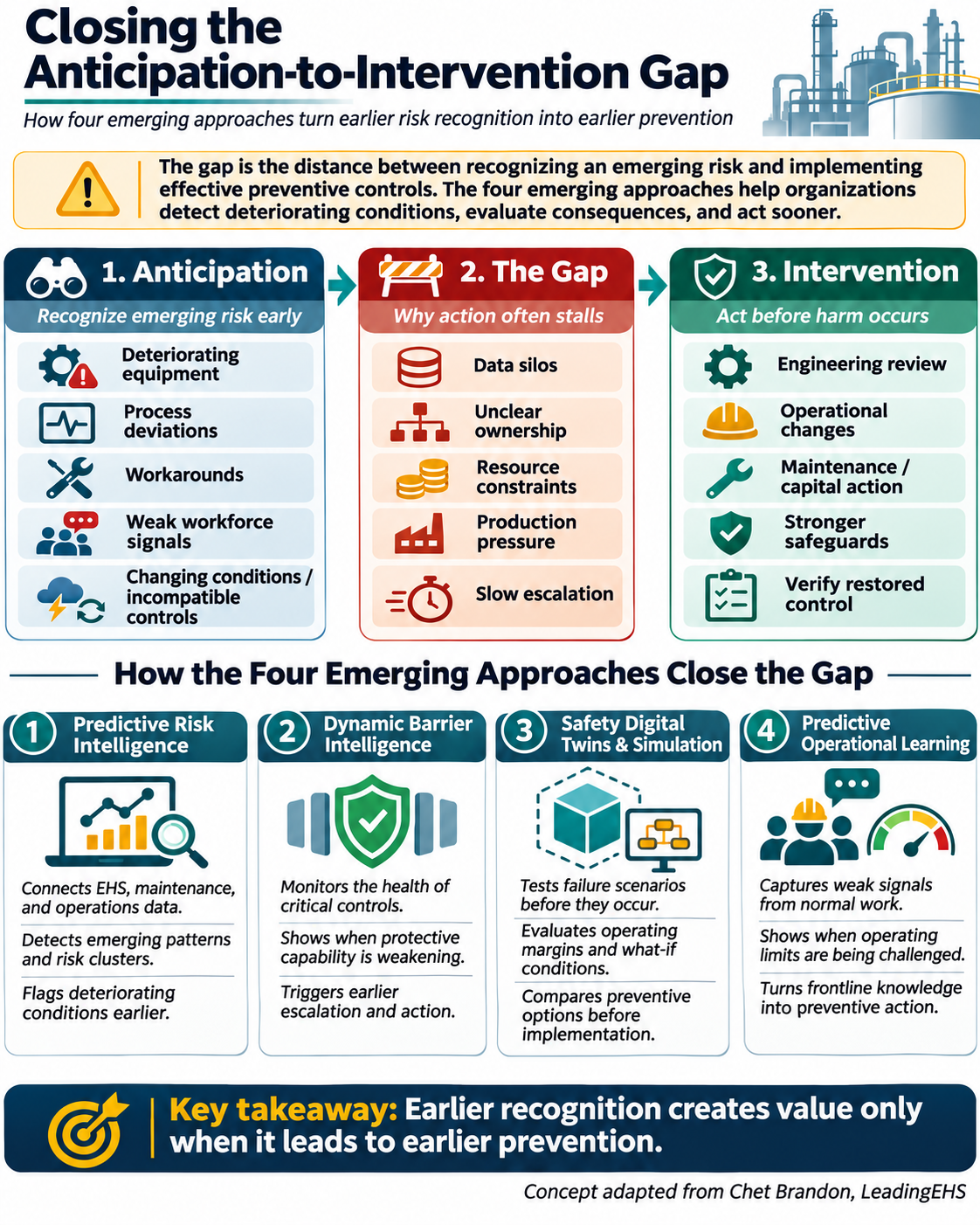
I think of the distance between identifying an emerging risk and implementing effective preventive controls as the Anticipation-to-Intervention Gap.
Sometimes the gap exists because information is incomplete or scattered across functions. Equipment deficiencies, procedural workarounds, maintenance problems, and employee concerns may be known individually without anyone recognizing their combined significance.
In other situations, the organization already understands the risk but has not acted.
Maintenance may be deferred because production demands are high. Employees may report unsafe workarounds without receiving the engineering support necessary to eliminate them. EHS may identify vulnerabilities but lack the authority or resources to implement the changes.
The failure in these situations is not necessarily a lack of prediction. It is a failure to convert available understanding into action.
The four emerging approaches discussed earlier can improve the quality and timeliness of risk intelligence. But their effectiveness ultimately depends on the organization’s ability to make decisions, allocate resources, and verify that interventions have worked.
An early warning about a deteriorating critical control should lead to a clear management response. Someone must determine the significance of the condition, decide whether operations can continue, authorize necessary changes, and confirm that protective capability has been restored.
This requires decision rights and accountability that extend beyond the EHS function.
An organization cannot claim to be genuinely predictive simply because it recognizes hazards earlier. It must demonstrate that earlier recognition leads to earlier and more effective prevention.
Stop Admiring the Problem: Turn Risk Intelligence Into Results
I once heard a senior executive express his frustration with the safety function in particularly direct terms:
“I need you to stop admiring the problem and show me understanding, planning, and results in solving it!”
It’s a blunt message, but one worth examining.
Safety professionals are often skilled at identifying problems. We conduct assessments, investigate incidents, analyze trends, document deficiencies, and prepare recommendations. These are important capabilities, and organizations need them.
But identifying a problem is not the same as understanding how to solve it. And understanding a problem is not the same as producing a measurable improvement.
Consider a manufacturing facility experiencing repeated deficiencies in its hazardous energy control program. The traditional response might involve documenting the findings, conducting additional training, revising procedures, and tracking corrective actions.
Those activities may be appropriate, but have they addressed the conditions allowing the deficiencies to occur?
Perhaps equipment was never designed for effective isolation. Production schedules may create pressure to shorten maintenance activities. Employees may have developed informal methods to compensate for inadequate engineering controls.
More training and revised procedures alone may accomplish very little.
An effective response begins with understanding the technical, organizational, and operational conditions sustaining the risk. That understanding must then be translated into practical solutions involving engineering changes, operational adjustments, resources, and clear accountability.
Finally, management must verify the results. Have hazardous workarounds been eliminated? Are isolation points more reliable and accessible? Can employees consistently perform the work safely under actual operating conditions?
Closing an action item is not the same as closing a risk.
This distinction matters in organizations that measure corrective action performance primarily through completion rates and overdue action counts. Administrative closure provides discipline, but it does not necessarily establish that the underlying hazard has been controlled.
EHS professionals rarely possess direct authority over all the resources and operational decisions needed to implement solutions. That does not diminish their responsibility to develop meaningful recommendations. It means that effective prevention requires operations and executive leadership to own the decisions affecting risk.
A capable EHS leader should be able to explain where the organization is vulnerable, what needs to change, which resources and decisions are required, and how management will know whether those changes worked.
That is the progression executives are asking for: understanding, planning, execution, and results.
Building Predictive Capability: A Practical 90-Day Starting Point
Organizations do not need to begin with a major technology investment or an enterprise-wide transformation. A focused pilot involving one significant hazard can demonstrate whether better risk intelligence leads to better operational decisions.
During the first 30 days, select a high-consequence exposure and establish the conditions necessary to control it safely. Identify credible severe outcomes, examine how the work is actually performed, and determine the safeguards essential to prevention.
For example, a manufacturing facility might examine hazardous energy during maintenance, vehicle-pedestrian interactions, or glove entanglement involving rotating assembly tools.
The assessment should evaluate interactions among hazards, equipment, protective measures, and work practices. Operations, engineering, maintenance, EHS, and frontline employees should participate.
During days 31 through 60, connect available operational information and test methods for recognizing emerging risks. Combine equipment records, maintenance findings, operating deviations, employee observations, and other relevant information. AI-assisted techniques may help identify patterns that existing processes overlook, but the team should first determine what can be accomplished using the data and analytical capabilities already available.
Establish criteria for distinguishing meaningful risk signals from routine variation. Determine which conditions require engineering review, management escalation, operational restrictions, or immediate protective action.
During days 61 through 90, implement targeted improvements and verify their effectiveness. The objective is to demonstrate that better information produces better decisions. That may involve modifying equipment, strengthening safeguards, changing work methods, reallocating maintenance resources, or revising operating conditions.
The pilot should evaluate measures directly connected to preventive performance, including the time between risk recognition and management decision, the proportion of critical controls verified effective, significant operating-limit deviations resolved, and evidence of reduced exposure to the selected hazard.
Where feasible, the team should also examine whether warnings are sufficiently reliable to support decisions and whether implemented controls remain effective.
These measures should not become another collection of administrative activity targets. They should tell leadership whether the organization is becoming more effective at controlling risk.
Closing ten maintenance work orders may demonstrate progress. Verifying that a degraded protective system has been restored to its required performance standard provides stronger evidence of risk reduction.
Ninety days may be sufficient to establish a baseline, test methods, and demonstrate selected improvements. It is not necessarily sufficient to validate a predictive model or establish sustained reductions in rare-event outcomes. Those findings require longer-term monitoring.
A successful pilot should establish that the organization can recognize an emerging risk, understand its significance, make an appropriate operational decision, and verify the resulting improvement.
If that can be demonstrated, the approach can be expanded to additional hazards and facilities.
A Different Conversation With the CEO
Imagine how the executive safety conversation might change.
Instead of concentrating primarily on last month’s incidents, the EHS leader begins by explaining where risk is increasing, which critical controls are becoming vulnerable, and which operational conditions deserve management attention.
Perhaps recurring equipment deficiencies across several facilities point to a systemic maintenance or design issue. Operational data may reveal growing exposure associated with increased production demands. Employee learning sessions may have uncovered a conflict between established procedures and how work actually must be performed.
The discussion then moves to the business implications, proposed solutions, required resources, and management decisions.
This is where safety can contribute more directly to operational performance, reliability, capital planning, and enterprise risk management.
Incident investigations will always be necessary. Unexpected failures will still occur, and no organization can eliminate uncertainty or human variability. Even advanced analytical technologies cannot guarantee that every serious event will be anticipated.
I believe we are approaching a point where our ability to recognize emerging risks could improve considerably. But that creates an obligation for leadership. If we identify deteriorating conditions earlier and still fail to act, better prediction has accomplished very little.
Predictive safety is ultimately about understanding the limits within which operations remain safe, recognizing when those limits are being challenged, and intervening before control is lost.
The technologies needed to strengthen these capabilities are advancing rapidly. The greater challenge may be ensuring that our organizations have the leadership, discipline, and accountability to use what they learn.
The CEO’s frustration is worth remembering. Explaining an incident after it happens may demonstrate technical competence, but preventing the next one requires a broader set of capabilities.
The real measure of progress will be when safety is valued as much for the incidents it helps prevent as for the incidents it helps explain.
Works Cited
Armenteros-Cosme, Pablo, et al. “Advancements in Artificial Intelligence and Machine Learning for Occupational Risk Prevention: A Systematic Review on Predictive Risk Modeling and Prevention Strategies.” Sensors, vol. 25, no. 17, 2025, article 5419. https://doi.org/10.3390/s25175419.
Brandon, Chet. “Seeing Risk Before It Hurts: An Example of How Predictive Analytics Are Redefining Safety.” LeadingEHS.com, 11 Jan. 2026, https://leadingehs.com/2026/01/11/seeing-risk-before-it-hurts-an-example-of-how-predictive-analytics-are-redefining-safety/.
Brandon, Chet. “Operational Integrity: The Operating Model Heavy Manufacturing Needs.” LeadingEHS.com, 11 May 2026, https://leadingehs.com/2026/05/11/operational-integrity-the-operating-model-heavy-manufacturing-needs/.
International Association of Oil & Gas Producers. Learning from Normal Work. Report no. 642, 2022. https://idms.iogp.org/Documents/1065.
International Association of Oil & Gas Producers. Process Safety: Recommended Practice on Key Performance Indicators. Report no. 456, version 3, revised May 2023. https://idms.iogp.org/Documents/545.
International Organization for Standardization. Hand-Held Non-Electric Power Tools—Safety Requirements—Part 6: Assembly Power Tools for Threaded Fasteners. ISO 11148-6:2012, 2012. https://www.iso.org/search.html?q=ISO%2011148-6.
La Torre, Giuseppe, et al. “Artificial Intelligence and Occupational Health and Safety: A Systematic Review.” Journal of Public Health, 25 Mar. 2026. https://doi.org/10.1007/s10389-026-02738-8.
Leveson, Nancy G., and John P. Thomas. STPA Handbook. MIT Partnership for Systems Approaches to Safety and Security, Mar. 2018. https://www.mit.stamp-institute.com/get_file.php?name=STPA_handbook.pdf.
Ma, Songling, and Patrick X. W. Zou. “How Digital Twin Technology May Improve Safety Management: A Multi-Industry Perspective.” Safety Science, vol. 189, 2025, article 106837. https://doi.org/10.1016/j.ssci.2025.106837.
Yuan, Shuaiqi, Genserik Reniers, and Ming Yang. “Dynamic and Integrated Safety and Security Barrier Management: A New Framework to Manage Major Event Risks in Chemical Plants.” Journal of Loss Prevention in the Process Industries, vol. 96, 2025, article 105632. https://doi.org/10.1016/j.jlp.2025.105632.
Zio, Enrico, and Leonardo Miqueles. “Digital Twins in Safety Analysis, Risk Assessment and Emergency Management.” Reliability Engineering & System Safety, vol. 246, 2024, article 110040. https://doi.org/10.1016/j.ress.2024.110040.


