
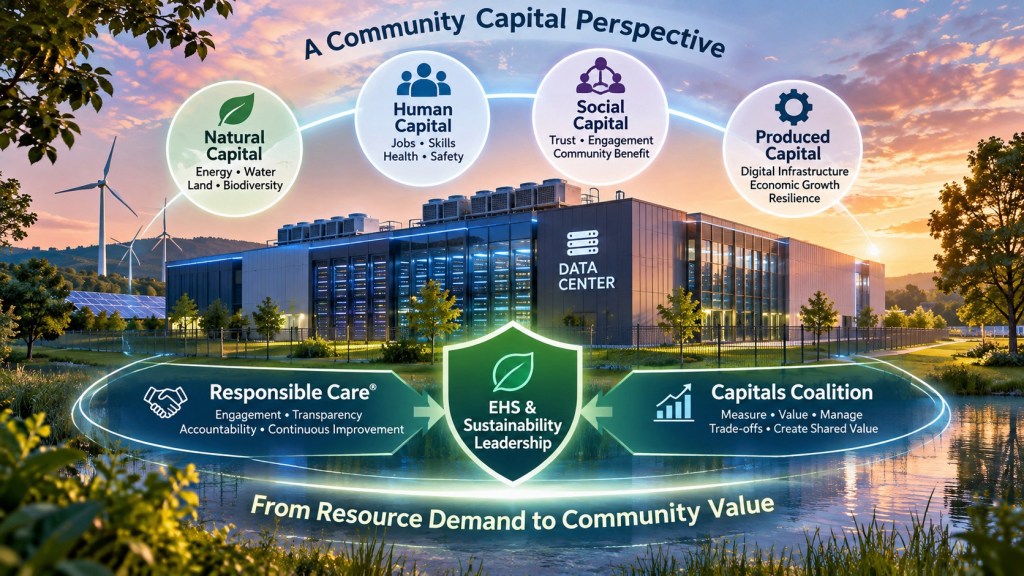
What heavy industry, the Capitals Coalition, Responsible Care, and consensus standards can teach us about building digital infrastructure that creates lasting community value.
Technology Is Moving Faster Than Community Confidence
Artificial intelligence promises advances in science, healthcare, industrial productivity, and safety. Yet communities across the United States are questioning the data centers needed to support it. Electricity and water are the visible flashpoints, but beneath them is a harder question about who benefits from the infrastructure and who bears its costs.
A multibillion-dollar computing campus can create enormous value for its owners and customers while leaving relatively few permanent jobs at the host site. It draws on locally available land, electricity, water, and infrastructure, yet much of the value it enables is realized elsewhere. I believe that gap between local obligations and locally retained benefits helps explain the unease. It is a proposition worth testing at each project, not a universal explanation for opposition.
I have seen a different industrial bargain. At Elkem Metals’ (now WV Alloys) Alloy WV manufacturing site in southern West Virginia, where I led Health and Safety, the ferroalloy operation had an instantaneous electrical load of approximately 250 megawatts. That is comparable to the demand of a substantial modern data center campus. The site also represented a significant industrial employment base, with skilled production, maintenance, and technical work. Traditional metals manufacturing can have much heavier direct burdens from process emissions, wastewater, wastes, and potential contamination. Nevertheless, permanent jobs and wages have often been central to the local economic case for such facilities.
The comparison does not mean industrial neighbors always welcomed these plants, or that employment makes pollution acceptable. It means we should test a fuller proposition: two projects with similar electrical loads can leave behind markedly different combinations of environmental conditions, employment opportunities, infrastructure, and community trust. For Environmental, Health, Safety, and Sustainability professionals, the opportunity is to connect these considerations to actual development decisions. Our expertise should influence site selection, engineering alternatives, capital allocation, construction and operating risk, and the commitments organizations make to surrounding communities.
Public Concerns Are Not All Misconceptions
A September 2026 Pew Research Center survey found that 54% of U.S. adults regarded data centers as mostly bad for the environment, 50% said they were mostly bad for home energy costs, and 49% said they were mostly bad for nearby quality of life. Sixty percent reported discomfort with a new data center operating in their area [1]. These are measures of public perception, not proof of actual impacts at a specific site.
Some claims are exaggerated or detached from engineering realities. Others, particularly around grid capacity, utility cost allocation, watershed conditions, construction impacts, and local benefits, require serious investigation. Meeting a permit limit does not necessarily resolve a community’s concern about the allocation of costs or the availability of a shared resource. Equally, public opposition does not prove that a project is unacceptable.
EHS and Sustainability leaders should be particularly careful to distinguish among potential hazards, actual exposure, demonstrated consequences, and reasonable uncertainty. The objective should be to improve the quality of decisions, not simply win an argument about whether data centers are good or bad.
Environmental Risks: Real, Uneven, and Design-Dependent
Electricity and Infrastructure
The International Energy Agency estimated worldwide data center electricity demand at 415 TWh in 2024, roughly 1.5% of global electricity use. The agency projects substantial growth through 2030 [2]. Large electrical loads are not novel in industrial history. Primary aluminum smelters, ferroalloy operations, electric arc furnaces, and other energy-intensive manufacturing processes have required enormous quantities of electricity for decades.
A steady 250 MW load equates to approximately 2.19 TWh of electricity over a year. Actual consumption at Alloy or any data center depends on utilization and operating conditions. What matters for a development decision is not only the annual total, but the generating resources required, local transmission constraints, reliability, environmental effects, and who finances the necessary capacity.
Rapid geographic concentration changes the infrastructure challenge. An industrial region with available generating capacity and suitable transmission infrastructure may be able to support a new development without imposing excessive additional costs. A different region may require substantial investment before the same facility can operate. Those differences need to be established through evidence rather than generalized assumptions about the industry.
Water and Other Environmental Burdens
Water impacts depend on cooling architecture, water source, climate, watershed stress, and indirect consumption from electricity generation. Dry cooling can reduce onsite water demand while increasing energy use, while evaporative systems may offer a different balance. A reclaimed-water project in a water-abundant area presents a different community risk from a facility drawing potable water from a stressed aquifer.
Data centers generally lack many direct process emissions characteristic of ferroalloy or aluminum production. However, electricity generation, backup engines, cooling refrigerants, construction materials, batteries, electronic waste, noise, and land conversion remain relevant environmental considerations. A credible analysis must distinguish direct from indirect impacts and evaluate each facility’s actual engineering and location.
This is where sustainability professionals should be particularly valuable. Their role is not to optimize a single environmental indicator, but to identify how design choices affect multiple environmental systems and the communities depending on them.
The Economic Bargain Is Different
Heavy manufacturing often provides a visible local return through jobs, wages, apprenticeships, and suppliers. Data centers may provide considerable property tax revenue, construction employment, digital services, and specialist procurement, but far fewer permanent direct positions relative to capital invested and electricity required. The balance varies by project and by the tax, labor, and utility agreements governing it.
A developer-funded substation that strengthens the regional grid has different consequences from infrastructure whose costs are shifted onto existing customers. A training partnership that gives local residents portable technical skills is different from a promise of jobs that residents cannot readily access. Tax abatements, public-service costs, and future expansion all change the net community proposition.
The central question is not how many billions a developer spends. It is how the project changes the wealth, capabilities, and future choices of the community that hosts it.
The Capitals Coalition: A Better Method for Valuing the Tradeoff
The Capitals Coalition offers a practical way to evaluate that question. Its integrated decision-making framework considers impacts and dependencies across four interconnected forms of capital: natural, human, social, and produced. It asks leaders to consider the environmental resources, people, relationships, and physical assets on which an investment depends and which it may strengthen or weaken.
The Coalition organizes its integrated assessment process into Assemble, Assess, and Act, supported by governance for valuation [3]. The significance is not another set of ESG indicators. It is the ability to compare development alternatives using evidence that financial models and traditional environmental assessments often hold in separate files. This includes the effects on people who do not receive the jobs, dividends, or tax benefits. Assessments can use monetary, quantitative, and qualitative information; not every human or environmental consequence should be forced into a dollar figure.
Natural Capital: Shared Environmental Capacity
Natural capital includes water, air, land, ecosystems, and the services they provide. Development can consume scarce capacity today and constrain future users. A capitals assessment asks not merely how many gallons or megawatt-hours a site uses, but how its needs alter watershed resilience, air quality, ecosystem conditions, and other users’ choices over time. It also asks whether the project can improve those conditions through reclaimed-water infrastructure, lower-emission electricity, or more thoughtful siting.
For a proposed data center, this could mean evaluating the cumulative demand of multiple existing and planned facilities rather than assessing each development independently. A watershed may support an individual facility under normal conditions while becoming vulnerable as additional development occurs or seasonal supply changes. Sustainability professionals should be examining those dependencies before site selection and engineering decisions become difficult to reverse.
Human Capital: More Than a Job Count
Human capital includes people’s knowledge, skills, health, and ability to earn a living. This is central to the development bargain. Alloy’s high electrical load was connected to industrial careers, maintenance trades, technical learning, and household wages. A similarly powered data center generally requires a smaller permanent site workforce, but that does not prove the center makes no contribution to human capital. It changes what must be demonstrated.
A developer could fund apprenticeships with portable credentials, local community-college programs, training in electrical and mechanical systems, and procurement that creates durable local career paths. It could also support emergency-response capability, technical education, and opportunities for residents to participate in the broader digital economy. But announcements are not outcomes. Reviewers should ask who enrolled, who completed training, how many obtained sustained employment, whether earnings improved, and whether local residents actually benefited.
Human capital also includes health. Construction exposure, continuous noise, combustion emissions from backup power, or pressure on public services may impose costs on people who never receive an economic gain. Impacts should be assessed by population and neighborhood rather than smoothed into a countywide average.
Social Capital: Trust, Cooperation, and Local Institutions
Social capital includes relationships, institutional confidence, and the capacity of people and organizations to cooperate. A development approved after residents believe decisions were predetermined can erode trust even if it complies with every applicable regulation. Effective engagement can strengthen that capital, but only if it has a credible route into engineering and investment decisions.
Industrial communities may have developed long-standing relationships with local employers through generations of work, supplier ties, and civic involvement. A data center can build different, equally durable relationships, but should not assume that a large capital expenditure creates community confidence by itself. Trust develops when commitments are credible, concerns receive meaningful consideration, and organizations demonstrate accountability over time.
Produced Capital: What Remains Locally
Produced capital includes buildings, equipment, and infrastructure. A hyperscale campus creates enormous physical and digital productive capacity, but much of the resulting value can accrue to owners and users outside its host community. The assessment should distinguish privately held computing assets from locally useful infrastructure, public fiscal capacity, water systems, roads, and grid improvements that support other residents and employers.
Ownership, access, financing, and future utility matter. A costly transmission investment is not automatically a community asset if existing customers pay most of the bill or if the capacity remains unavailable for other development. By contrast, utility infrastructure that expands capacity for other employers, improves reliability, and creates new development opportunities could provide lasting community value.
The Key Innovation: Evaluate Interactions, Not Four Separate Scorecards
These capitals are connected, not four independent categories. If a project contributes to higher household electricity bills, disposable income and the ability of small businesses to invest may decline. If a developer finances additional electrical capacity that other users can access, future employers may gain room to expand. Water stress can affect agriculture, public supplies, and ecosystems, while training investments may expand residents’ future options even when onsite jobs remain limited. The relationships are causal questions to investigate, not effects to assume.
A county may show a net fiscal gain while a nearby neighborhood bears concentrated noise or an aquifer loses resilience. Higher tax receipts do not automatically make a health impact acceptable, and some environmental and safety thresholds are non-negotiable. A credible assessment should identify affected groups, the likely outcomes without the project, uncertainty, and the distribution of benefits rather than collapse everything into one reassuring score.
This is the Capitals Coalition’s most important contribution to the data center debate. It provides a way to make the full consequences of an investment more visible to executives and communities.
What a Different Investment Decision Could Look Like
Imagine a proposed 250 MW data center campus next to an established community. The original business case forecasts property taxes, several hundred construction positions, a comparatively small operations team, and major electrical upgrades. Environmental work establishes expected water demand, generator emissions, and noise levels. That is necessary information, but it does not yet show whether local residents will be better off.
A four-capitals assessment would ask the utility to distinguish upgrades solely needed for the campus from infrastructure that other customers and future employers can use. It would examine the local workforce’s access to construction and technical jobs, establish watershed constraints, and test whether nearby households bear noise or rate impacts disproportionate to the benefits. Residents and local institutions would help identify material concerns before engineering is finalized.
The analysis might support a different financing agreement, reclaimed water instead of potable water, a reduced initial phase, a funded apprenticeship pathway, or a different location. Any of those choices has costs, and some may be rejected after comparison. The point is that the developer and community can see why, with assumptions and decision ownership documented rather than concealed inside an attractive headline investment figure.
From Theory to Investment Decisions: Assemble, Assess, Act
Assemble: Define the Decision and Establish a Baseline
Begin with the choices still open: site, campus size, phased growth, cooling system, power arrangements, infrastructure financing, and construction timing. Work with residents, businesses, public agencies, utilities, and community institutions to establish baseline conditions across all four capitals. Identify groups likely to be affected differently and record what evidence is missing before major commitments are made.
Assess: Compare Alternatives and Distributional Effects
Compare development alternatives against the baseline and a credible without-project scenario. Evaluate direct and indirect effects, cumulative demand, plausible expansions, dependencies on public services, and the distribution of benefits. Separate forecast outcomes from commitments that are contractually enforceable, and document uncertainties, data sources, analytical methods, and the evidence supporting each material judgment. The Coalition’s governance principles for valuation are particularly relevant here [3].
Act: Make Findings Influence the Project
Make the assessment part of the investment decision. If dry cooling materially protects a stressed watershed, or a revised utility agreement prevents costs from being shifted to existing customers, present those alternatives with their financial and technical implications. Require a documented executive decision, assigned owners, and a transparent record of material commitments. An assessment that cannot influence design, financing, or site selection is not functioning as an effective governance process.
Consensus Standards: The Technical Foundation EHS Leaders Must Bring to the Table
The Capitals Coalition framework is not a substitute for sound engineering. Data center developers must also demonstrate how recognized consensus standards will be applied to design, construction, occupational safety, environmental performance, and operations. This distinction is important for executives and communities. Regulations establish applicable legal requirements, while consensus standards provide recognized technical practices, management systems, and methods for evaluating performance. Neither independently determines whether the overall community tradeoff is acceptable.
Energy Performance: ANSI/ASHRAE 90.4 and ISO/IEC 30134
ANSI/ASHRAE Standard 90.4-2025 addresses energy performance in data center design and related environmental considerations. The ISO/IEC 30134 series provides standardized data center performance indicators, including Power Usage Effectiveness, Water Usage Effectiveness, Carbon Usage Effectiveness, Renewable Energy Factor, and Energy Reuse Factor.
Two of these indicators deserve particular attention.
Power Usage Effectiveness (PUE) measures the relationship between the total energy consumed by a data center facility and the energy delivered to its information technology equipment. It is calculated by dividing total data center facility energy by IT equipment energy.
For example, a facility consuming 150 MWh of total electricity while delivering 100 MWh to its IT equipment would have a PUE of 1.50. A PUE approaching 1.0 generally indicates that relatively little additional energy is required for supporting functions such as cooling, power distribution, and other facility infrastructure. However, PUE does not establish the carbon intensity of the electricity, whether power infrastructure costs are fairly allocated, or the overall environmental impact of computing operations. A highly efficient facility can still consume enormous quantities of electricity.
Water Usage Effectiveness (WUE) measures onsite water usage relative to the energy consumed by IT equipment, commonly expressed in liters per kilowatt-hour. It is calculated by dividing annual data center site water usage by annual IT equipment energy.
For example, a facility using 50 million liters of water annually while its IT equipment consumes 100 million kWh would have a WUE of 0.50 L/kWh. A lower WUE generally indicates less onsite water use relative to the computing energy delivered. However, WUE alone does not indicate whether the water is sourced from a stressed aquifer, reclaimed wastewater, or another source. Nor does it account for all indirect water consumption associated with electricity generation.
These distinctions are fundamental. A facility can achieve excellent PUE and WUE values while still creating substantial environmental or infrastructure concerns. Conversely, a facility operating in a water-abundant region with appropriate water sourcing may have a different overall sustainability profile than another facility reporting a lower WUE in a severely water-stressed location. EHS and Sustainability professionals should use these standards as components of a broader environmental assessment rather than treating them as definitive measures of sustainability.
Infrastructure Design and Environmental Management
The ISO/IEC 22237 series and ANSI/TIA-942-C address data center facility infrastructure, including location considerations and the design of power, cooling, and other critical systems. ISO 14001:2026 provides a framework for environmental management systems, including the identification of environmental aspects, operational controls, compliance obligations, and continual improvement. ISO 50001 supports systematic energy management, while ISO 14040, ISO 14044, and ISO 14046 provide established approaches to lifecycle and water footprint assessments.
Together, these standards can help EHS and Sustainability teams move beyond isolated facility efficiency metrics toward a more complete understanding of environmental performance.
Occupational Safety and Operational Integrity
Relevant standards include NFPA 70 for electrical installations, NFPA 70E for electrical safe-work practices, NFPA 75 for fire protection of information technology equipment, and NFPA 855 where stationary energy storage is involved. ISO 45001 provides an occupational health and safety management framework. The applicable editions and enforceability of standards vary by jurisdiction and contractual requirements.
A useful enterprise standards register should identify the relevant requirements, systems or hazards covered, accountable owners, evidence required before startup, and operating performance measures to be verified. EHS professionals can use this structure to demonstrate technical credibility without implying that conformity with engineering standards alone resolves broader community concerns.
Responsible Care: Turning Community Engagement into Accountability
The chemical industry has considerable experience managing industrial risks in communities that may question or oppose its operations. The American Chemistry Council’s Responsible Care initiative and RC14001:2026 technical specification provide a management-system perspective. The broader Responsible Care program also offers established community engagement practices, including Community Advisory Panels [4, 5]. These panels should not be presumed to be mandatory requirements of RC14001:2026.
For data centers, a properly designed advisory panel could provide residents, utilities, municipalities, schools, emergency responders, and affected businesses with an ongoing forum to review concerns and performance. However, the panel’s value depends on more than meeting regularly. It should have access to understandable technical information, a transparent process for identifying members, documented issues and responses, and a formal connection to the people authorized to make investment and operating decisions.
The roles of the different approaches are complementary. The Capitals Coalition provides the method for assessing changes in community capital, Responsible Care contributes experience in sustained community engagement and management accountability, and engineering and EHS standards provide methods for designing, constructing, and operating facilities responsibly. The proposed integration of these approaches offers a more complete governance model than relying on any one of them independently.
A Community Capital Review
I would ask a Community Advisory Panel to review an annual community capital account covering water availability and use, electricity infrastructure costs, local jobs and wages, training outcomes, public infrastructure improvements, health and environmental conditions, and the effectiveness of community engagement. Results should show changes from baseline, distinguish projected from observed benefits, and identify development decisions modified in response to community input.
The companion Data Center Community Capital & Involvement Framework translates this approach into a practical model incorporating four-capitals assessments, community advisory processes, decision gates, issue registers, executive accountability, and performance indicators.
Companion resource: Data Center Community Capital & Involvement Framework.
The framework is a proposed application of established methodologies, not an official Capitals Coalition or RC14001 certification program.
The Leadership Role of EHS and Sustainability: From Development to Operations
The value of these approaches depends on whether EHS and Sustainability professionals have sufficient access, expertise, and authority to influence the decisions that matter. Our involvement should begin before construction and continue throughout the operating life of the facility. The responsibilities are complementary, but not identical.
Before Site Selection and Capital Approval
EHS leaders should evaluate construction hazards, electrical infrastructure, emergency response capacity, operating risks, contractor interfaces, physical climate hazards, and the implications of proposed technologies. Sustainability leaders should examine watershed conditions, electricity supply, environmental dependencies, lifecycle impacts, resource availability, and consequences for the four forms of community capital.
Working with finance, engineering, real estate, utilities, and government affairs, both functions should help compare alternative locations and designs. The resulting assessment should identify material uncertainties, potential controls, alternative investments, and risks requiring executive decisions. Neither function should simply endorse a project because applicable permits appear obtainable.
During Construction and Commissioning
Data center construction and commissioning require particularly disciplined risk management. Multiple contractors may be installing and testing switchgear, uninterruptible power systems, batteries, generators, chillers, and automated controls while other work proceeds nearby. Electrical energization, switching authorization, isolation, temporary power management, lifting operations, simultaneous work activities, and contractor coordination deserve executive scrutiny. Construction schedules cannot become the default justification for accepting unnecessary risk.
Before operational handover, structured readiness reviews should verify equipment configuration, electrical documentation, protective devices, alarm logic, redundancy assumptions, emergency procedures, personnel competency, and the ability to respond to abnormal conditions. Management of change should address modifications to electrical systems, cooling arrangements, automation, and maintenance practices that could undermine safeguards or defeat designed redundancy.
Operational Integrity and Human Performance
At Honeywell Aerospace, I worked with critical cooling infrastructure serving sensitive electronic equipment and manufacturing operations. That experience reinforced the importance of understanding how equipment, controls, people, and organizational decisions interact. A cooling interruption, electrical switching error, or control-system modification can produce consequences extending beyond the component involved.
For data centers, this makes operational integrity particularly important. Effective EHS leadership should integrate critical control verification, electrical safety, contractor performance, emergency preparedness, incident learning, and management of change. Human performance must remain central. Workers and supervisors operate within systems influenced by staffing, equipment design, schedules, training, procedures, and management expectations. As data centers expand and equipment becomes more complex, the industry must ensure that operational pressure does not undermine fundamental risk controls.
EHS should work closely with reliability and operations teams while recognizing that responsibility for uptime, engineering decisions, and business continuity is shared across functions.
Sustainability and Long-Term Community Performance
Sustainability leadership must extend beyond greenhouse gas inventories, annual reporting, and facility efficiency indicators. Its influence should encompass electricity procurement, water stewardship, infrastructure strategy, lifecycle impacts, workforce development, and the distribution of community benefits.
A sustainability leader should be capable of explaining how a particular cooling technology affects energy consumption, water demand, capital cost, and long-term resource availability. The same leader should help evaluate whether infrastructure investments strengthen the surrounding community, whether workforce commitments create measurable human capital, and whether development alternatives improve the overall balance of environmental and economic consequences.
This requires collaboration with finance, operations, engineering, utilities, government affairs, and other stakeholders. It also requires meaningful participation in capital approval. If sustainability professionals are expected to manage the consequences of infrastructure development, they need opportunities to influence the decisions creating those consequences.
Integrating Performance Accountability
After construction, both EHS and Sustainability leaders should ensure that major commitments remain part of the organization’s operating management systems. That includes assigning responsibilities, defining measures, verifying results, reviewing deviations, and implementing corrective actions. Environmental and community commitments should survive changes in leadership, organizational structure, and facility ownership.
Equally important, communities should be able to understand whether promised benefits are materializing. A workforce development commitment should be evaluated through actual participation and career outcomes. A water stewardship commitment should be assessed against measured consumption and watershed conditions. An infrastructure commitment should be evaluated in terms of its actual contribution to reliability, capacity, and local economic opportunity.
This is where management-system discipline becomes particularly valuable. Responsible development requires more than making credible promises; it requires demonstrating performance over time.
Building Community Value into Executive Decision-Making
The practical objective is to integrate these approaches into a development governance process that can change investment decisions. I would require six dimensions to be examined at major project decision gates:
- Energy and infrastructure responsibility. Electrical demand, generation sources, reliability, infrastructure financing, and cost allocation.
- Natural capital and environmental stewardship. Water availability, emissions, land use, ecosystem impacts, resource resilience, and environmental performance.
- Occupational safety and operational integrity. Construction, commissioning, electrical hazards, critical cooling, contractor management, emergency preparedness, and human performance.
- Lifecycle sustainability. Embodied emissions, equipment sourcing, operating efficiency, replacement cycles, waste, and decommissioning.
- Human, social, and produced capital. Employment, workforce development, public infrastructure, community relationships, distribution of benefits, and long-term economic resilience.
- Transparency and accountability. Community participation, documented decisions, measurable commitments, independent verification where appropriate, and continual improvement.
These should not become another checklist completed after major decisions have already been made. They should help determine whether a project proceeds as proposed, requires additional controls, should use a different technology or financing arrangement, or would be better developed elsewhere.
The analysis may identify costs that were not included in the original business case. It may also reveal opportunities to reduce delays, strengthen infrastructure, improve resilience, protect community relationships, or make the investment more commercially sustainable. Responsible development and business performance need not be competing objectives.
Conclusion: Measure What the Community Keeps
At Elkem Metals’ Alloy plant, I saw a 250 MW industrial load connected to a substantial local workforce and environmental burdens characteristic of ferroalloy production. Data centers often change both sides of that exchange: fewer permanent site jobs and different direct environmental impacts, with substantial benefits reaching users elsewhere.
The Capitals Coalition helps reveal what changes across the four capitals, for whom, and over what period. Responsible Care offers a useful tradition of sustained engagement and management accountability. Engineering standards and disciplined EHS practices provide the controls needed to construct and operate complex facilities responsibly. Putting them together does not guarantee agreement, but it makes the choices, tradeoffs, and accountability clearer.
For EHS and Sustainability professionals, the opportunity is to help shape those choices rather than simply measure their consequences. Before celebrating the amount invested or condemning the megawatts required, ask a more useful question: twenty years from now, what will the community have gained, what will it have lost, and who will be able to show the evidence?
References
- Pew Research Center. (2026, September 22). Americans’ views of data centers have turned more negative. https://www.pewresearch.org/short-reads/2026/09/22/americans-views-of-data-centers-have-turned-more-negative/
- International Energy Agency. (2025). Energy and AI. https://www.iea.org/reports/energy-and-ai
- Capitals Coalition. (2025). Integrated Decision-Making Framework and Capitals Protocol. https://capitalscoalition.org/resources/integrated-decision-making-framework/
- American Chemistry Council. (2026). RC14001:2026 Technical Specification. https://store.americanchemistry.com/collections/responsible-care%C2%AE
- American Chemistry Council. Responsible Care community engagement resources. https://www.americanchemistry.com/driving-safety-sustainability/responsible-care-driving-safety-sustainability/community-engagement
- ASHRAE. (2025). ANSI/ASHRAE 90.4-2025: Energy Standard for Data Centers. https://www.ashrae.org/
- ISO/IEC. ISO/IEC 30134 series: Data centre key performance indicators. https://webstore.iec.ch/
- ISO/IEC. ISO/IEC 22237 series: Data centre facilities and infrastructures. https://webstore.iec.ch/
- Telecommunications Industry Association. ANSI/TIA-942-C: Telecommunications Infrastructure Standard for Data Centers. https://tiaonline.org/
- ISO. (2026). ISO 14001:2026: Environmental management systems. https://www.iso.org/standard/14001
- ISO. (2018). ISO 50001: Energy management systems. https://www.iso.org/standard/69426.html
- ISO. ISO 14040, ISO 14044, and ISO 14046: Lifecycle and water footprint assessment standards. https://www.iso.org/
- NFPA. NFPA 70, 70E, 75, and 855. https://www.nfpa.org/
- ISO. ISO 45001: Occupational health and safety management systems. https://www.iso.org/
Editorial note: The integrated community-capital governance model is an original LeadingEHS proposal. It is not an official Capitals Coalition certification program or an RC14001 requirement.


