
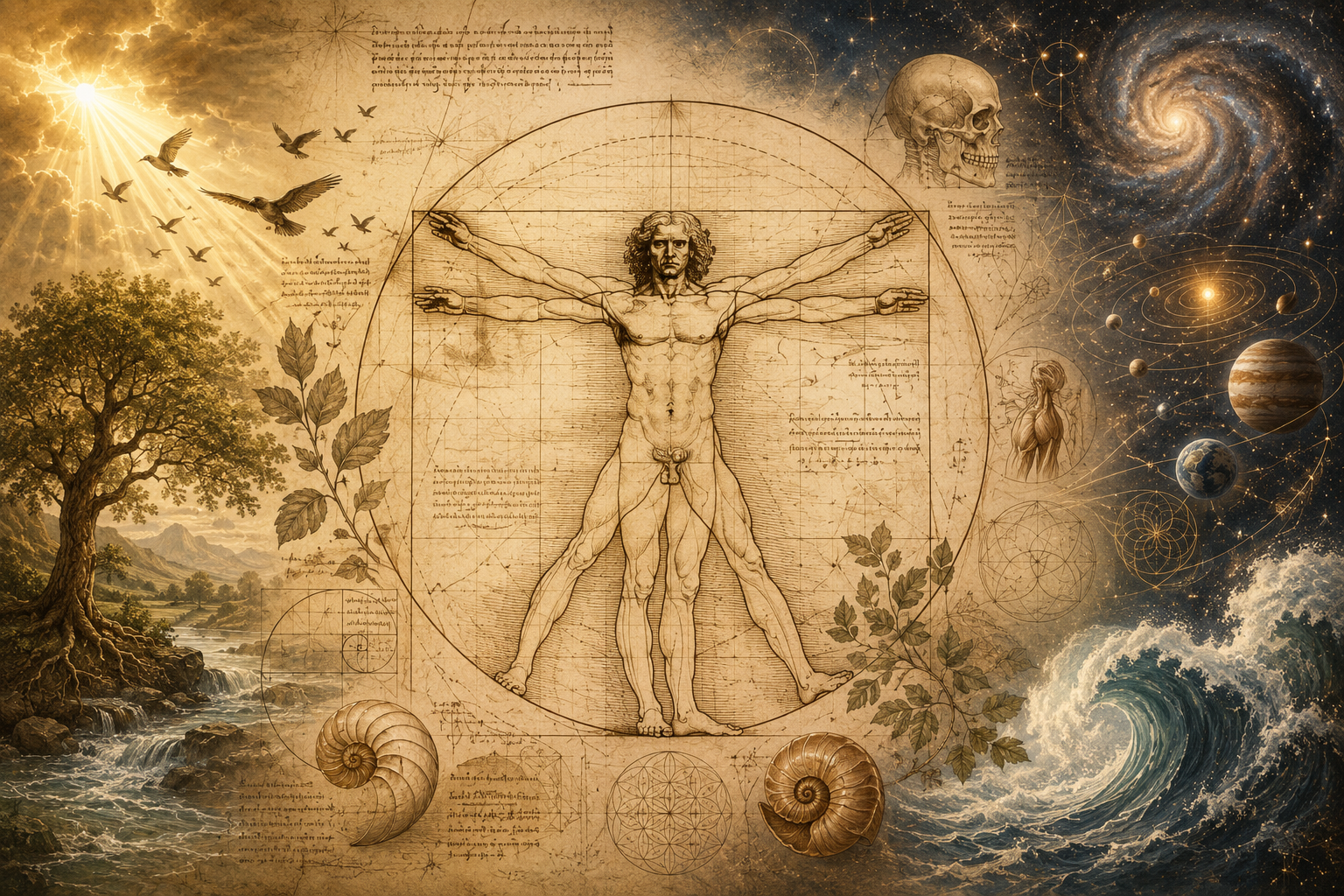
The Method Behind the Genius
I have been reading Walter Isaacson’s biography of Leonardo da Vinci. I expected to be impressed by the art, the inventions, and the range of Leonardo’s mind.
I was.
But what has stayed with me most is not simply the genius. It is the method.
Leonardo observed.
He observed water moving around obstacles. He studied birds in flight. He examined muscles, bones, light, shadow, plants, machines, geometry, and motion. He wanted to know how things worked. Not approximately. Not casually. Deeply.
That is an important distinction.
Many people look. Leonardo studied.
He also practiced something that anticipated what we now recognize as the scientific method. He observed carefully, questioned accepted explanations, tested ideas against experience, and revised his understanding when reality demanded it. That matters for leadership because organizations are full of inherited assumptions. Some are useful. Some are outdated. Some are simply wrong. The leader’s job is not to defend the assumption. The leader’s job is to test it against the work.
Isaacson’s portrait of Leonardo’s curiosity and observational discipline caused me to think about what modern leaders can learn from that same method. Leonardo did not seem satisfied with knowing that something happened. He wanted to know why it happened, how it behaved, what forces shaped it, and how that knowledge could be applied.
That habit of disciplined observation may be the most useful leadership lesson in his life. His work reminds us that nature is not random disorder. It is full of pattern, proportion, adaptation, force, resistance, flow, and consequence. When we take the time to observe those patterns, we learn how to work with reality rather than simply impose our will on it.
Proportion, Pattern, and the Human Place in Nature
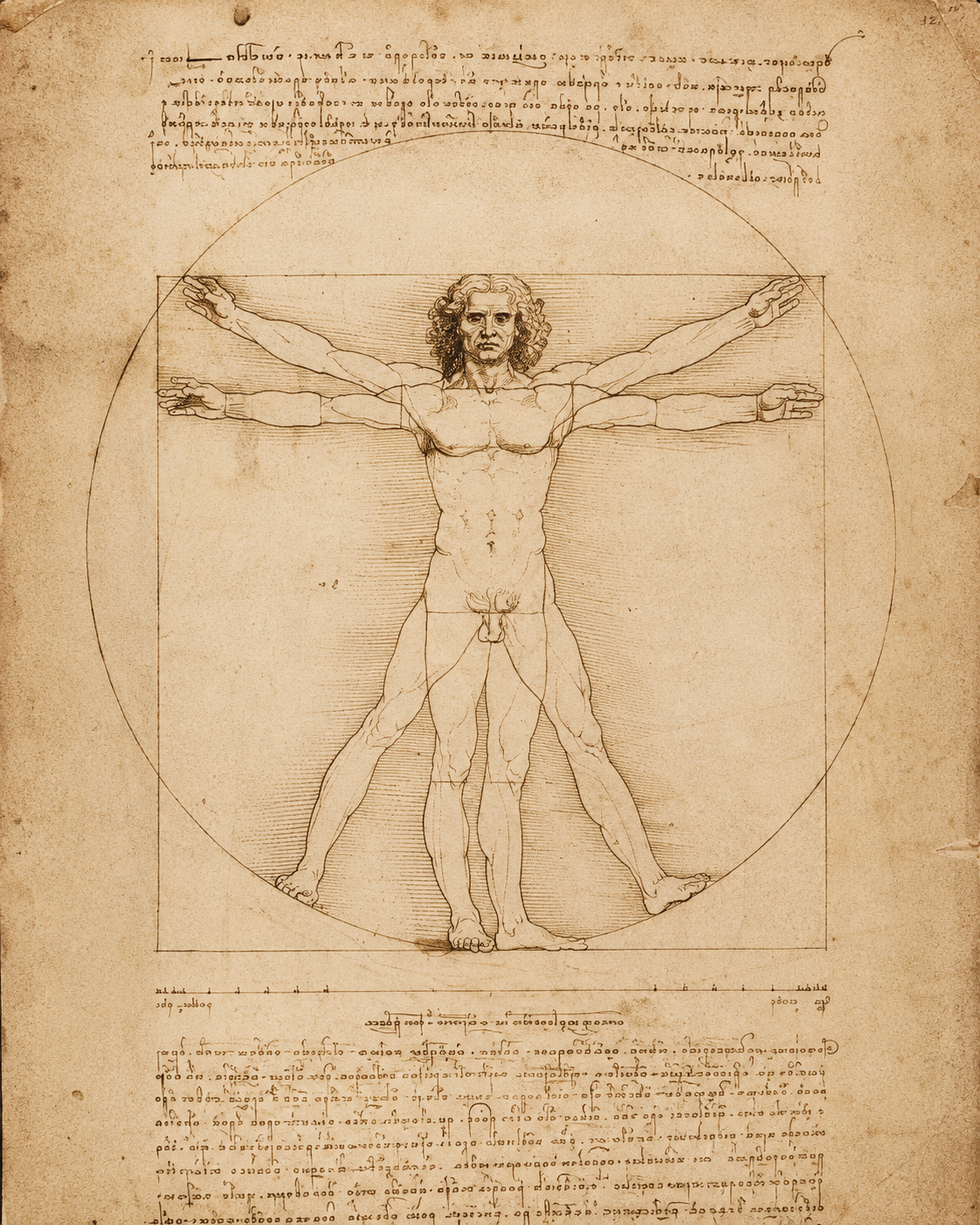
That brings me to one of Leonardo’s most recognized images: Vitruvian Man.
The drawing is familiar to almost everyone. A human figure stands with arms and legs extended in two positions at once, inscribed inside a circle and a square. The body is centered, but not static. It reaches. It measures. It connects geometry, movement, and human proportion in one image.
At one level, it is a study of the human body. At another, it is a statement about the relationship between human beings, design, structure, and the natural order.
Walter Isaacson captures the importance of the drawing well. He describes Vitruvian Man as a moment when “art and science combined,” and later as humanity “standing naked at the intersection of the earthly and the cosmic.” (Issacson, 2017)
“It’s an idea worth sitting with…”
That is part of what fascinates me about Leonardo. He was not only an artist creating images. He was a discoverer of truths about ourselves and our world. Through observation, measurement, imagination, and disciplined curiosity, he gave us a lens on humanity that still feels alive centuries later. In Vitruvian Man, we see the human body as physical form, but also as a question: How do we fit within the larger order of nature, reason, and the universe?
It is beautiful, but it is not merely decorative.
It is disciplined thinking made visible.
The circle and square suggest structure. The body reminds us that human beings are not separate from nature. We are part of it. Leonardo was exploring whether the human form reflected a broader pattern of order, proportion, and relationship.
That idea is worth sitting with.
Not because every natural form should be forced into a mathematical claim. That is a trap. Not every shell, leaf, river, wing, or face needs to become proof of the golden ratio to be meaningful. Overstating the math weakens the lesson.
The stronger point is this: nature operates through relationships.
Proportion matters. Balance matters. Form and function are connected. Systems have limits. Forces interact. What appears beautiful is often also effective.
Nature rewards fit.
Operations do too.
A manufacturing site, laboratory, maintenance job, transportation network, chemical process, or sustainability program all have their own proportions. People, equipment, energy, materials, procedures, supervision, environmental limits, customer expectations, and regulatory obligations all operate in relationship to each other.
When those relationships are healthy, the work has flow. Planning is clear. Energy is controlled. People understand the risk. Environmental obligations are built into the process. Maintenance supports reliability. Contractors know the boundaries of the job. Leaders verify the critical controls. Corrective actions close the weakness, not just the finding.
When the proportions are wrong, the operation tells us.
It tells us through injuries, near misses, spills, permit deviations, quality defects, production interruptions, excessive waste, employee frustration, weak audit findings, and recurring corrective actions that never stay corrected.
The operation is speaking.
The question is whether we are observing closely enough to hear it.
What Light Reveals
Leonardo’s study of light adds another important lesson. He understood that light does not simply illuminate an object. It reveals form, depth, texture, distance, and relationship. He studied how light moved across surfaces, how shadows softened edges, how reflection changed perception, and how careful use of light could make a painting feel alive.
That was not just artistic technique. It was disciplined observation of physical reality.
Leadership has a similar requirement.
A leader’s job is not only to look at the obvious object in front of them. It is to understand what the light is revealing and what the shadows may be hiding. The same process can look very different depending on where you stand, what questions you ask, and how much of the surrounding condition you are willing to see.
The Risk of Motion Without Understanding
That matters greatly in manufacturing organizations.
There is a common pressure on incoming leaders and newly promoted leaders to move quickly, make visible changes, and disrupt the status quo. Some of that pressure is understandable. Leaders want to show energy. They want to demonstrate value. They want to prove that their selection was justified.
But speed without understanding is not leadership.
It is motion.
Too often, the result is blind action taken in the hope of better outcomes. A structure is changed before the work is understood. A metric is replaced before the behavior behind it is known. A meeting cadence is disrupted before its real purpose is clear. A procedure is rewritten before the field condition is observed. A team is reorganized before the informal operating system is understood.
That kind of change may look decisive from a distance, but inside the organization it often creates chaos, confusion, and wasted energy.
People stop improving the work and start reacting to the leader.
That is not transformation. It is turbulence.
There are certainly times when leaders must act quickly. High-risk conditions, ethical concerns, regulatory exposure, and serious performance failures require timely intervention. Observation is not an excuse for delay when credible risk is present.
But in most situations, the first obligation of a new leader is to understand the pattern before changing the geometry.
Where is the real constraint?
Which practices are outdated, and which are holding the system together?
Where are people compensating for weak design?
Which routines create control, and which merely consume time?
Where is the organization stable for good reasons?
Where is the status quo protecting risk rather than controlling it?
Those questions require disciplined observation. They require time in the plant. They require listening to operators, maintenance personnel, supervisors, EHS professionals, engineers, planners, and site leaders. They require enough humility to recognize that every existing practice has a history. Some practices need to be challenged. Others need to be understood before they are disturbed.
Observe deeply. Plan intelligently. Act decisively. Adapt when reality teaches you something.
Strategy and action have to survive contact with operational reality. A leader who changes the work before understanding the work may create movement, but not improvement.
No plan survives long unless it is tested against reality. In manufacturing, that reality is the work itself: the equipment, the people, the energy, the constraints, the culture, and the conditions in the field. Strategy and action have to survive contact with operational reality.
Leonardo would not have painted light before studying how it behaved.
Leaders should not redesign work before studying how it operates.
Better Light, Better Questions
An incident report may show that an employee stepped into the line of fire. Better light may reveal poor layout, unclear work sequencing, schedule pressure, inadequate tools, weak supervision, or a job plan that did not match the work as performed.
An environmental finding may show a missed inspection. Better light may reveal aging infrastructure, unclear ownership, inadequate training, insufficient management review, or a compliance process that depends too much on memory.
A repeated corrective action may show that people did not follow a procedure. Better light may reveal that the procedure is compensating for poor design.
That is where Leonardo’s method becomes practical. He did not begin with the answer. He began with attention. He followed curiosity. He connected disciplines. Anatomy informed art. Water informed engineering. Geometry informed design. Light informed perception. Observation informed imagination.
That is a good model for modern leadership.
Too often, organizations rush to the solution before they understand the condition. A procedure is revised. A training module is assigned. A campaign is launched. A dashboard is built. A slogan is introduced. Some of those actions may be useful. They may also miss the real issue.
The value is not in activity.
The value is better control of the process.
If a site has repeated line-of-fire exposures, the issue may not be awareness alone. It may be poor job planning, equipment layout, supervision quality, schedule pressure, inadequate tools, weak pre-task review, or a culture that has normalized exposure because “that is how the job gets done.”
If energy isolation findings repeat, the issue may not be that people do not know the rule. It may be unclear system boundaries, inconsistent lockout points, production pressure, poor drawings, contractor interface problems, or a permit process that works better on paper than in the field.
If environmental compliance issues continue to return, the issue may not be lack of intent. It may be weak ownership, aging infrastructure, poor inspection routines, ineffective change management, or operating conditions that have drifted away from the assumptions in the permit.
In each case, the leader has a choice.
React to the event, or study the work.
Leonardo would study the work.
That does not mean paralysis by analysis. It means disciplined observation before action. It means looking for proportion, relationship, pattern, light, shadow, and consequence. It means asking better questions.
Where is the energy?
Where are people placed in relation to that energy?
Where does the process depend too heavily on perfect human behavior?
Where do we see recurring variation?
Which sites, teams, or shifts are performing better, and what are they doing differently?
Where are we asking a procedure to compensate for a design problem?
Where are we treating sustainability as a reporting exercise instead of an operating discipline?
Those are not abstract questions. They are leadership questions.
Sustainability as Operating Discipline
Sustainability especially requires this kind of thinking. Real sustainability is not just a report, a rating, or a public commitment. Those things may matter, but they are not the work itself. The work is understanding how the organization uses energy, water, raw materials, transportation, packaging, land, technology, and human capability to create value.
A sustainable enterprise learns to operate with the pattern instead of against it. It reduces waste because waste is a signal of poor fit. It controls emissions because emissions are material leaving the intended process. It protects workers because people are not disposable inputs. It designs safer products because stewardship does not end at the shipping dock. It treats compliance as the floor, not the ceiling.
Compliance is the floor.
Harmony is not a substitute for discipline. It is the result of discipline.
That is important. It is easy to talk about harmony in nature in a soft or sentimental way. That is not what I mean. Harmony in an operating environment is not passive. It is engineered, led, verified, and maintained.
It requires standards. It requires accountability. It requires curiosity. It requires leaders who will go see the work, listen to the people closest to the risk, and take timely action when things are out of balance.
Leonardo’s genius was not disconnected dreaming. It was disciplined imagination anchored in observation.
Seeing the Whole
That is the leadership challenge for us.
We have to look at our operations with enough curiosity to see what is really happening. Safety, sustainability, compliance, quality, reliability, and culture are not separate realities. They are connected signals from the same operating environment.
When people are too close to energy, when procedures carry too much of the burden, when environmental controls depend too much on memory, when corrective actions are too narrow, or when business pressure distorts risk judgment, the geometry of the work is wrong.
The same is true when leadership action becomes disconnected from operational understanding. Change that is not grounded in observation can distort the organization’s geometry. It can move people, metrics, meetings, and priorities without improving control. It can consume attention without reducing risk. It can make the organization busier without making it better.
Vitruvian Man endures because it captures a powerful idea: the human being exists within a larger order. Leonardo saw proportion in the body, but he also saw the body as connected to design, movement, nature, and the world around it.
His study of light reinforces the same lesson. To understand a thing, we must see how it is shaped, where the shadows fall, and what the surface alone does not reveal.
Modern leaders need that discipline of connection.
We need to see the whole.
Safety, sustainability, and regulatory integrity are not side programs. They are expressions of whether the organization understands and controls its work. When they are strong, the business is usually stronger. When they are weak, the business may still operate for a while, but the imbalance is already there.
Eventually, the operation will reveal it.
Nature is patient, but it is not forgiving of poor design.
Neither are high-risk operations.
Neither are organizations.
The Practical Test
The practical test is simple:
Are we observing deeply enough to understand the pattern, or are we forcing solutions onto work we have not fully studied?
Leonardo reminds us that harmony is not discovered by accident. It is found through observation, clarified by light, tested through discipline, and sustained through better control of the process.
Observe first.
Study what the light reveals.
Connect the patterns.
Respect the system.
Then act.
References
Isaacson, Walter. Leonardo da Vinci. New York: Simon & Schuster, 2017.


I’m trying something new… I have created a short video to cover this article’s main points. I would love to hear your thoughts on sharing my content in the video medium. It’s on YouTube at the newly created LeadingEHS.com channel: https://www.youtube.com/@LeadingEHS