

Contractor safety management is entering a new era.
For years, many organizations treated contractor management primarily as a compliance process. The contractor had to provide insurance. Training records had to be complete. Safety statistics had to meet a threshold. Prequalification forms had to be submitted, reviewed, and approved.
Those requirements still matter. But they are no longer enough.
The next era of contractor safety will be won by organizations that move from contractor qualification to work readiness — and from compliance confidence to verified control of work.
That is the central shift facing the profession.
The future of contractor safety management will not be defined by more forms, longer checklists, or thicker qualification packets. It will be defined by how well organizations control real work in real conditions, with real people, under real operational pressure.
Contractor management is no longer just a compliance process. It is an operational integrity system.
This article extends my earlier operational integrity work for heavy manufacturing. In that work, I wrote that operational integrity is the condition in which an organization consistently operates its assets, processes, people systems, and management routines within defined expectations and with a commitment to excellence for stakeholders (Brandon, 2026a). Contractor operations require the same discipline, but with a more complex boundary because work is executed through a shared operating system between the hiring organization and the contractor.
For contractor operations supporting heavy industry, contractor operational integrity is the demonstrated ability of the hiring organization and its contractor network to plan, authorize, execute, verify, and improve contracted work within defined risk, operational, compliance, and performance expectations. It exists when both parties protect workers, assets, communities, customers, production continuity, and other stakeholders through disciplined planning, capable supervision, reliable controls, and honest learning.
That shift matters because contractor risk has become enterprise risk. A serious contractor failure can affect safety, environmental compliance, process reliability, product quality, production continuity, schedule performance, legal exposure, and reputation at the same time. Contractor safety is not a side program managed outside the business. It is part of how the business protects its people, its assets, and its license to operate.
The Old Model Has Reached Its Limit
The traditional model of contractor safety management was built around prequalification, documentation, lagging indicators, and legal defensibility.
That model created value. It established minimum expectations. It helped organizations screen contractors. It brought needed structure to contractor selection and onboarding. It gave safety, procurement, and operations teams a common starting point. Prequalification and compliance assurance remains an important foundational activity for contractor safety management, however, excellence is driven with more impactful actions in the field during execution of the work. Avetta did a nice job of initiating discussion on these advanced topics at their conference this year.
But the model has limits.
A contractor can be compliant and still not be ready for the actual work. A company can pass prequalification and still fail at the point of execution. A scorecard can be green while serious exposure is building in the field.
This is one of the most important lessons for the profession: compliance does not equal safe operations.
Compliance tells us whether certain requirements have been met. It does not prove that the crew understands the task, that isolations are correct, that simultaneous operations have been coordinated, or that a supervisor can recognize when the job has drifted outside the plan.
The old model asked, “Is this contractor qualified?”
The future model asks, “Is this contractor capable, ready, supervised, aligned, and able to control the specific risk of this specific job under today’s conditions?”
That is a materially different question.
The Contractor Landscape Has Changed
Organizations are relying on contractors for more specialized, higher-risk, and business-critical work than in the past. Contractors support shutdowns, turnarounds, maintenance, construction, capital projects, logistics, environmental services, specialty technical work, and tasks that may sit directly on the critical path of operations.
At the same time, contractor capability is uneven.
Some firms are excellent. They have strong supervision, disciplined planning, capable craft workers, mature safety systems, and the ability to execute under pressure. Others are stretched by labor shortages, turnover, rapid scaling, new workers, fragmented crews, and inconsistent field execution.
That does not make contractors the problem. It means the contractor ecosystem is more complex than it used to be.
The modern workforce is also more mobile, diverse, and dynamic. Crews change. Supervisors change. The mix of experience changes. A job that looked stable yesterday may have a different risk profile today because one key person left, one assumption changed, or one handoff failed.
Culture is not static. It is human-centered and fluid. One supervisor, one crew, one shift, or one poorly managed transition can change how risk is understood and controlled in the field.
That is why the next generation of contractor safety management must focus less on whether the file is complete and more on whether the work is truly ready to proceed safely.
Introducing the Contractor Operational Integrity Model
To meet this next era, organizations need a stronger operating model. I call it the Contractor Operational Integrity Model.
The model is built on a simple premise:
Contractor safety performance is strongest when qualification, work readiness, critical risk control, field verification, and corrective learning operate as one integrated management system between the hiring organization and the contractor.
In heavy industry, this matters because contracted work often occurs inside high-energy, high-complexity operating environments where safety, reliability, environmental compliance, quality, production, and schedule performance are interdependent. A contractor failure is rarely just a contractor failure. It is a signal about the strength of the shared operating model.
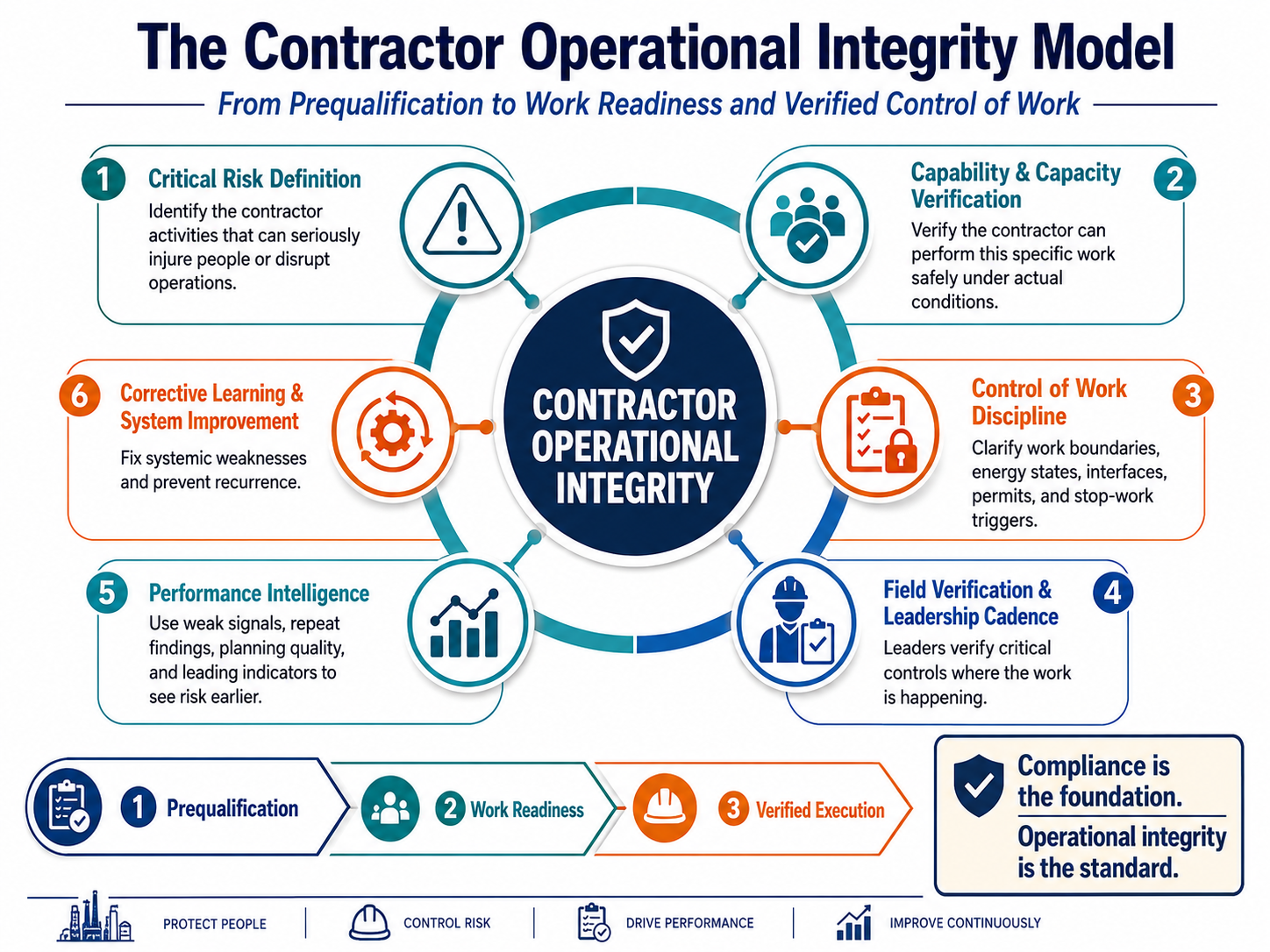
The Contractor Operational Integrity Model has six core elements:
| Model Element | Core Question | What Good Looks Like |
|---|---|---|
| 1. Critical Risk Definition | What contractor work can seriously injure people or disrupt operations? | The organization knows its highest-risk contractor activities and applies focused controls. |
| 2. Capability and Capacity Verification | Can this contractor perform this work under these conditions? | Task-specific readiness is verified, not assumed from general qualification. |
| 3. Control of Work Discipline | Are the work boundaries, energy states, interfaces, and stop-work triggers clear? | Workers can explain the plan, the controls, the failure modes, and when to stop. |
| 4. Field Verification and Leadership Cadence | Are leaders verifying controls where the work is happening? | Leadership presence confirms control effectiveness and removes barriers. |
| 5. Performance Intelligence | Are weak signals visible before serious events occur? | Leading indicators, repeat findings, planning quality, and field observations guide action. |
| 6. Corrective Learning and System Improvement | Are we fixing the system or just closing action items? | Corrective actions prevent recurrence and are scaled across similar work. |
These elements are not separate programs. They are connected parts of one operating system.
Prequalification remains important, but it is only the front door. The real test is whether the contractor and the hiring organization can control the work where risk is real.
1. Critical Risk Definition
The model starts with critical risk.
Not all risks are equal. Safety leaders must identify the small number of exposures that can kill people, seriously injure workers, create major environmental impacts, or significantly disrupt operations.
Critical contractor risks often include hazardous energy, line breaking, confined space entry, work at height, lifting and rigging, hot work, mobile equipment, excavation, electrical work, simultaneous operations, process safety interfaces, startup and shutdown conditions, and changes in scope or operating state.
The future of contractor safety management cannot be built around generic compliance categories alone. It must be built around the exposures that matter most.
The practical leadership question is this:
Have we clearly defined the contractor activities that can produce serious harm or serious business disruption, and have we built reliable controls around them?
If the answer is unclear, the system is not mature enough.
2. Capability and Capacity Verification
Experience matters, but it cannot be assumed.
A contractor may be experienced as a company, but that does not mean the specific crew is experienced. A supervisor may be qualified on paper, but that does not mean they can manage a complex job under pressure. A contractor may have strong historical performance, but that does not guarantee current capacity if they are dealing with turnover, labor shortages, rapid scaling, or unfamiliar work conditions.
The Contractor Operational Integrity Model requires verification of both capability and capacity.
Capability means the contractor can perform the work safely and effectively.
Capacity means the contractor can perform the work safely and effectively under the actual schedule, staffing, complexity, and operating conditions presented.
Both matter.
A contractor can be capable in principle but not ready in practice. That gap is where serious risk can develop.
Organizations should evaluate demonstrated task experience, supervision quality, crew stability, training relevance, planning quality, equipment readiness, subcontractor control, and prior performance on similar work. They should also pay attention to whether the contractor has the leadership depth and operational bandwidth to perform safely while meeting schedule and quality expectations.
The practical leadership question is this:
Are we verifying readiness for this work, or are we relying on general confidence from past qualification?
3. Control of Work Discipline
The future of contractor management is not more paperwork. It is better control of work.
Control of work is where contractor safety becomes operational. Before the job starts, the work boundaries must be clear.
What is the system condition? What is the energy state? What has been isolated? What assumptions are being made? What other work is occurring nearby? What has changed since planning? What are the stop-work triggers? Who has authority to stop the job? What changes require reassessment?
Most serious failures do not begin with bad intent. They usually begin when assumptions go untested, interfaces are unclear, handoffs lose important risk information, or field conditions change faster than the management system responds.
Contractor safety failures often occur at the seams: the handoff between planning and execution, the handoff between the client and contractor, the handoff between operations and maintenance, the handoff between shifts, the handoff between one contractor and another, and the handoff when scope changes, a permit is revised, an isolation is removed, or startup begins.
These are the moments where risk becomes unstable.
A mature contractor management system treats handoffs as critical control points. Poor handoffs create uncertainty, and uncertainty is one of the most dangerous conditions in field execution.
The practical leadership question is this:
Can the people doing the work clearly explain the work boundary, the critical controls, the failure modes, and the conditions that require stopping or reassessing the job?
If they cannot, the work is not ready.
4. Field Verification and Leadership Cadence
Prequalification is the front door. Field verification is where trust is earned.
No digital platform, management system, or prequalification process can replace visible leadership where risk is real.
Leaders need to be present in the field — not to create theater, not to perform safety, but to verify, reinforce, listen, correct, and remove barriers.
The work system learns from what leaders consistently see, challenge, reinforce, resource, and follow through on.
If leaders only inspect paperwork, the organization will optimize paperwork. If leaders verify critical controls in the field, the organization will learn that control of work matters. If leaders respond constructively when workers raise concerns, people will speak up. If leaders ignore weak signals, the system will drift.
Field verification should focus on the critical few controls that prevent serious harm. It should test whether plans match field conditions. It should confirm that workers understand the hazards, controls, and stop-work expectations. It should also identify barriers that make safe execution harder than it needs to be.
Contractors should be treated as part of the operating system. That means clear expectations, mutual accountability, respect, and fast response when concerns are raised.
A strong contractor relationship is not soft. It is disciplined. It is built on clarity, fairness, and follow-through.
The practical leadership question is this:
Are leaders verifying risk control where the work is happening, or are they managing contractor safety from conference rooms and dashboards?
5. Performance Intelligence
The profession needs better contractor safety intelligence.
Lagging indicators have value, but they are incomplete. They tell us what has already happened. They do not always show where control is weakening now.
Serious and fatal exposures can remain hidden inside apparently healthy systems when leaders rely on indicators that confirm activity rather than control.
The Contractor Operational Integrity Model requires leaders to look for weak signals and system patterns. These may include repeat permit issues, poor job hazard analyses, unclear incident descriptions, turnover in key contractor roles, repeated audit findings, supervision gaps, stop-work trends, poor job brief quality, recurring housekeeping or barricading issues, schedule pressure, uncontrolled simultaneous operations, and corrective actions that do not prevent recurrence.
Leaders should also look across contractors, sites, work types, and time periods. The goal is to identify the top recurring drivers of risk and act before those patterns produce a serious event.
This is where technology and analytics can help.
Digital tools, artificial intelligence, mobile platforms, and connected contractor systems can help organizations evaluate contractor capability faster and more deeply. They can identify patterns that may not be visible through traditional review. They can support better onboarding, improve communication, accelerate learning, and provide real-time insight into readiness and risk.
But technology has a dual nature.
We can use it to improve risk management, but we must also manage the new risks it creates. Poor data, false confidence, weak governance, privacy concerns, unequal access, and overreliance on automated scoring can create new blind spots.
The opportunity is not simply to digitize old processes. The opportunity is to use technology to improve judgment, planning, verification, and execution.
The practical leadership question is this:
Are our metrics helping us see risk earlier, or are they mainly helping us explain performance after the fact?
6. Corrective Learning and System Improvement
Many organizations close corrective actions. Fewer actually correct the weakness.
The next generation of contractor safety management must focus on corrective action quality. When the same failure mode returns through a different contractor, crew, shift, or location, the issue was not solved. It was documented.
Strong corrective actions address the system conditions that allowed the problem to occur. They balance engineering, procedural, supervisory, and behavioral controls, with preference for more reliable controls where feasible. This logic is consistent with the hierarchy of controls, which places elimination, substitution, and engineering controls above administrative controls and personal protective equipment (National Institute for Occupational Safety and Health [NIOSH], 2025). They also prioritize high-impact actions that can be implemented in a timely way and scaled across similar work.
Administrative closure is not the objective. The objective is a durable reduction in the probability or severity of recurrence.
Corrective learning also requires humility. If a contractor raises a concern, stops a job, reports a near miss, or identifies a planning weakness, the hiring organization should treat that as valuable intelligence. Punishing the messenger teaches silence. Responding with discipline and speed builds trust.
The practical leadership question is this:
Are we learning across the system, or are we closing actions one job at a time while the same risks keep returning?
A Practical Example: Line Break Work During a Turnaround
Consider a contractor crew assigned to perform line break work during a plant turnaround.
Under the old model, the contractor may have been prequalified, trained, insured, and approved. The job package may include a permit, a job hazard analysis, and a lockout or isolation plan. On paper, the work may look ready.
The Contractor Operational Integrity Model asks a deeper set of questions.
Has line breaking been identified as a critical risk for this site? Has the contractor demonstrated capability on this specific type of system? Is the assigned supervisor experienced with turnaround conditions, compressed schedules, and simultaneous operations? Are the isolations verified in the field? Are blinds, valves, drains, vents, and energy states understood by both operations and the contractor crew? Has anything changed since the permit was prepared? Are nearby crews performing hot work, confined space entry, or other tasks that could interact with this job? Can the workers explain what would cause them to stop?
This is where the model changes the conversation.
The issue is not whether the contractor file is complete. The issue is whether the work is controlled at the point of execution.
If a field verification finds that the crew cannot clearly explain the isolation boundary, that is not a paperwork problem. It is an operational integrity problem. If the same confusion appears on multiple jobs or across multiple contractors, it is a system weakness. The corrective action should not be limited to coaching one crew. It should improve the way the organization plans, communicates, verifies, and governs line break work across the site or enterprise.
That is the difference between managing contractor documentation and managing contractor risk.
From Old Model to Future Model
The shift facing the profession can be stated plainly.
The old model emphasized contractor qualification. The future model emphasizes work readiness.
The old model relied heavily on lagging metrics. The future model uses leading intelligence and field verification.
The old model focused on documentation. The future model focuses on critical control effectiveness.
The old model treated contractors as external parties to be managed. The future model treats contractors as part of the operating system.
The old model asked whether requirements were met. The future model asks whether risk is controlled.
This is not a rejection of compliance. It is a recognition that compliance must be connected to execution.
Compliance is the foundation. Operational integrity is the standard.
What Different Leaders Must Do Now
This shift cannot be owned by the safety department alone.
Safety leaders need to define critical contractor risks, strengthen field verification, improve corrective action quality, and help the organization see weak signals before they become serious events.
Procurement and supply chain leaders need to evaluate more than price, availability, and paperwork. They need to understand contractor capability, capacity, supervision quality, and risk maturity as business-critical selection criteria.
Operations leaders need to treat contractor work as part of operational discipline. The same expectations applied to internal work — planning, control of work, supervision, accountability, and learning — must apply to contractor work.
Executives need to ask better questions. Not only, “Are our contractors qualified?” but also, “How do we know critical contractor work is being controlled in the field?”
Contractors also have a responsibility. They need to be honest about capability, staffing, supervision, and readiness. They need to raise concerns early, stop work when conditions change, and bring disciplined execution to the job.
The strongest systems will be built on mutual accountability.
The Role of Technology in the Next Era
Technology will change contractor safety management, but it will not save weak systems by itself.
The most valuable technology will help organizations answer practical questions:
Are the right controls in place?
Are they understood?
Are they being used?
Has anything changed?
Are weak signals emerging?
Are the same issues repeating across crews, sites, or contractors?
Are corrective actions actually strengthening the system?
Technology should improve visibility, knowledge transfer, risk recognition, and decision speed. It should help teams manage real-time uncertainty and constant planning. It should support better handoffs from shift to shift and better learning across contractor networks.
But leaders must avoid false confidence. A digital score is not the same as control. A completed workflow is not the same as readiness. A dashboard is not the same as leadership presence.
The future belongs to organizations that combine better tools with better judgment and deliberately people-centered activity. Technology should make the human parts of contractor safety stronger: better pre-job conversations, clearer handoffs, more informed supervision, faster escalation of uncertainty, stronger stop-work decisions, and more disciplined learning after the job is complete. The winning organizations will not use digital systems to distance leaders from the work; they will use them to bring leaders, contractors, and frontline crews closer to the conditions where risk is changing. In contractor operational integrity, technology creates advantage only when it improves human understanding, reinforces accountability, and helps people make better decisions before exposure becomes consequence.
The Future Standard
The organizations that will lead in contractor safety management will share several characteristics.
They will define critical risk clearly. They will verify contractor capability and capacity for the actual work. They will manage handoffs as critical control points. They will connect contractor safety to reliability, process safety, environmental compliance, quality, production discipline, and business performance.
They will use technology to improve visibility and knowledge transfer, not just administrative efficiency. They will verify controls in the field. They will treat contractors as part of the operating system. They will expect strong planning, capable supervision, and disciplined execution. They will respond to weak signals before they become serious events.
And they will understand that contractor safety is owned by the business.
Call to Action
The future of contractor safety management is not about choosing between safety and speed. It is about building systems that allow work to be done safely, efficiently, and reliably.
We need to use new tools and technology to better manage risk and meet rising expectations for performance and capability. But the fundamentals remain the same: clear expectations, competent people, strong controls, disciplined planning, leadership presence, and timely corrective action.
Contractor management is becoming a test of operational maturity.
The organizations that perform best will not be the ones with the most forms. They will be the ones that know where their critical risks are, verify that controls are working, and lead contractor work with the same discipline they expect from their own operations.
That is the Contractor Operational Integrity Model.
It is a shift from prequalification to readiness.
From documentation to control.
From compliance confidence to verified execution.
And from contractor management as an administrative process to contractor safety as a core measure of operational integrity.
That is the future of contractor safety management.
And it is where the profession needs to lead.
References
Brandon, C. (2026a, May 11). Operational integrity: The operating model heavy manufacturing needs. LeadingEHS.com. https://leadingehs.com/2026/05/11/operational-integrity-the-operating-model-heavy-manufacturing-needs/
Brandon, C. (2026b, May 13). Avetta Safety Summit 2026: Emerging safety trends: Managing the next generation of contractor risk [Unpublished conference speaking notes]. Avetta Summit Chicago 2026.
National Institute for Occupational Safety and Health. (2025, January 31). Hierarchy of controls. Centers for Disease Control and Prevention. https://www.cdc.gov/niosh/hierarchy-of-controls/about/index.html


