
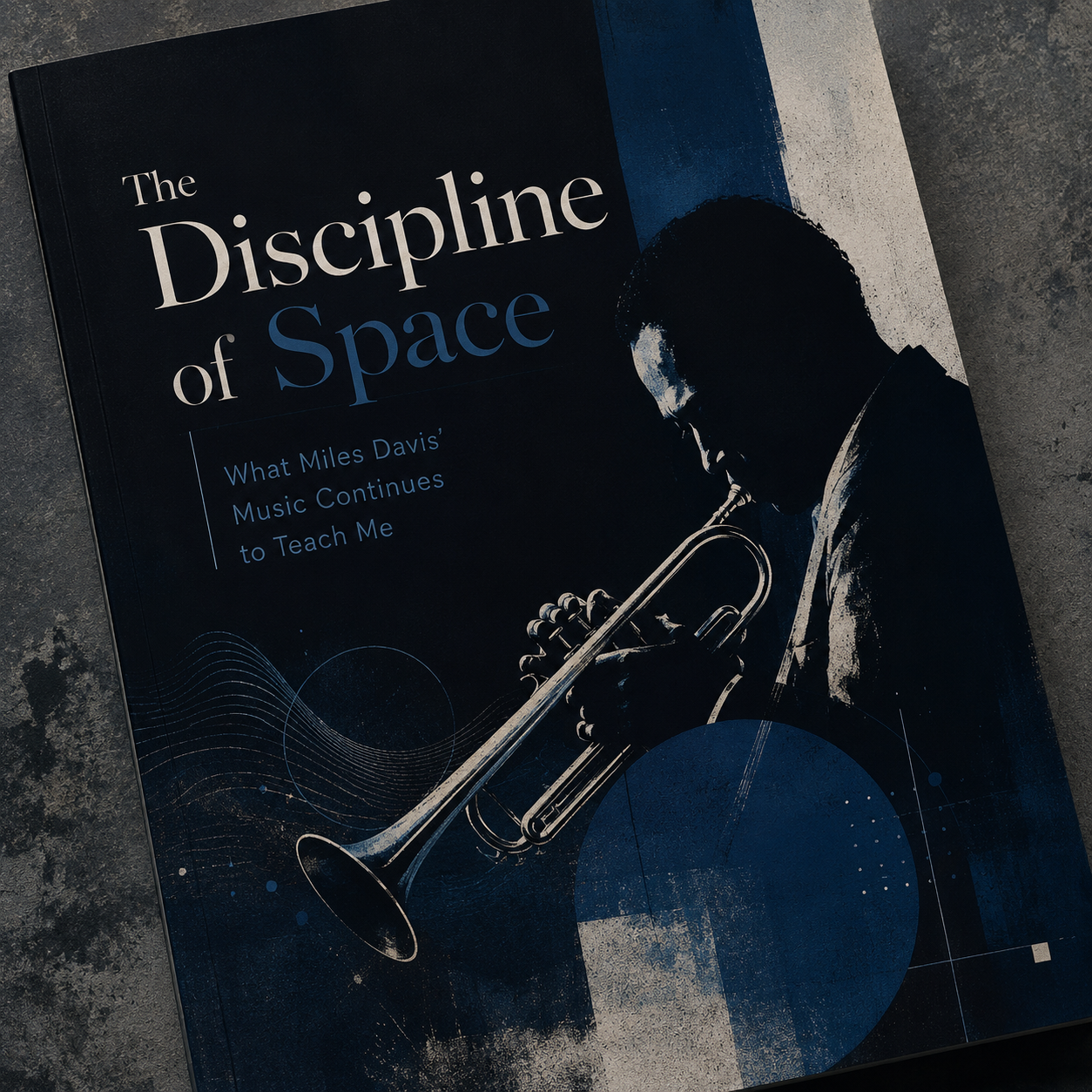
Miles Davis reminds us that people often crowd their lives with noise when what they really need is the courage to leave space...
…that is part of why I keep returning to Kind of Blue. It does not chase the listener. It waits. It creates room. And when I am ready to listen carefully, it has something new to teach me.
Some music entertains us. Some music impresses us. And then there is music that keeps returning at different points in life, revealing something new each time—not only about the artist, but about ourselves. For me, Miles Davis’ Kind of Blue is that kind of music.
I have developed a deep appreciation for the jazz of Miles Davis, especially his work from the late 1950s and early 1960s. There is something in that period of his music that consistently reaches me. It is not just technical brilliance, although there is plenty of that. It is the feeling the music creates. For me, it carries a sense of lift, movement, elation, and possibility. It sounds like good things are ahead.
That may be an unusual way to describe music often associated with restraint, coolness, and sophistication. But that is part of its power. Miles Davis did not need to fill every space. He understood that what is left out can be just as important as what is played. His music from this era is clean, uncluttered, and disciplined, but never simple. The arrangements create room for the musicians to speak with clarity. The result is music that feels precise and emotionally alive at the same time.
That balance is what draws me back.
When I listen to Kind of Blue, I hear musicians operating at an extraordinary level of skill, but I also hear trust. No one seems to be trying to dominate the room. The music breathes. Each player contributes something distinctive, but always in service of the whole. There is structure, but there is also freedom. There is discipline, but not rigidity. There is space, but never emptiness.
That is a rare combination.
As I have gotten older, I find myself increasingly drawn to work that does not try too hard to announce its importance. Kind of Blue has that kind of maturity. It trusts the listener. It trusts the musicians. It trusts space, timing, and restraint. That confidence is part of what makes the album feel not only beautiful, but wise.
Miles Davis was a complicated person. Like many highly consequential artists and leaders, his life and personality do not fit neatly into a simple narrative. But one of his great gifts was his ability to bring out excellence in the people around him. He had a remarkable instinct for talent, timing, sound, and atmosphere. He knew who belonged in the room. He knew what kind of framework would allow them to do their best work. He seemed to understand that leadership is not always about saying more, directing more, or controlling more. Sometimes it is about setting the conditions where great people can create something that exceeds the plan.
That lesson applies well beyond music.
In leadership, as in jazz, the best outcomes rarely come from noise, clutter, or over-control. They come from clear expectations, capable people, disciplined preparation, and enough room for judgment. The leader’s role is to establish direction, define the standard, and create the conditions for strong performance. Then the leader must have the confidence to let people perform.
That is part of what I hear in Miles Davis’ best work. I hear restraint with purpose. I hear confidence without unnecessary force. I hear people listening to each other. I hear complexity made accessible because the structure is sound.
Each time I listen to Kind of Blue, I discover something new. Sometimes it is in the music: a phrase, a pause, a shift in tone, a moment between musicians that I had not fully noticed before. Other times, the discovery is in myself. The album seems to meet me differently depending on where I am in life, what I am thinking about, and what I need to hear.
That is the mark of enduring work. It does not exhaust itself. It continues to reveal.
We do not always need more volume, more activity, or more complexity. Sometimes we need more clarity…
A Listening Sequence: Before, During, and After Kind of Blue
Apple Music Playlist: Kind of Blue Influence
As I have spent more time with Kind of Blue, I have also become interested in the music that helped lead Miles Davis toward that masterpiece, and the music that followed after it. I am building a playlist that listens to Kind of Blue not as an isolated album, but as the center point in a larger musical conversation.
The playlist has three movements: the music that influenced the album, the album itself, and the music that carried its influence forward.
Before Kind of Blue: The Ingredients
The first section begins before Kind of Blue, with several pieces that help prepare the ear for what Miles Davis would later accomplish.
Ahmad Jamal’s “Pavanne” is a good place to start. Jamal’s influence on Miles was not about playing louder, faster, or more densely. It was about space, elegance, restraint, and timing. Jamal showed how silence and simplicity could create tension and sophistication. That sense of space becomes essential to understanding Miles’ late-1950s work.
George Russell’s “Concerto for Billy the Kid” brings in another major influence: musical architecture. Russell’s thinking helped move jazz toward a more modal approach, where improvisation could be organized around scales and tonal centers rather than fast-moving chord changes. This piece also matters because of Russell’s connection to Bill Evans, whose piano voice would become central to the sound and atmosphere of Kind of Blue.
Ahmad Jamal’s “Poinciana” deepens the point. It is patient, hypnotic, and rhythmically confident. It demonstrates how repetition, groove, and restraint can create emotional momentum without clutter. Miles clearly valued that discipline.
Bill Evans’ “Peace Piece” brings the emotional color closer to Kind of Blue. It has a quiet, suspended quality that points directly toward the mood of “Flamenco Sketches.” It is meditative, spacious, and deeply expressive without being sentimental.
Thelonious Monk / Miles Davis’ “Round Midnight” adds a different kind of influence to the sequence. Monk’s composition brings angular beauty, restraint, and emotional economy. Miles’ interpretation shows how much power can come from tone, timing, and what is left unsaid. The piece does not rush to explain itself; it creates tension through space and resolves it with quiet authority. In that sense, “’Round Midnight” belongs naturally in the path toward Kind of Blue. It prepares the listener for the idea that disciplined restraint can carry more emotional weight than excess.
Miles Davis’ “Milestones” is the direct bridge. This is Miles testing the modal concept before making it the organizing principle of Kind of Blue. After listening to Jamal, Russell, and Evans, “Milestones” sounds like Miles gathering those ideas and shaping them into his own language.
Kind of Blue: The Center of Gravity
Then comes Kind of Blue itself.
“So What” opens the album with unmistakable authority. The bass figure, the call-and-response structure, and the relaxed confidence of the performance announce that the listener has entered different territory. The music is sparse, but not thin. It is disciplined, but not stiff. It gives the musicians room to speak.
“Freddie Freeloader” brings the blues back into focus. It is more earthy and swinging, with Wynton Kelly adding a different piano character than Bill Evans. The track reminds me that Miles was not abandoning tradition. He was expanding it.
“Blue in Green” may be the emotional interior of the album. It is spare, reflective, and beautifully controlled. The arrangement creates space for feeling to become the focal point. This is music that does not tell the listener what to feel. It creates the conditions for feeling to emerge.
“All Blues” opens the room again. The 6/8 motion gives the track lift and movement. It has confidence without force. There is a forward motion in it that feels almost optimistic to me.
“Flamenco Sketches” closes the album not with finality, but with openness. The musicians move through a sequence of scales, but the experience is not academic. It feels patient, searching, and human. It is the right ending because it does not close the conversation. It leaves space for the listener to continue it.
After Kind of Blue: The Language Expands
The final section of the playlist follows the influence of Kind of Blue into the music that came after it.
John Coltrane’s “My Favorite Things” takes modal thinking and stretches it into a new kind of exploration. A familiar melody becomes a platform for extended improvisation. Where Miles often used space and restraint, Coltrane used repetition, intensity, and expansion.
John Coltrane’s “Impressions” is one of the clearest descendants of “So What.” It carries similar modal DNA but moves with a different kind of urgency. Coltrane takes the open structure and drives it harder, faster, and further.
John Coltrane’s “Acknowledgement,” from A Love Supreme, shows the modal language becoming something more spiritual and declarative. The music is still structured, but the structure serves a larger emotional and personal statement.
Herbie Hancock’s “Maiden Voyage” represents a more refined post-Kind of Blue evolution. It keeps the spaciousness and suspended harmony, but carries it into a new generation of jazz. It feels elegant, controlled, and expansive.
Wayne Shorter’s “Footprints” is a fitting endpoint for the playlist. It shows the modal idea becoming more elastic and modern. The blues foundation remains, but the rhythm and harmony move with a new freedom. This is not imitation. It is development.
Taken together, the playlist tells a powerful story. Ahmad Jamal contributes the space. George Russell contributes the architecture. Bill Evans contributes the color. Miles Davis brings the judgment, taste, and leadership to make it all cohere. Then Coltrane, Hancock, and Shorter show what happens when that language enters the bloodstream of modern jazz.
Why I Keep Returning to Miles
For me, Miles Davis’ music is not background music. It asks for attention, but it does not demand it loudly. It rewards patience. It reminds me that excellence can be quiet, that precision can serve emotion, and that simplicity, when earned, can carry tremendous power.
There is a leadership lesson in that. There is also a human lesson.
We do not always need more volume, more activity, or more complexity. Sometimes we need more clarity. More space. More discipline. More trust in the people around us. More confidence that the right note, played at the right time, can say more than a dozen unnecessary ones.
That is why I keep returning to Miles Davis.
His music renews my personal and professional energy. It sharpens my focus while also opening something deeper and more reflective. Each piece creates a rich tapestry where my intellect can immerse itself in the emotion, fabric, and joy of the music. Listening becomes the experience of exploring a familiar yet exhilarating work of art—one that continues to challenge, restore, and inspire me.
And that is why Kind of Blue still feels alive every time I hear it.
References
- Davis, M. (2009). Kind of blue: Legacy edition [Album]. Columbia/Legacy.
- Nisenson, E. (2000). The making of Kind of Blue: Miles Davis and his masterpiece. St. Martin’s Press.


