
By Fay Feeney and Chet Brandon
Series Context
This four-part series examines how artificial intelligence is reshaping cyber risk in operational technology and what it means for industrial organizations. It brings together perspectives from safety leadership, cybersecurity, operations, and board governance to address cyber-physical risk as an enterprise issue. The series is co-authored by Chet Brandon, a global Environmental, Health & Safety (EHS) and operational risk leader, and Fay Feeney, an expert in board governance and enterprise risk oversight.
The first three articles argued that Operational Technology cyber risk has moved from technical concern to operational and resilience challenge. This final article asks a harder question: How should boards govern, resource, and make capital decisions in response?
Introduction
The next major Operational Technology (OT) capital request your board reviews may not be a modernization project at all. It may be a proposal for new robots, AI-enabled inspection systems, autonomous material-handling assets, or other connected technologies that promise more throughput, less labor strain, and sharper quality performance.
Those proposals often arrive wrapped in the language of innovation and competitiveness. But for directors, the more important question is not whether the technology is impressive. It is whether management is asking the board to approve capital expenditures that build a better business, or simply a faster way to create new categories of operational risk.
That is the boardroom challenge. OT cyber risk is no longer merely a management issue boards oversee; it is increasingly a fiduciary obligation boards must actively govern.
Operational technology now sits at the intersection of strategy, safety, cyber risk, resilience, and capital allocation. When directors approve spending on new OT-enabled assets, they are not merely approving equipment. They approve of a new operating model, a new risk profile, and a new set of assumptions about how the company will create value. Boards that understand this will demand decision-ready information.
Executive summary
This article advances a straightforward proposition: safety professionals who work close to operational technology are among management’s most underused assets in improving business decision quality. They see weak signals before they become failures. They understand how controls perform under pressure. They recognize where workarounds, maintenance drift, procedural gaps, and human-machine interaction begin to erode resilience.
When their observations are translated through operational leadership, the CISO, and enterprise risk management, they give the CEO and the board a clearer picture of what a proposed OT investment really means for the business.
For directors, the lesson is practical. OT is not a narrow engineering or technical issue. It is the equipment and the control and monitoring systems that run the physical side of the business—the plants, production lines, machines, robots, and connected assets that make, move, and deliver value in the real world.
If information technology runs data and transactions, operational technology runs physical processes and assets. As a result, OT failures, design flaws, or cyber intrusions can become safety, production, regulatory, financial, and reputational events with remarkable speed.
The broader governance implication is clear: new OT investments should come into the boardroom as enterprise risk and strategy decisions. The board should expect management to show how those investments change risk appetite, resilience, strategic capacity, and long-term value, not merely productivity or obsolescence.
Why decision quality is essential for digital investments.
Boards are generally disciplined about reviewing outcomes. Yet many spend less time examining the quality of the decision process that produced them. In complex operating business systems, management teams still default too easily to speed, confidence, precedent, and partial information. In manufacturing, where robotics, automation, quality, workforce safety, supply chain, continuity, and cybersecurity increasingly intersect, those habits create dangerous blind spots.
This is why decision quality is now a board issue that deserves a renewed assessment. Directors should not stop at asking, “Do we have the right recommendation?” They should also ask, “Did management frame the issue correctly? Did it examine credible alternatives? Did it test assumptions and develop fallback plans?” In OT-intensive environments, those questions are not process niceties. They are part of governing resilience and enterprise value.
Safety professionals matter here because their disciplines are grounded in structured inquiry. Hazard identification, root-cause analysis, barrier management, scenario assessment, and learning from near misses are not only safety disciplines. They are decision-quality disciplines. They help management resist optimism bias, sunk-cost thinking, and the temptation to mistake a confident proposal for a sound one.
Resetting boardroom decision-ready expectations from leadership
“As Technology, Risk, or Audit Committee members, our role is to oversee Operational Technology and ensure that OT decisions are treated as enterprise risk and strategy decisions. We expect management to bring us OT issues and investments framed through safety, cyber, and ERM lenses, so we can see how they affect the company’s risk appetite, resilience, and long-term value.”
Why safety matters in new OT investments
As manufacturers invest in a new generation of connected physical assets, safety professionals should be viewed as contributors to enterprise judgment, not simply compliance resources. Robots, cobots, autonomous mobile systems, machine-vision tools, and AI-enabled controls do more than improve throughput. They change how people interact with equipment. They alter line dependencies and operating rhythms while expanding the digital attack surface. They create new failure modes and recovery challenges. And they change the company’s future operating risk profile.
That makes safety professionals especially valuable. They are often the first to see where human-machine interaction may be misunderstood, where safeguards may be overestimated, where maintenance assumptions may be unrealistic, or where emergency fallback procedures are too theoretical to be useful.
They help management determine whether a proposed investment is ready for deployment, whether risks are understood, and whether the company is considering the impact on their enterprise risk profile.
For Directors, that is an important distinction. The question is not whether new OT creates value. It often does. The question is whether management has done enough to ensure that the value case and the risk case are being considered together.
In practice, safety professionals do not usually brief the board directly. Their value depends on what happens next—how their observations move upward and are translated.
The first step is operational leadership. Plant managers, engineering leaders, maintenance and reliability teams, production executives, and quality leaders add context around throughput, asset performance, labor implications, customer commitments, and commercial performance. They connect operational evidence to business reality.
That translation becomes more powerful when joined by the CISO and ERM. The CISO contributes the cyber-physical perspective: how connectivity, software updates, vendor access, identity management, remote diagnostics, segmentation weaknesses, and monitoring gaps could affect the safe and reliable operation of robots and other connected equipment. In a connected manufacturing environment, the relevant question is rarely whether a cyber event is “IT” or “OT.” The question is whether it can disrupt physical production, compromise worker safety, or degrade the integrity of critical assets and what level of reputation risk the organization is prepared to accept.
ERM adds portfolio discipline. It helps convert site-level observations into a small number of scenarios, consequence ranges, likelihood bands, and treatment options that can be assessed alongside other capital and strategic choices. This is where management should demonstrate not merely that a project is technically feasible, but that it is a sound decision relative to the company’s risk appetite, strategic priorities, and competing uses of capital.
The CEO’s role is to bring these threads together in a board-ready form. Directors do not need a stack of technical details. They need a board paper that shows how safety, operations, cyber, finance, and enterprise risk perspectives converge on a recommendation. Where that integration is absent, the board is being asked to approve spending. Where it is present, the board is being invited to make a business decision.
Artificial intelligence is increasingly embedded in many of the OT investments now coming before boards. Robotics, machine vision, and connected control systems rely on AI, introducing more complex behavior, tighter interdependencies, and less predictable failure modes. For directors, this does not change the responsibility—it raises the standard for it. Management should demonstrate how these systems perform under both normal and degraded conditions, and how resilience is maintained when assumptions do not hold.
A simple operating model for directors
A useful way for directors to think about this flow is as a simple operating model.
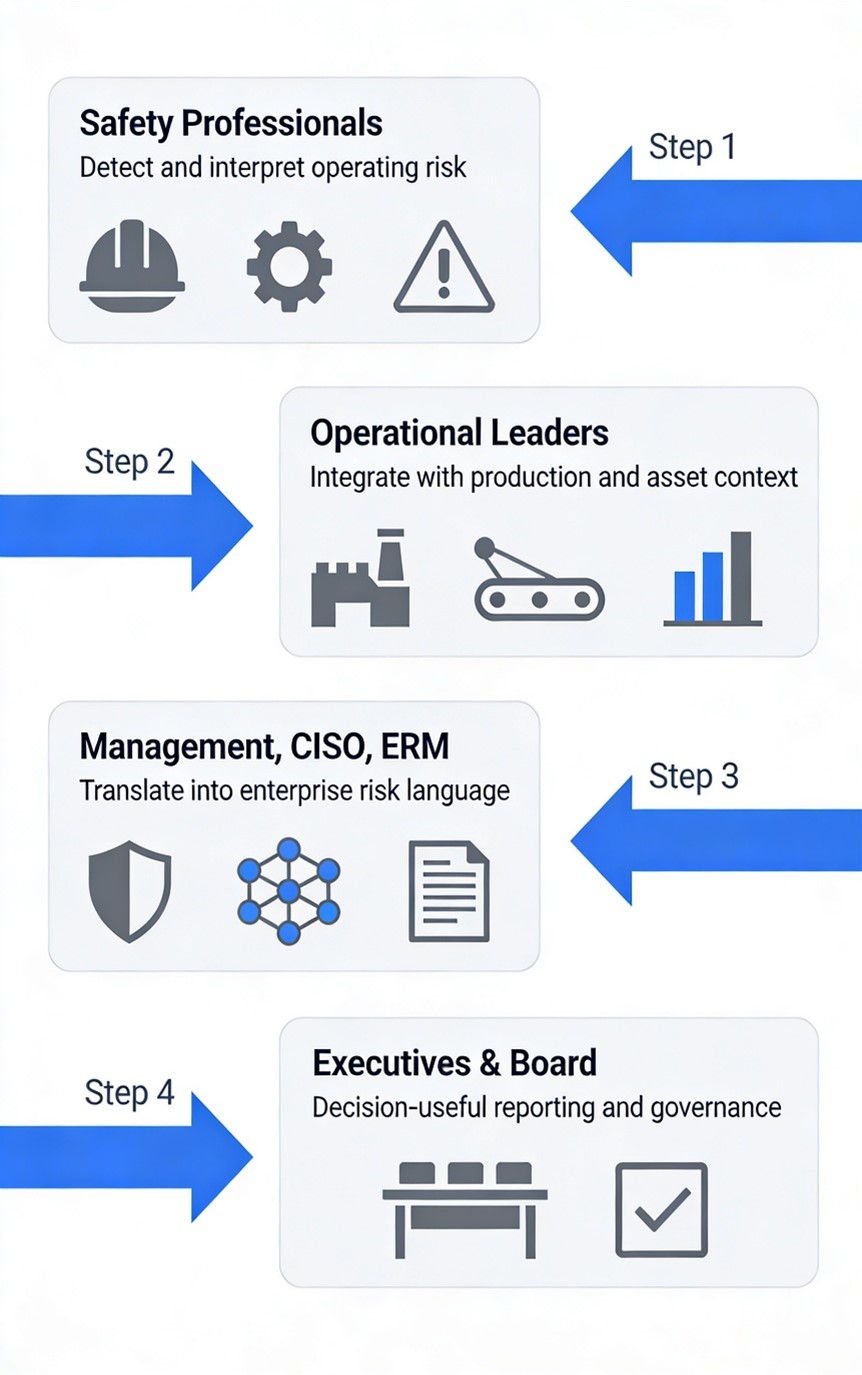
First, safety professionals detect and interpret operating risk. They identify control weaknesses, unsafe interactions, maintenance drift, procedural non-conformance, resilience gaps, and weak signals in OT-dependent operations.
Second, operational leaders integrate those findings with production and asset context, linking them to continuity, quality, labor, customer commitments, and commercial performance.
Third, management, the CISO, and ERM translate the issue into enterprise risk language—documenting scenarios, consequences, alternatives, assumptions, and response options in forms suitable for executive and board review.
Finally, executives and the board receive decision-useful reporting, so the issue appears not as a narrow technical matter but as a governance question involving risk appetite, resilience, capital allocation, and strategic tradeoffs.
Once that model is in place, directors can hold management accountable for using it consistently rather than episodically.
The Artificial Intelligence Operational Technology (AIOT) Resilience Index: Turning Operational Reality into Board-Level Oversight
As OT environments become more connected, automated, and AI-enabled, boards need a practical way to evaluate whether the organization is genuinely becoming more resilient—or simply becoming more technologically complex. That requires more than isolated cybersecurity metrics or compliance reporting. Directors need a disciplined framework that translates operational risk into decision-useful information that can be monitored over time. One approach is the use of an AIOT Resilience Index: a board-level measurement framework designed to evaluate how effectively the organization is managing cyber-physical risk across operations, safety, resilience, and governance.
The purpose of the index is straightforward. It is intended to help directors and executives understand whether the organization is improving its ability to anticipate, withstand, respond to, and recover from disruptions affecting operational technology. Rather than focusing only on technical vulnerabilities, the index evaluates the operational realities that determine whether an organization can continue to operate safely and reliably under strain.
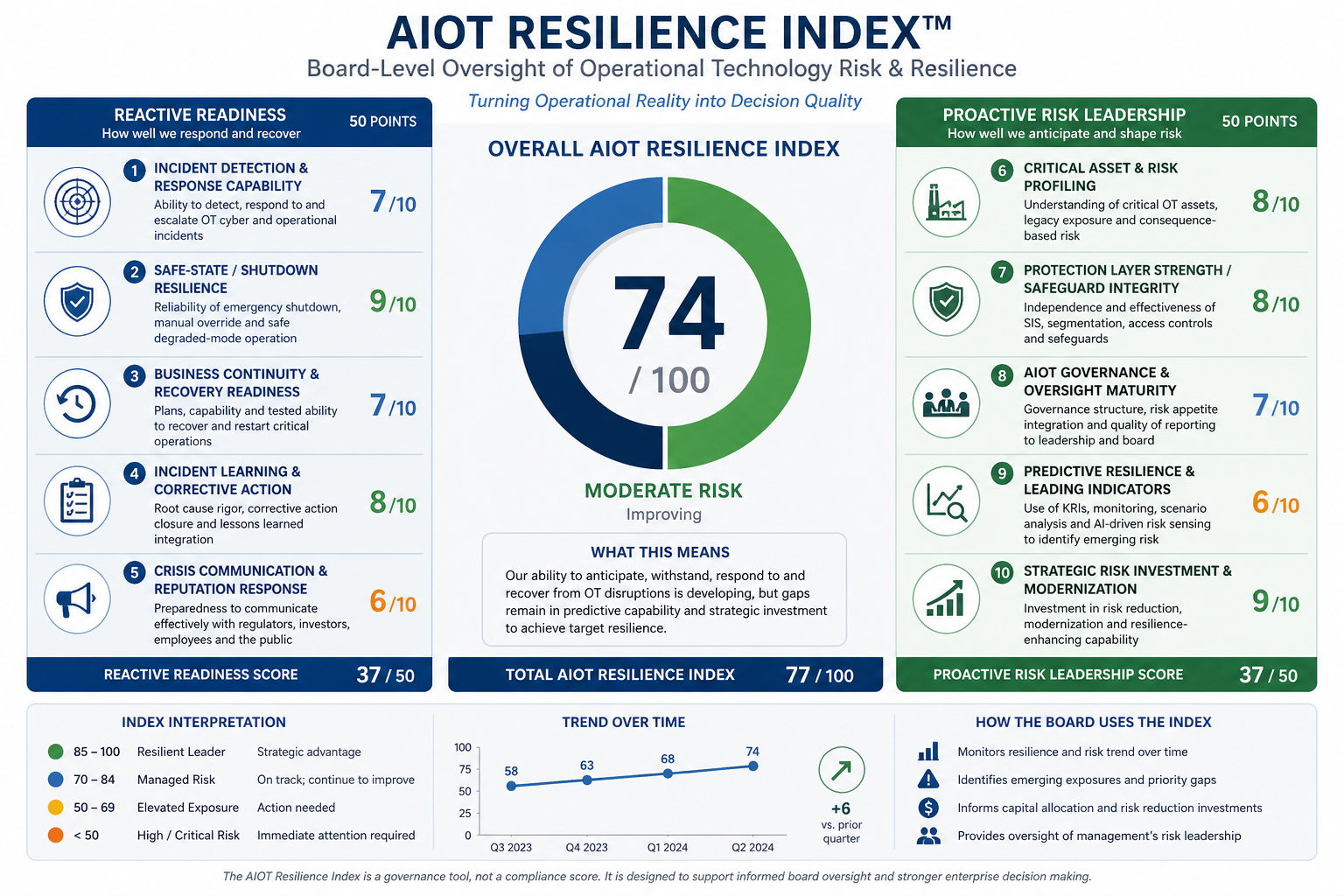
The AIOT Resilience Index combines both reactive and proactive dimensions of performance. The reactive side evaluates capabilities such as incident detection, emergency shutdown readiness, operational recovery, corrective action closure, and crisis communications. These indicators help leadership understand how effectively the organization can stabilize operations and limit consequences once an event occurs. The proactive side focuses on activities more directly within management’s control, including critical asset risk profiling, safeguard integrity, governance maturity, predictive monitoring capability, and strategic investment in modernization and resilience.
Importantly, the index is designed around factors management can actively influence rather than abstract external threat conditions. That distinction matters in the boardroom. Directors cannot govern geopolitical uncertainty or the existence of cyber threats, but they can oversee whether management is systematically reducing exposure, strengthening safeguards, improving resilience, and investing appropriately in risk reduction. The index therefore becomes less a technical scorecard and more a governance tool for evaluating operational readiness and long-term resilience.
The value of the index is not the number itself. Its value is the discipline it creates. A well-constructed index allows directors to identify trends, compare facilities or business units, evaluate whether risk reduction investments are producing measurable improvement, and determine where exposure may exceed the organization’s stated risk appetite. It also helps frame more informed discussions about capital allocation, legacy asset exposure, third-party dependency, and the operational implications of AI-enabled systems.
Used properly, the AIOT Resilience Index becomes a mechanism for connecting plant-floor realities to boardroom oversight. It gives management a structured way to present operational risk in enterprise terms and gives directors a clearer basis for evaluating resilience, strategic readiness, and long-term value protection in increasingly connected industrial environments.
The illustration below shows how the AIOT Resilience Index™ can translate complex operational technology risk into a board-ready view of resilience, readiness, and governance performance. By separating reactive capabilities from proactive risk leadership, the index helps directors see not only how well the organization can respond to disruption, but how effectively management is reducing exposure before an event occurs.
Case study: approving new robots and connected equipment
Consider a board reviewing a request for a $32 million multi-year investment to deploy a new robotic assembly cell, AI-enabled machine-vision inspection system, and autonomous material-handling platform at a high-volume plant. The proposal includes collaborative robots working near people, new safety interlocks, integration with legacy line controls, expanded network connectivity, vendor remote support, and software that coordinates production flow and inspection data.
The initial management narrative is familiar: labor constraints are tightening, throughput can improve, quality escapes can be reduced, and the facility needs more automation to remain competitive. For a board, however, that framing is incomplete.
The real board question is broader. Does this investment materially improve the company’s future strategic capacity and resilience, and does the organization understand the new operating risk profile it is about to create? The board is not simply approving equipment. It is approving a new way of operating.
For that reason, the CEO should bring six elements into the boardroom.
- Strategic context: how the new robotic system supports growth, margin improvement, workforce availability, customer commitments, and longer-term automation strategy.
- Current operating risk: where existing manual or semi-automated processes create safety exposure, quality variation, rework, downtime, or throughput constraints.
- Scenario-based consequences: a small number of realistic situations such as unsafe robot-human interaction, software or sensor malfunction, failure of a safety interlock, network disruption affecting production flow, or vendor access creating cyber-physical vulnerability.
- Alternatives and tradeoffs: phased deployment, pilot testing, a more limited automation scope, or deferral, each with different cost, risk, and speed implications.
- Portfolio fit: what other projects this request displaces and why management believes this investment deserves priority now.
- Execution and contingency planning: operator training, maintenance readiness, cybersecurity controls, vendor dependency, fallback procedures, and the plan if the technology underperforms or deployment takes longer than expected.
This is precisely where safety professionals, the CISO, and ERM add visible value. Safety professionals can identify where workers may be exposed, where safeguarding assumptions are weak, where human-machine interaction is poorly understood, and where recovery procedures are unrealistic.
The CISO can explain how insecure remote support, software patching failures, weak segmentation, or poor access control could magnify the operational consequences of the new asset base.
ERM can place the entire picture into the context of enterprise exposure, risk appetite, and competing capital priorities. Together, they transform an innovation proposal into a strategic capital decision worthy of board judgment.
Questions directors should keep asking
The board’s role is not to second-guess engineering design. It is to insist that management present OT investment in decision-ready form. As directors upgrade their board’s AI, digital, and cybersecurity expertise and raise overall skills, then can begin now by asking a short set of practical questions:
- How does this investment change our future operating risk profile, not just projected productivity?
- What assumptions about workforce readiness, vendor support, and change management sit beneath the expected return?
- Which risks are genuinely reduced, and which new risks are introduced?
- If rollout slips or technology performs below expectations, what is the fallback position?
- How are safety, cybersecurity, and resilience being governed together rather than as separate workstreams?
- Where does this proposal sit relative to other opportunities and risk-reduction investments competing for capital?
These questions do more than improve oversight of one proposal. They raise the standard by which management prepares OT matters for the board.
Some Closing Thoughts
The companies that will benefit most from robotics, connected automation, and intelligent equipment will not necessarily be the ones that buy the most technology first. They will be the ones whose leaders understand that every new OT investment is also a decision about resilience, safety, cyber-physical exposure, and the company’s long-term capacity to perform under strain to deliver innovation at scale.
That is why this conversation belongs in the boardroom. Safety professionals are not merely helping management avoid incidents. Properly integrated with operational leadership, the CISO, and ERM, they help the CEO bring better business decisions to the board—decisions grounded in operating reality, tested against risk appetite, and weighed against strategic alternatives.
When directors insist on that discipline, they do more than improve oversight of OT. They improve the quality of the judgments on which the company’s future value will depend. Their investors and stakeholders will appreciate the dividends that delivers.
In the age of AI-enabled operational technology, the companies that govern this well will not simply reduce cyber risk; they will build safer, more resilient, and more valuable industrial enterprises.


