

Building an Operating System for EHS Leadership at Scale
One of the most important leadership lessons of my career came during a period of extraordinary growth. At ATI Worksite Solutions, our operation grew from approximately 15 people to roughly 300. Over about five years, revenue grew from approximately $7 million to $36 million—more than a fivefold increase and a compound annual growth rate of approximately 39%.
Early in that journey, I could stay close to much of what was happening. I knew the people, understood the problems, participated directly in important decisions, and could intervene when something needed attention. That approach became impossible as we grew.
At 300 people, I couldn’t personally coach every employee, solve every operational problem, ensure every customer received the same experience, or make every important decision. More importantly, I shouldn’t have tried. Working harder wasn’t the answer. I had reached one of the fundamental constraints of leadership: you can’t scale yourself. You have to scale your impact.
We built organizational structure, developed managers, established processes and expectations, and deliberately transferred knowledge, authority, and accountability to others. We also created a formal leadership-development program that ultimately reached approximately 100 employees. My job was changing. I was no longer primarily responsible for producing results myself. I was responsible for creating an organization capable of producing results at a scale I could never achieve individually.
Years later, I see the same leadership principle taking another evolutionary step through artificial intelligence. I have been working extensively with AI as a tool for EHS and organizational decision-making. What interests me most isn’t simply what AI can do for an individual professional. It is what happens when we use it to distribute expertise, improve access to knowledge, recognize patterns, challenge assumptions, accelerate learning, and help people throughout an organization make better decisions.
These experiences, separated by many years and very different technologies, are versions of the same leadership challenge: how do you expand your professional impact beyond the limits of your own time and attention?
From Doing to Multiplying
Early in our careers, professional impact is largely additive. We solve problems, improve processes, complete projects, and help teams succeed. Our contribution is primarily defined by what we personally accomplish.
As responsibility grows, that model reaches a limit. There are only so many meetings we can attend, people we can coach, facilities we can visit, and decisions we can make.
Leadership therefore progresses from doing, to leading, to building, and eventually to multiplying. First, our expertise creates value. Then we learn to create value through other people. Eventually, we build systems that enable entire organizations to perform. Technology and AI now give us the potential to multiply that capability even further.
For an enterprise EHS leader, that progression ultimately requires something deliberate: an operating system for leadership at scale.
Building the EHS Leadership Operating System
An EHS management system establishes how an organization manages risk. A leadership operating system addresses a related but different question: how does the senior EHS leader make that system work across an enterprise without becoming part of every transaction?
I see nine interconnected elements in that operating system: purpose and strategy; the EHS management system; organization and people; governance and accountability; data, AI and digital tools; communication and influence; performance and continuous improvement; culture and engagement; and executive focus and delegation.
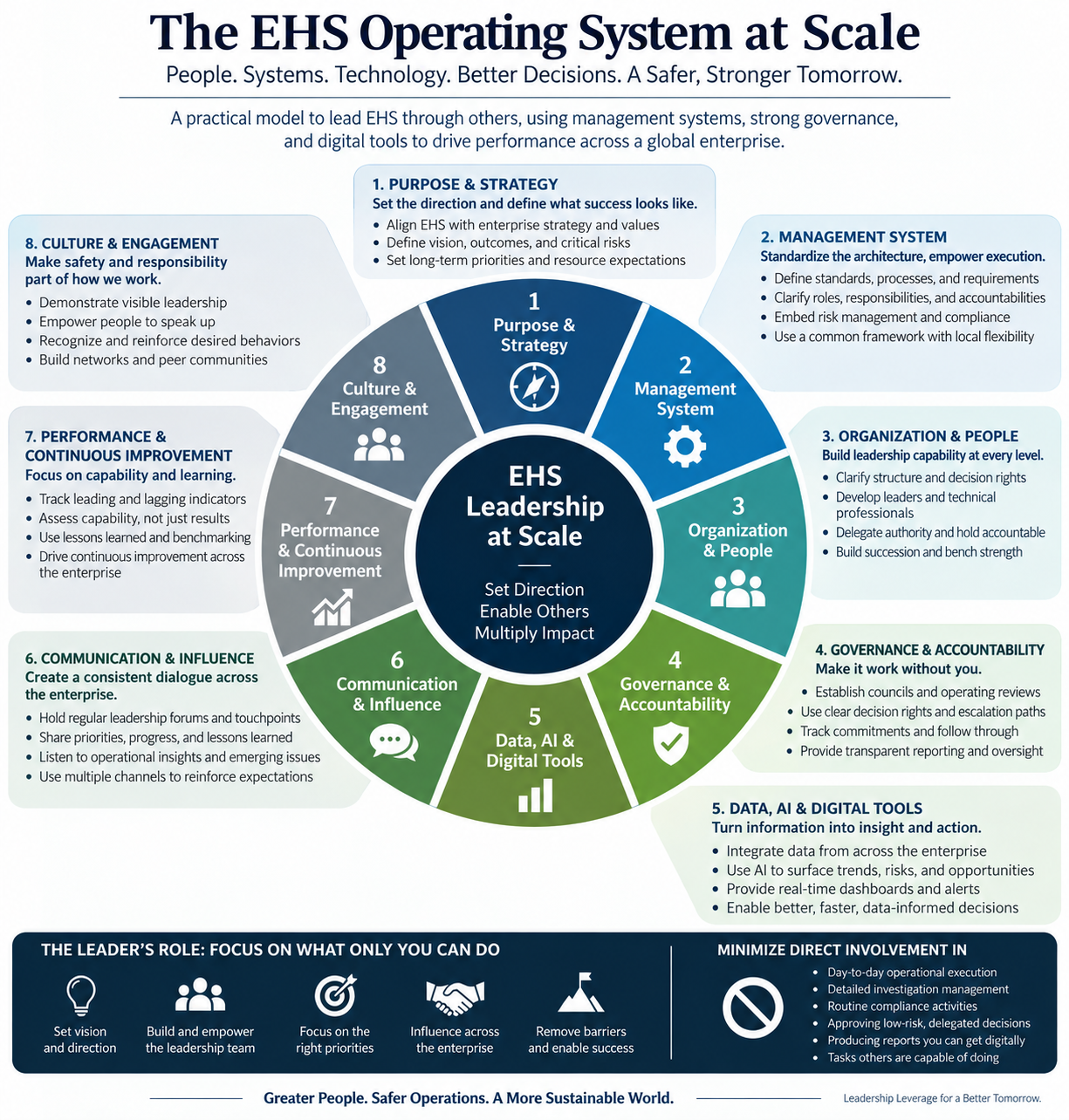
To make the framework practical, I developed an EHS at Scale Operating System Assessment Tool that translates the nine elements into a detailed leadership checklist. The tool allows leaders to evaluate how effectively their organization is executing each element, identify gaps, assign ownership and actions, and generate an overall maturity score. It also includes an Executive Work Organizer that challenges leaders to examine what they should personally own versus delegate, automate, simplify, or stop, along with a leadership cadence for governance, communication, talent development, and performance review. The intent is not simply to score an EHS organization, but to create a structured way for leaders to ask a more important question: Are we building a system that can perform at scale without depending on constant senior-leader intervention?
You can download the EHS at Scale Operating System Assessment Tool at this link. Try it out and let me know how well is helps you scale your influence.
The objective is not to create another layer of bureaucracy. It is to create clarity around what must be standardized, what should be delegated, how information moves, where decisions are made, what gets escalated, and where senior leadership attention creates the greatest value.
At scale, the management system becomes one of the leader’s most important forms of leverage. Critical-risk requirements, management of change, assurance, investigations, corrective actions, performance measures, and other core processes should not depend on whether the senior leader is personally paying attention to them that week. The system creates repeatability.
That does not mean identical execution everywhere. Different businesses, operations, cultures, and regulatory environments require room for adaptation. My preference is to standardize the architecture while empowering execution. Define the critical requirements, decision rights, controls, data definitions, and accountability, then allow capable leaders closest to the work to execute within those boundaries.
Developing Leaders and Distributing Decisions
This was perhaps my most important lesson from ATI. As the organization grew, people closest to the work needed the judgment, skills, confidence, and authority to lead without waiting for senior management to provide every answer.
One of our most effective mechanisms was surprisingly simple: the weekly operations meeting. My direct reports participated, but we also used the meeting as a development opportunity for their designated alternates. It became far more than a performance review.
For me, it provided organizational intelligence. I could hear what was happening from leaders closest to the work, recognize patterns, and identify emerging workforce or customer issues. For my direct reports, it became a peer-learning forum where a solution developed in one part of the organization could quickly become useful somewhere else. For the alternates, it provided leadership development in real time. Future leaders gained exposure to broader business issues and observed how decisions were made before assuming larger responsibilities.
The meeting also became a two-way communication conduit. Information traveled upward from operations, expectations moved back into the workforce, and knowledge traveled horizontally among leaders. One management mechanism supported performance, communication, learning, succession, culture, and leadership development. That is leadership leverage.
A scalable organization also cannot depend on the senior leader personally following every initiative. Clear ownership, operating reviews, enterprise councils, escalation thresholds, executive sponsorship, transparent measures, and disciplined follow-through allow accountability to operate without constant intervention.
This creates a useful test of organizational maturity: how many good decisions can the organization make without requiring senior executive involvement?
If routine decisions continually migrate upward, the organization may have hierarchy, but it has not achieved scale. This idea also has a strong foundation in research on high-reliability organizations. Weick and Sutcliffe describe deference to expertise as an important characteristic of organizations operating successfully in complex, high-risk environments. Decision-making does not automatically remain with the highest-ranking person. When conditions require it, authority moves toward those with the expertise and operational knowledge needed to understand the situation.
That principle has important implications for enterprise EHS leadership. The executive should become directly involved when an issue requires something only that level can provide, such as enterprise direction, significant resource decisions, executive influence, resolution of systemic barriers, major risk decisions, talent decisions, or governance. Everything else should occur at the lowest appropriate accountable level.
Delegation is not disengagement. The leader remains accountable for the system without personally performing the work of the system.
Technology, AI and Continuous Visibility
Historically, one reason senior leaders became deeply involved in operational detail was simple: that was often how they learned what was happening. Digital systems increasingly remove that constraint.
A well-designed EHS technology architecture can provide continuous visibility into critical controls, serious-risk indicators, overdue high-risk actions, audit findings, incidents, environmental performance, regulatory issues, and management-system effectiveness. Instead of repeatedly asking people to create presentations explaining what happened last month, leaders can increasingly operate from continuous information and exception-based reporting.
AI extends that capability. Properly designed AI systems can identify patterns across incidents, audits, corrective actions, risk assessments, operational data, and lessons learned that would be extremely difficult for an individual leader, or even a team, to recognize manually.
AI can also help distribute institutional knowledge. Experienced professionals accumulate decades of expertise in investigations, regulations, critical controls, human performance, process safety, and environmental management. Historically, transferring that expertise depended largely on procedures, training, mentoring, or direct consultation. AI can make portions of that knowledge available much closer to the moment someone needs it.
That creates another form of leadership leverage: the scarce expertise of a few becomes more accessible to many.
There is an important boundary, however. Scaling judgment is not the same as outsourcing accountability. AI can surface information, test reasoning, identify patterns, and expand analytical capacity. Qualified people must remain accountable for consequential decisions. The objective should be Humans + AI: machine capability expanding the reach of human expertise while people retain judgment and responsibility.
Lead Through Cadence, Communication and Capability
The operating system also needs rhythm. At ATI, the weekly operations meeting created that rhythm. At enterprise scale, the mechanisms may include weekly leadership forums, monthly operating reviews, critical-risk councils, communities of practice, quarterly executive reviews, talent and succession reviews, and board reporting.
The exact cadence matters less than its purpose. Each forum should exist for a reason: decision, escalation, learning, accountability, talent development, or information exchange. If a meeting exists only to move information that a dashboard could provide, it should probably be redesigned.
The leader’s interactions with direct reports should be frequent enough to maintain alignment and influence without creating dependence. Those conversations should increasingly focus on priorities, emerging risks, barriers, talent, cross-enterprise learning, and decisions, not detailed supervision of work that has already been delegated. In that sense, leadership communication itself becomes part of the operating system.
Traditional EHS measures remain useful, but most tell us what has already happened. TRIR, DART rates, spills, regulatory events, and lost-time cases provide important information. They do not necessarily tell us whether the organization is becoming more capable of preventing tomorrow’s event.
An operating system for EHS at scale therefore needs measures of capability and resilience, including critical-control reliability, leadership engagement, learning effectiveness, corrective-action quality, management-system performance, risk reduction, digital adoption, and other indicators that reveal whether the underlying system is strengthening.
The question shifts from “What were our results?” to “Are we building an organization increasingly capable of producing the results we want?” That is a much more powerful management question.
Focus on What Only You Can Do
Perhaps the most difficult element of leadership at scale is deciding what not to do.
Successful professionals are often promoted because they are good at solving problems. Knowing the details, making decisions, and personally driving work helped make them successful. At enterprise scale, those same behaviors can become constraints.
A senior EHS leader should periodically examine their calendar and ask what they are doing that someone else should own, and what can be delegated, automated, simplified, or stopped. Routine investigation details, low-risk approvals, manually assembling reports, chasing site corrective actions, and attending meetings that function perfectly well without the executive are usually poor uses of senior leadership capacity.
That time should migrate toward activities where executive leverage is greatest: enterprise strategy, critical risks, leadership development, executive and board influence, organizational capability, governance, major transformation, and removing barriers others cannot remove.
This may be the most important test of whether the operating system is actually working: can the leader step away without routine execution slowing down? If not, the organization may still be scaling the leader’s effort rather than scaling the leader’s impact.
Building an Adaptive Learning Organization
The final multiplier is learning.
Incidents, near misses, audits, operational experience, successful practices, and weak signals should not remain isolated within the locations where they occurred. Information needs to move across the enterprise, become organizational knowledge, and ultimately change decisions.
Again, I can trace this idea back to our ATI operations meeting. Information came upward, moved horizontally among leaders, and traveled back into the organization. Today, digital systems and AI allow us to imagine that same learning loop operating continuously across a global enterprise.
An incident at one facility should not simply become a report stored in a database. It can become part of an organizational knowledge system capable of connecting the event with previous experience, identifying similar exposures elsewhere, recognizing emerging patterns, and delivering relevant insight to people confronting similar circumstances.
The technology has changed dramatically. The principle has not. Information only creates value when it moves, becomes knowledge, and ultimately influences decisions.
The Leadership Paradox
There is a paradox at the center of scaling professional impact: as your responsibility becomes larger, your personal involvement in individual activities often has to become smaller.
That can be uncomfortable. I experienced it as ATI Worksite Solutions grew. An operating style that worked with 15 people could not possibly work with 300. The answer was not to work 20 times harder. It was to create leverage through people, systems, governance, communication, technology, and organizational learning.
Today, AI gives us another potentially powerful multiplier. But none of these mechanisms removes the need for leadership. They change where leadership is applied.
The enterprise leader becomes less valuable as the person who personally knows every detail and more valuable as the architect of the system that ensures the right people know the right details, make the right decisions, escalate the right issues, and continuously improve the organization.
Early in our careers, the equation is largely additive: my expertise plus my effort equals my contribution. Leadership changes the equation. Your knowledge develops other leaders. Those leaders influence hundreds or thousands of employees. Management systems shape actions you will never personally see. Governance distributes accountability. Communication networks move knowledge. Digital tools create visibility. AI expands access to expertise. Organizational learning improves future decisions.
That is the Leadership Multiplier.
The job is not to make thousands of good decisions. The job is to build an organization capable of making thousands of good decisions every day.
References and Further Reading
Weick, K. E., & Sutcliffe, K. M. (2015). Managing the unexpected: Sustained performance in a complex world (3rd ed.). Jossey-Bass. https://doi.org/10.1002/9781119175834
Christianson, M. K., Sutcliffe, K. M., Miller, M. A., & Iwashyna, T. J. (2011). Becoming a high reliability organization. Critical Care, 15(6), 314. https://doi.org/10.1186/cc10360
Kouzes, J. M., & Posner, B. Z. (2023). The leadership challenge: How to make extraordinary things happen in organizations (7th ed.). Jossey-Bass.
Pertusa-Ortega, E. M., & Molina-Azorín, J. F. (2018). A joint analysis of determinants and performance consequences of ambidexterity. BRQ Business Research Quarterly, 21(2), 84–98. https://doi.org/10.1016/j.brq.2018.03.001
Sadowski, J. P., & Howard, J. (2026, January 18). Practical strategies to manage AI hazards in the workplace. National Institute for Occupational Safety and Health.


