Safety 2016 – Speakers, Students, and Vendors Create a Vibrant Atmosphere

Safety 2016 Day 2

Incoming ASSE President Tom Cecich (right) takes the reigns at Safety 2016.

I was asked to contribute daily as a guest blogger by ASSE for Safety 2016.  This post was my last but due to some IT glitches it was not posted to the ASSE website.  I think the learnings from the expo were meaningful though, so I am posting it here.  See my other posts from Safety 2016: House of Delegates Meeting (Sunday),  Conference Opening Day

Day 2 of Safety 2016 started off with an exciting opening session.  We witnessed the change of the President, recognized the regions for their work in the Safety Matters Campaign, and watched the awarding of student scholarships.  Seeing the students come on stage and receive the scholarship money is certainly a feel good moment for all of us.  They represent the future of our profession and the ASSE Foundation is our commitment to a bright future.  See my post on Engaging the Next Generation of OSH Leaders on LinkedIn for more of my perspective on this topic.

The Expo was full of energy!  The vendors bring an air of excitement and discovery.  As you walk the many isles of the Expo, you can’t help but feel that new answers and solutions are literally right around the corner.  For the first time last year, and again this year, I was also an exhibitor.  My ATI Worksite Solutions colleague Julie Nelson and I had a lot of fun talking with Expo goers.  I really enjoy just striking up a conversation with my fellow OSH Professionals as they stroll by and share experiences and ideas.  We, like most other vendors, are there because we truly believe we have exciting and innovative solutions for OSH issues .  This year we had a vendor new to the OSH industry beside us. He is fine a young man who believes in his product and is working hard to be successful.   It was fascinating to watch him take in all that OSH is.  He commented on how collaborative and friendly we are as a profession and how interesting our work is.  It gave me pause yesterday after the expo closed, we completed our work of taking down our booths and were enjoying a quiet moment after the storm of exhibiting, when he said to me: “I really like this industry and I think I might want to become a Safety Professional”.  That, my fellow OSH Professionals, is the golden moment when you realize what an impact our way of doing things has on the world around us.  Thank you for showing him who we are.

Last area I want to comment on is the educational sessions.  That’s the other reason why we attend!  I caught some great ones.  It’s very important that you give your honest feedback on each session.  This is done through the Safety 2016 app or in the link in the email you should receive each night.   That information is used by the ASSE Conference committee to determine trends of interest, vet speaker applications for the next year, and by the speakers to improve their presentation skills.  Your feedback is critical to the quality of the conference.

I enjoyed the last day of conference also, participating in it as an OSH Professional simply there to learn.  Like the young vendor I mentioned above, I continue to be in awe of our OSH world.  I remember being a student attending these events and looking at the seasoned pros, pining for they day I could include myself in their ranks.  I never want to lose that sense of appreciation for the job we do and the results it brings to our lives and those for whom we labor to protect.

As OSH Professionals actively practicing in the field, it’s hard to get away from our daily work but, time must be taken to learn to be even better at what we do!  I hope to see you at Safety 2017 in Denver.

Posted in Uncategorized | Leave a comment

The Ace of Aces

I enjoy rEddie-Rickenbacker-Enduring-Courageeading about people who have accomplished remarkable things.  The biographies of their lives are very interesting to me.  What were their childhoods like?  How did the events come together that led to their success.  What struggles did they overcome and how.  The answers to these questions typically reveal interesting features of their character, strategies and good fortune

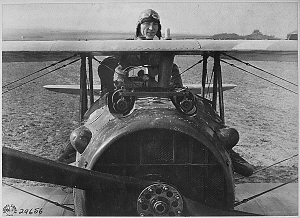
I just finished reading about the life and experiences of Eddie Rickenbacker, the WWI fighter pilot nicknamed The Ace of Aces.  It’s a great read, especially if you are into aviation or stories of American heros.  Eddie was from Ohio, raced in the very first Indianapolis 500, commanded 94th Squadron and later owned the Indianapolis Motor Speedway.  Eddie operated his own car company.  He did not fight in WWII but was quite active in the administration of the air war in both theaters.  Obviously his experiences included many of the topics that I find engaging.  The Book was: Eddie Rickenbacker,  An American Hero in the Twentieth Century, by W. David Lewis.

It is Eddie’s leadership experiences and methods that I want to comment on in this post.  He took over leadership of the 94th “Hat-in-Ring” squadron.  When Eddie assumed command of the squadron it was performing poorly.  It was recognized by some U.S. Army Air Corps Leaders that Rickenbacker had the right mixture of leadership and technical qualities to change the squadron’s performance.  They were right.  Under his leadership the unit racked up an impressive record in the war and he became the ace of aces with 26 victories.  That record stood until WWII.  Rickenbacker was awarded the Congressional Medal of Honor in 1930 for scoring 7 victories in one day in 1918.

But what were these characteristics of Eddie’s  that allowed such success?  I have briefly summarized my view of them below.  I could have written a post on each of them but in an effort to keep this short, I’ll leave it at a summary sentence.  Read the book if you want more!

The Eddie’s leadership characteristics were:

  • Technical Competence – He was a skilled pilot and mechanic forged by self education and years of work in the field.
  • Maturity – Patience to plan activities and carefully assess risk.
  • Team Building – The ability to not only engage the pilots but also bring the ground crews into the team.
  • Hands on Leadership – He shared the work of his team and demonstrated the ability to accomplish the mission.
  • Tremendous Work Ethic – He was known for doing whatever it took to get the job done.

These leadership traits also helped him to become the highly successful Chief Executive Officer of Eastern Airlines during the formative years of the commercial aviation industry in the United States.  He took the airline from an unstable start up to the most dominant and profitable operation in the industry for many years.  In the process he led the advance of the industry into the international service and jet eras.

Rickenbacker was not perfect.  He had a temper, was outspoken to a fault and became egotistical later in life.  But the mixture of these traits created a one of a kind American hero.  The man left a mark that is still visible today in politics and aviation.

The author ends his book with one of my favorite quotes from another great leader I admire: T.R. Roosevelt.  The quote sums up the life and accomplishments of Eddie Rickenbacker.  The quote is:

“It is not the critic who counts; not the man who points out how the strong man stumbles, or where the doer of deeds could have done them better. The credit belongs to the man who is actually in the arena, whose face is marred by dust and sweat and blood; who strives valiantly; who errs, who comes short again and again, because there is no effort without error and shortcoming; but who does actually strive to do the deeds; who knows great enthusiasms, the great devotions; who spends himself in a worthy cause; who at the best knows in the end the triumph of high achievement, and who at the worst, if he fails, at least fails while daring greatly, so that his place shall never be with those cold and timid souls who neither know victory nor defeat.”


Posted in Career Skills, Leadership | Tagged , , , , | Leave a comment

1000 Tweets Later…

Chets TwitterThis blog post will generate my 1001st tweet.  It seems to me that 1000 tweets is a milestone.  I’ll celebrate it here.  I estimate that each tweet averages about 45 seconds to write.  When you do the math, it turns out that I have spent about half of day (12 hours) of my life generating these short messages.  So the obvious question: to what end?

I have made many new acquaintances, learned a myriad of new things and immersed myself in the current ways of modern culture from these concise quips.  Learning to convey complex thoughts in 140 characters or less has taught me the skill of brevity.  The iOS version of the Twitter App includes a pretty handy analytics feature that shows you what subjects your followers find most interesting. Honestly though, I mostly tweet what I find interesting.

One of the people I have met on Twitter is Pamela Walaski.  She is an EHS Consultant and active member of the ASSE.  She has been active on Twitter since 2008.  I enjoy reading her Tweets.  Pam has done some formal work on studying the value of social media in general, and Twitter in particular, during crisis situations.  The work culminated in the publication of a comprehensive article in the  journal Professional Safety titled:  Social Media: Powerful Tools for SH&E Professionals.  It’s a great article that it well worth your time to read.

What I love most is the river of ideas that flows each hour through the medium.  I focus on EHS, Leadership, Aviation and Industrial topics.  Those I follow post frequently on these subjects.  Literally every day I see something that deepens my understanding of these topics.  I have also noticed that news breaks first on Twitter.  Many times it is a tweet from the scene of the news written in real time.

Finally, as I approach the Back Nine of my career, I recognize the need to stay current with the new ideas and methods.  This is especially true in the area of Technology.  Twitter is a good tool for spotting emerging trends as well.  It also allows me to identify emerging issues that my existing knowledge base can be applied to.

I’ll sum up by saying that I see value in the effort that went into my thousand tweets.  I have enjoyed the conversations it has generated with people from literally all over the world.  I am well informed on the current happenings in the topics of interest to me.  My involvement in the medium enhances my feeling of involvement in the communities I am interested in.

This tweet starts my journey to the next thousand.


Additional resource:  25 Ways To Get The Most Out Of Twitter

Posted in Innovation, Uncategorized | Tagged , , | Leave a comment

The Beauty of the New Year

Fresh Start (2)The sun rises on a new year.  I can see fifty years old from here…  I have learned many things in my life, some from the career within it.  Time stands still for no one. Meaningful to me here is General George S. Patton’s belief that you are either taking ground or losing it.

Reinvention is a skill I learned early thanks to the ever changing landscape of American Industry.  It is New Years Day that gives us all the chance to invent a new story for ourselves.  The day symbolizes a fresh start with unlimited potential.  I find this time of year to be very important in maintaining my confidence and drive to keep moving onward and upward.  As I sit here today (New Years Day), I am thinking of what I want to be next.

2014 was a year of massive change for my family and I.  There were some pretty dark nights but we made it work out well in the end.  As I reflect on the past 12 months, it does not escape me that I am at the halfway point of my career.  I am proud of what I have done, but I know I have more to do.  I need this time of year to identify what new horizons I will set out for, putting tangible form to the possibilities before me.

I look forward to 2015 as a clean sheet of paper on which I can write one of the greatest periods in my life.  My years of martial arts study have taught me the value of balance. Success is defined by more that monetary rewards.  I was recently reminded of the importance of family, true friends and coworkers.  As I contemplate the “grand plan” for 2015, it will surely include the people that matter to me.

I am not going to bore you with my list of goals.  These are mine to know and achieve.  I wrote this today to remind us both that fresh starts are to be cherished while we still have them.  Let’s both you and I  commit to making the most of this one.

Welcome to 2015.  What story will you invent for yourself this year?

Chet


Posted in Career Skills, Leadership, Uncategorized | Tagged , | 2 Comments

Guest Blogger: A Word to Millennials…From A Millennial

A guest post by Scott Unruh

millennials-300x167In the EHS profession and manufacturing industries in general, we are starting to see an influx of Millennials entering the workforce. These “Young Pups” (still a nickname of mine today), are joining the ranks of career veterans and are trying desperately to prove why they should be the next CEO. Now that I’ve got some experience under my belt, I can look back on how I got to where I am, and laugh at how I made the same mistake that so many young professionals make: I followed the rules by the book.

Four short years ago, I was that strong, smart, savvy, high-potential intern who had been given the opportunity to break into a big company. I had just gotten a job as a Safety Analyst – and in my opinion – made mind-numbingly awesome metrics reports that I was getting a great reputation for! Life was going great! I had already presented to 100 of the top management in the company and I was going up, up, up! I was even proving my worth to the work force who was on average 30 years older than me. Nothing was going to stop me and I could do no wrong…that is until I stumbled upon the opportunity to be humbled…permanently.

Hungry for success and ready to prove myself, I was constructing some metrics reports one day. They included charts of incidents, near misses, and incompliances reported in audits After compiling the charts I came to the stark realization that one manager far-and-away was having the most issues and was the biggest offender in the bunch…my dad, who also worked for the company. Yikes…

So I went to speak with my dad about it and tell him that I was going to have to put these metrics out there for everyone to see, and that he may be get in trouble. But those were the rules. I had to make people comply with the safety guidelines. I had to blow the whistle and make an example when things weren’t right. I had to prove that I belonged at the top and could report the tough facts.

After showing my dad the metrics and neglecting to ask his take on it, he just grinned and said, “Do what you have to do son.”

When it came time for dad to “pay the piper” for letting his team have so many non-compliances, we happened to be in the same room with his boss and multiple managers…and I had to report the metrics. Talk about uncomfortable! But I had to make sure people were following the rules so it was the right thing to do!

After I reported the metrics to all the managers in the room and basically threw my dad under the bus, he responded, “I’m glad you pointed that out Scott.” The knot in my chest immediately tightened and my pupils grew to the size of coconuts…this can’t be good! He continued, “I didn’t realize my folks were doing so well. They always are adamant about reporting when things don’t go right, but seeing how well they are reporting is great!”

He had just turned the entire interpretation of the metrics around, rightfully – I just hadn’t seen it that way when I put the metrics together. His boss gave him a pat on the back and he became the hero of the meeting; the hero that I had just thrown under the bus. I proceeded to insert my size 13 dress shoe into my mouth and hopped out of that meeting with my tail between my legs, defeated.

However, in this defeat and throughout my career, I have learned some very valuable lessons that I will carry for the rest of my life:

  1. You weren’t hired to be liked – but wow does it make a difference when you are! Being likable AND knowledgeable has been the bread and butter for my success. Don’t be a Compliance Cop, be human!
  2. The reason for telling someone “No” is never, “Because that’s the rules.” I cannot even count how many times I said that in my early career and was shown just how wrong I was.
  3. Don’t be too quick to judge, because a shoe is a lot harder to pull out of your mouth than it is to put it in.
  4. ASK QUESTIONS!!!!! Do not just assume you know what’s going on.
  5. The rules are guidelines with multiple interpretations. Don’t assume your interpretation is the only good one.
  6. Listen twice as much as you speak and take EVERY opportunity to learn and help people. You will be rewarded handsomely in your career.
  7. Old dogs have plenty of tricks, stay on your toes or you will learn them quickly.


About Scott Unruh

Scott UI am a professional intrigued by advances in technology and the dynamic changes that occur in the economy and the world. Currently pursuing my MBA, I aspire to be a leader in my career and in life. I am fueled by interacting with people and influence those around me.  You can reach me at:  www.linkedin.com/pub/scott-unruh/38/4a


Guest Bloggers on LeadingEHS.com

From time to time I find other professionals whom I believe have something important to say.  I like to offer them a forum to make their point and hopefully spark some healthy debate.  It also offers my readers some variety of style and opinion.  I don’t have any formal criteria for selecting Guest Bloggers.  The selection is usually made during a scintillating conversation between me and another person that leads me to think: that would be a great blog post!

Posted in Business Accumen, Leadership 101, Uncategorized | Tagged , , | Leave a comment

Using the Digital Hawthorne Effect to Improve Safety at Work

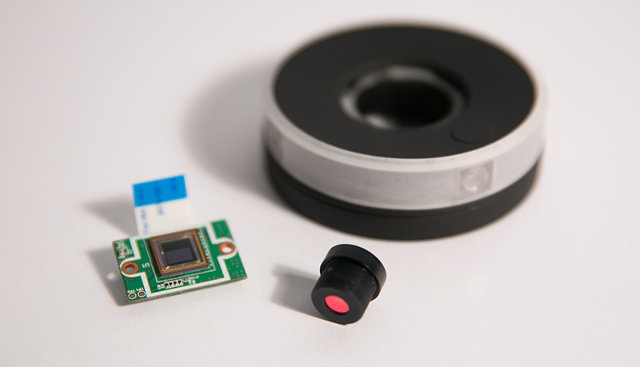
inline-i-centrcamera-lense-and-chipI ran across a Fast Company article discussing a new 360 degree action camera that has been invented by former Apple Engineer Paul Alioshin.  What’s new about is is the ease in which it captures events from all angles.  The device is called the Centr.  It is in the same category as the GoPro camera that has received so much attention lately.

The article got me thinking about uses for this technology in the work place.  I think there is a real opportunity here to permanently change employee behavior to be safer.  By instituting constant digital video monitoring in the workplace that creates a digital record of each individuals actions, the processes involved in the Hawthorne Effect will modify employee behavior.  I think we already have a good example of this:  traffic cameras.  Once the presence of the camera is common knowledge to drivers, their behavior changes.  They know that the technology is ever vigilant and a negative outcome (a ticket with fine) is nearly certain.

We have this same opportunity in the workplace.  The use of digital video via a camera like the Centr by employees will create an ongoing Hawthorne Effect.  I envision it would be built into their headwear or otherwise on their person.  Employees should be fully informed of the video record of their behavior both for personal privacy issues and to create the desired recognition that there is a record of their actions.  Employees who are knowledgeable of the safety and environmental rules will conclude that the records creates a certainty that any deviation from those rules will be in the record and they can be held accountable.  A rational employee will determine the risk of easily documented noncompliance far outweighs the potential gain.  Soon, certain and negative consequences are a powerful behavioral motivator (soon, certain and positive is the most powerful).  That is exactly what digital image technology like Centr can be used to deliver.

So does this create a Big Brother atmosphere?  Yes, it does.  Legal controls will need to be put in place.  The unprecedented level of digital observation in public places in place today is already forcing our country (and others) to develop laws on the topic of privacy outside of private residences.  With such reasonable controls in place, I believe the increased safe behavior created by the use of digital imaging like Centr outweighs the privacy concerns in the work environment.


Posted in Uncategorized | Tagged , , | 1 Comment

International EHS Collaboration: A Discussion with Darryl Hill

Darryl HillI had the opportunity recently to talk with Darryl Hill about his upcoming participation in HSE Excellence Europe, May 20-22, Vienna, Austria. You may know Darryl from his work with the American Society of Safety Engineers (ASSE). His involvement includes a recent tenure as the President of the Society.  Darryl is currently the Executive Director of Global Health & Safety at Johnson Controls, located in Milwaukee, Wisconsin. Johnson Controls (JCI) is a global diversified technology and industrial leader who’s 170,000 employees serve customers in more than 150 countries.

The purpose of my interview with Darryl, and this post, is to share his views as an Executive Leader of EHS on the value of international collaboration. I asked Darryl three questions regarding his participation in the conference.  Below are the questions and Darryl’s responses.

Question 1:  Why did you decide to speak at HSE Excellence Europe?

Darryl’s Response:

I have been involved with this group before in similar conferences in the Middle-East and it was very interesting to get the perspectives of their culture.  I like going [to other countries] to share some of our viewpoints and learn some of theirs.

The learning and sharing of best practices is the main reason.  Before I commit to speak I learn about the theme of the conference and make a determination if I have something to offer.

Question 2:  What do you perceive is the biggest value of working with professionals from other cultures?

 Darryl’s Response:

In the case of Europe I know from some of JCI’s European operations that the professionals there tend to focus more heavily on training and employee behavior and especially on Risk Assessment/Risk Mitigation activities.  I think it is the risk focus that has really driven their improvement.

Another aspect [of the European approach] is the use of Design in of Safety requirements typically included in project specifications and contractor service requirements.  Risk assessment is even included in these agreements.  In the U.S. these activities are hit-or-miss.  I feel like these are the areas where Europe, particularly Western Europe, is ahead of us.  I also see a slow movement towards these concepts in the Middle-East.

It’s always interesting for me to get some of these perspectives and bring some of these thoughts back to the States.

Question 3:  What is the most exciting aspect of your presentation?

Darryl’s Response:

The opportunity to discuss my company’s improvement project to integrate an HSE Maturity Model into the Johnson Controls Manufacturing System.  We have just started the alpha testing but are already seeing some early traction.  I will discuss how we started it, give detail on how it’s integrated with operations and what we are ultimately trying to achieve with this project.

I’ll also discuss the linkage between EHS and Manufacturing Capability and Competitive Advantage.  I’ll build off of the work I did with Kathy Seabrook (ASSE President, 2013-2014) in a 2013 article for Professional Safety: Safety & Sustainability: Understanding the Business Value.

This is what really peaked my interest in this conference.

HSE X EUYou can see by the revealing responses from Darryl, there is a lot to be gained by interacting with our peers around the world.  The diversity of experiences and norms drives innovation for the group as a whole.  Also, because of language barriers, it becomes imperative to distill concepts and strategies down to clear and concise descriptions, driving simplicity, focus and cost reduction in the new ideas.  Finally, organizations that are able to build successful global collaboration capabilities not only gain more knowledge and vision, but have also strengthened their ability to execute projects to exploit this knowledge for increased competitive advantage.

I would like to thank Darryl for sharing his time with me to discuss this topic and to wish him good luck at the HSE Excellence Europe Conference.


Posted in Uncategorized | Leave a comment

Leadership 101: Increase your Influence with Critical Questions

Boss looking over glassesAs a staff member on the organizational chart, many EHS Pros don’t ask critical questions of line staff at decisive moments.  This is a missed opportunity to be influential during key decision making processes. By not constructively challenging the status-quo our agenda becomes secondary to those of other more assertive leaders.  It is critical that we get better at asking critical questions.

Critical questions are an element in the leadership activity of critical thinking.  A concise definition of critical thinking is:

“Reasonable reflective thinking that is focused on deciding what to believe or do”.  -Robert H. Ennis

Logical questions are formulated, asked and answered that lead to an economical increase in the multi-faceted understanding of the issue being discussed.  The technique addresses the fact that all human understanding is from a limited viewpoint and unknowns may have a significant affect on the outcome of the issue.   I ran across the credo below and thought it a good description of the assumptions of critical thinking.

A Critical Thinker’s Credo

    • I admit that I see the world from a highly limited viewpoint.
    • Before I offer an argument, I consider the best case against my argument.
    • I take stands.
    • To correct errors (my intent), I must sometimes make them.
    • I justify an argument by whether it meets certain explicit reasonable standards.
    • I distinguish the quality of an argument from both the worth of the person giving the argument and from the merit of the conclusion. 

Source: Indiana University Southeast: critical_thinking_handout_fall_ 02.pdf

There are several steps to using the critical questioning technique effectively.  These are:

Be a good listener.  You have to understand what is being discussed first.  Avoid jumping to conclusions after hearing the first words out of the other person’s mouth. Practice active listening which involves the listener re-stating the speakers key points to confirm to both that the message was understood.

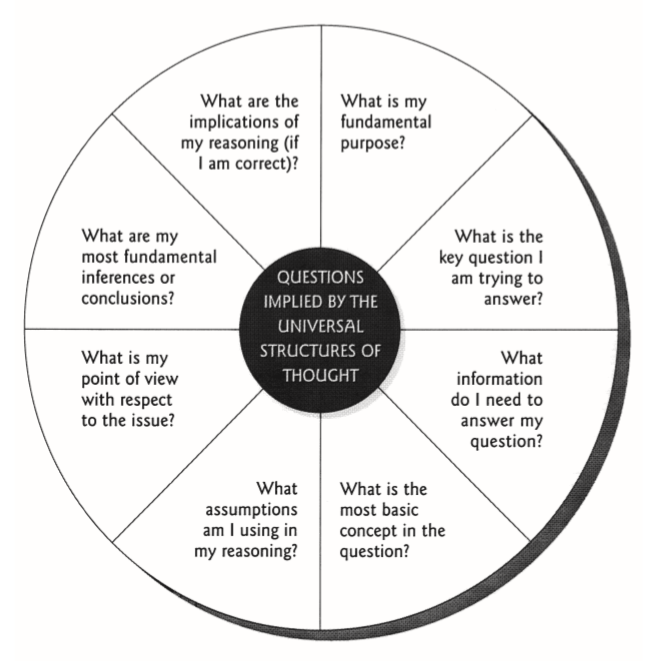
Formulate concise open-ended questions that yield contrasting perspectives on the issue.  Your goal is the develop an adequate understanding of the issues and concepts the speaker is describing.  formulate brief questions on specific points that elicit focuses responses.  You are striving for a back and fourth discussion where knowledge is obtained in packets that your thought process can quick analyze and apply.  The chart below shows that a few general lines of thought can be used to tailor questions to specific elements of the discussion.  Keep a quiet mind while the other person is speaking; focus on their message not your inner dialogue.  Pauses in conversation while you think about what has been said is okay.

Analytic Questions Derived from the Elements of Thought. Source: The Miniature Guide to the Art of Asking Essential Questions.


Thoughtfully consider the answer and ask a follow up questions until you feel you thoroughly understand the issue and feel reasonably confident you can predict the consequences.  Keep in mind the saying that “perfection is the enemy of completion”. You will have to make a judgement call with less than full information most of the time. In business time is money so sparingly ask meaningful questions that further your complete understanding of the issue.

For an interesting discussion on the principles of critical questions, see The Miniature Guide to the Art of Asking Essential Questions, by Elder and Paul.

Early in my career I noticed that the senior leaders in the company I worked for had the knack of asking the right question at the right time.  They had the uncanny ability to cut to the heart of the issue at hand and ask the questions that mattered most in making the right decision.  It frequently derailed me because I was not ready to answer that penetrating question on the fly.  Now that I have years under my belt I understand how they were able to do this; It is experience in making decisions.  They have learned through trial and error where the likely pitfalls are and want to understand the risk around those traps.  They are also gauging the subordinate’s understanding of the situation and confidence in the answer.

To be consistently successful in front of senior leaders, think through these types of questions and rehearse the answers.  It will give you confidence and credibility, both traits the leader needs to see to place his/her faith in your capabilities.


About Leadership 101

In posts with this phrase in the title, I am documenting key skills that experience has taught me are necessary to succeed. These are the principles of leading organizations to EHS success. They are, in most cases, applicable to the other functions of the organization as well. Early to mid-career professionals will increase their level of success by developing the skills and techniques identified in Leadership 101.  For us old dogs, these are reminders of the skills that got us here…

Posted in Business Accumen, Leadership, Leadership 101, Serial Post | Leave a comment

What Does the EU Have for You?

7th HSE ExcelAre you looking for some new perspectives on HSE processes and systems?  With those new perspectives come new ideas as well. Something to differentiate you and your organization from the pack.  Innovation is more than just a way to pad your performance review though. It’s a requirement of our modern world.  I have touched on disruptive innovation several times in posts on this blog. The reason is that I am watching these disruptions redefine industry after industry.  Just ask UPS if they are concerned about Amazon experimenting with various schemes to deliver it’s products. Our trade is plied in these same industries. We too must accept the need to radically innovate in our systems and methods to support the same efforts our organisations are undergoing at the enterprise level.  Competition is fierce and little tweaks can be the difference maker.

But where might you find these departures from the tried an true?  There are proven methods to find innovative ideas and bring them to your industry. One of the best methods is to benchmark HSE Professionals in other countries.  Differences in regulations, cultural norms, and engineering application methods can create vastly divergent approaches to HSE success.  Through a friend and fellow HSE Professional, I recently made contact with a European organization that specializes in conducting professional development events for technical specialties like ours.

The event is The 8th Annual HSE Excellence Europe, May 20-22, in Vienna, Austria.  I asked to see the agenda and was immediately taken by the quality of the speakers and the freshness of many of the topics.  These are high-level HSE Professionals, from industry leading organizations, who are sharing the ideas and methods that they have used to be successful.  HSE gold my friends!  Three of the subjects particularly caught my eye as likely sources of innovation.  These are:

  • A Strategic and Practical Approach to Managing HSE Risks, by Alastair Davey, Global Health and Safety Director, Sodexo.
  • The Five Keys to Achieving Total Wellbeing, Cesar Gamio, Chopra Center for Wellbeing.
  • Safety Leadership: From the Boardroom to the Frontline, Representatives from an Australian Mining Company

Follow the link above to get more detail on the contents of these presentations and to register for the event.  All together there are 3 days of exciting presentations from HSE Leaders who are in the trenches driving continuous improvement for their organisations or in the public arena.

I am pleased to see two of the United States’ distinguished professionals on the list of speakers for this event.   Darryl Hill, Global Director of Health & Safety, Johnson Controls and Neil Tonge, Global Director of EHS & Sustainability, Molsen Coors Brewing Company are representing our best efforts in North America.  I am going to ask both of them for some comments on their presentations and the event for a blog post to be made in the next week or two.

My work as an executive in global businesses has allowed me to see firsthand the value of learning and collaborating with leaders from other cultures.  Some of our best ideas were a blend of what works in each region.  It is truly inspiring to develop a close working relationship with a leader from another land, and to find the common ground all HSE Professionals have around protecting people, planet and profit.  HSE Excellence Europe is a great chance for you to experience that same sense of collaborative innovation for yourself and your organization.

Posted in Benchmarking, Innovation, Leadership | Leave a comment

Is EHS Verging on Disruption?

Disruption light bulbIf you’re in EHS Cop mode your job is about to be disrupted!  A convergence of technologies is occurring that will have a profound impact on the future of our workplaces as EHS professionals and employees.  Today I want to focus on several trends: cloud based Safety Management Software, Learning Management Systems, Optical Object Tracking Systems and Wearable Sensors.  I’ll give some detail on each below but the most important point I am making is that these technologies, and likely others to follow, are going to change our profession.  You had better be ready for it!  Of critical importance to us as practitioners is understanding how to take advantage of the new capabilities and how we add value after they enter the workplace.

These technology tools will shortly be combined and utilized by organizations to obtain further efficiencies regarding time and labor (cost).  Each of these tools will automate aspects of our current work tasks.  Reporting, Inspecting/Observing and Training will be accomplished by computers.  If these are the majority of the activities you are engaged in, you may be redundant.  A fourth piece of technology pulls all this together into an easy to use interface.  We know the technology as Siri, the iPhone app (further explanation below).  Your boss will soon be asking his iPad how many recordables his plant has last year.

Same old story right?  Technology makes another type of job obsolete…  Not quite.  EHS, at it’s core, is about the human condition.  The biggest impact on the human condition is, well, humans!  Only a human can have a truly meaningful and maximally influential impact on another human.  One of the sources from which I have been finding new directions about leading people is from management leadership thought leader Harold Jarche.  In a recent blog post titled Some Useful Models, Mr. Jarche made the following thought provoking statement:

Command and control will be replaced by influence and respect, in order to retain creative talent.

A computer, or any other piece of technology, cannot Lead people.  Leading is the ability to articulate a vision,  enable people to engage in it and create the desire in them to take action to see the vision become reality.   In the recently published HBR post Why Good Managers Are So Rare, by Randall Beck and James Harter, the talents of a great Manager are identified.  I believe a great manager is a great leader.  The traits of such an impactful person are:

  • Motivation of employees to take action and engage them with a compelling mission and vision.
  • Assertiveness to drive outcomes even with resistance.
  • Accountability, for themselves and members of the group.
  • Relationships that create trust, open dialogue, and full transparency.
  • Making decisions that are based on productivity, not politics.

Note that machines are not capable of displaying the first 4 of these talents.  Even their ability to make decisions requires a simple situation with predefined outcomes.  It is our ability to connect with each other that has the most power to influence the human condition.  Leaders find ways to engage those they lead in order to create an environment were all can participate.  This inclusion drives motivation perform actions that achieve the group’s shared goals.

In the final analysis, the coming convergence of technologies will be a boon for our profession and the stakeholders we serve.  It will allow an unprecidented level of focus on solutions that result in significant improvement in people’s lives, environmental protection and business sustainability.  These systems will allow us to spend less time collecting, organizing and turning data into information, and more time accomplishing improvements and motivating people.  To be successful in the work environment equipped with this new technology, we must be in leadership mode.  It’s our ability to connect with, influence and provide vision for people that is the real value of what we do – with or without technology.

Deeper Dive on Technology

Safety Management Software (Decision Support Systems) are interactive software-based systems intended to help decision makers compile useful information from a combination of raw data, documents, and personal knowledge, or business models to identify and solve problems and make decisions.  An example from the EHS function is the VelocityEHS or GenSuite programs for EHS.  These systems act as data collections, warehousing and querying capabilities that allow users to make sense out of the data being produced by the EHS Processes of the organization.  In short, these systems take raw data and provide detailed and specific information needed to make informed decisions.  (4/30/19 update): This industry continues to innovate and grow.  A helpful reference for implementing safety management software is available from NAEM:  The 2017 EHS & Sustainability Software Buyer’s Guide

Learning Management Systems are software applications for the administration, documentation, tracking, reporting and delivery of e-learning education courses or training programs.  They allow personnel in the work environment to take the courses at the time and pace that fits their schedule.  They are fully automated systems that require only the student to present during the instruction.  The current trend is the blending of the DSS and LMS systems, such as the PureSafety example above.

Optical Object Tracking software can track objects in pace and real time and identify and record what actions those objects are performing.  The technology originated in the missile defense industry but was quickly repurposed for tracking player actions in sporting events.  The NBA has become particularly interested in this technology.  The video clip below demonstrates the program in operation for a basketball game.

The software as applied to sports uses layers of software to track the objects, record the their actions, classify the actions and convert the raw data into information.  The information is in the form of statistics.  An Israeli company called SportVu is the developer of this technology.

Wearable Sensors  (Authors Note 4/30/19: this is an update to the original post)  In the last five years sensor technology has become much smaller and powerful.  As of early 2019, the market for wearable sensors used for tracking human movement and bio metrics continues to grow rapidly.  Current products are offered that track such human conditions as body segment position/movement/physical stress, biometrics such as pulse, respiration, sleep quality, and mental states such as stress and cognitive load.  Also in the category of wearables are exoskeletons intended to prevent human injury.  Exoskeleton technology is rapidly advancing today but is still in what I would consider the “beta test” phase.  Ford Motor Company is doing some in-depth evaluation of Exoskeletons.  The segment below from The Verge summarizes it nicely.

Johns Hopkins recently published a nice discussion of the wearables topic related to public health:  5 ways mobile sensors are changing public health.

Siri of the Future: a “Do Engine”.  The effort to create an artificially intelligent electronic personal assistant has been underway for some time.  The software Siri is composed of is already far more powerful that we realize.  Siri like systems will evolve into Do engines.  Do Engines are search engines that are capable of completing tasks in the physical environment.  An example would be you telling future Siri to find the most protective hard hat at the cheapest price and order 10 for deliver to the office in one week.

Technology, Privacy and Ethics (Authors Note 4/30/19: this is an update to the original post)

This is not a new area of concern.  Recent events in 2018 and 2019 have brought the subject of privacy to the forefront of discussion.  Privacy from technologies is of paramount importance to all free societies and their citizens.  I recently came across some work NIOSH did in early 2018 on the subject of ethical use of new technologies in the work environment: Wearable Sensors: An Ethical Framework for Decision-Making.  They are making the case that central considerations in the use of a technology impacting personal privacy should center around the benefit to society and the minimization of harm to individuals.  The case law is still fleshing out he particulars on this subject and will be for years to come (See: ACLU: The Supreme Court’s Groundbreaking Privacy Victory for the Digital Age)  I suggest however that following NIOSH’s thoughts will provide an ethical and responsible path forward.

Re-Primer on Innovative Disruption

A while back I posted on disruptive innovation.  I believe it is important that EHS&S professionals understand what effect market disruption has on the organizations we serve. If you are not familiar with the term take a quick look at my post.

Posted in AI, Artificial Intelligence, Innovation, Leadership, Machine Learning, Technical Skills | Tagged , , , , , , | 2 Comments