
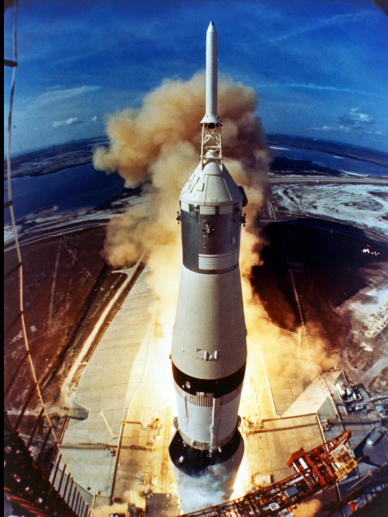
Apollo 11 Launch
I often look to NASA and the Apollo missions for examples of safety methods that were/are successful in the harshest of environments –outer space. The moon landing missions in particular represent risk management, safety engineering and operational control tools that were highly successful. Recently I was reading the authorized biography of Neil Armstrong, Commander of the Apollo 11 Lunar Mission and first human being to step on the surface of the Moon. The title of the book is First Man, by James Hansen. I ran across a description of the written procedures the astronauts and support crews used to ensure the mission was consistently safe and successful. It intrigued me that such a high tech (for the time-1969) venture relied extensively on written rules.
“One tool in particular that has been scorned is written procedures.”
Flash forward to today… Much has been written about new approaches to safety. The recent focus on Human Error, or Safety Differently (also called the New View), from visionaries such as Sidney Dekker and Todd Conklin have revealed fresh tools and techniques to continue the improvement in injury prevention outcomes. I believe these new approaches are vital to the continued vitality and relevancy of the EHS profession far into the 21st century. That said, I also think it is important to understand there are no “magic bullets” in our field. We must continue to build on, and evolve, our successful methods and concepts that have already been proven in the workplace. Our profession is science based and, like all scientific endeavors, it builds a cumulative knowledge base vetted with the experimental method.
One tool in particular that has been scorned in the new view is written procedures. The criticism is that the act of writing EHS concepts and requirements down does not guarantee compliance. I agree that simply having written procedures is not the only action required to prevent injures and accidents. However, written rules are an early step in a complete OSH management process, and they are a critical step. Below is a list of benefits that are produced by written procedures.
Benefits of Written Rules:
- Capture important learnings and assumptions
- Establish a standardized, organized and reproducible, method of conducting work safely
- Ensure effective transfer of knowledge to new members of the group
- Require disciplined thinking to formally document thus reducing errors in processes
- Create a framework for delegation of decision-making
- Demonstrate the organizations commitment to safety
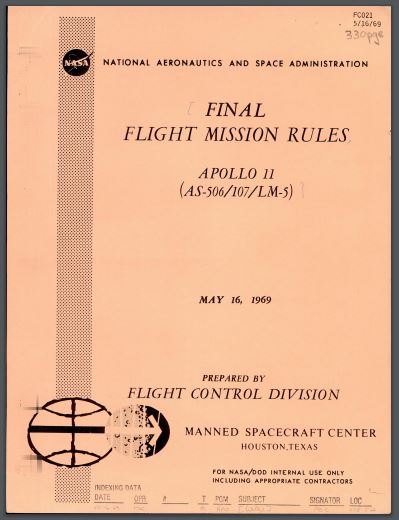 The Apollo 11 Flight Mission Rules book is a great example of a thorough set of written procedures that capture all of the benefits identified above. First conceived for the Mercury program, the mission rules were so successful that every mission after it has it’s own mission rules, with the Apollo program’s being the most sophisticated. Take a moment to peruse the rules at the links. Note they are quite detailed covering a wide range of topics in 330 pages. It is important to understand however that the Mission Commander had the privilege of ignoring or modifying these rules if he felt crew/spacecraft safety would be jeopardized if they were followed in a specific situation. This is a precedent that still exists today in the regulations that aircraft pilots in command are required to operate by. See the discussion below about Sidney Dekker’s comments on the flexible application of rules.
“Safety comes from people being skillful at judging when and how procedures apply.”
One of the innovations in the Apollo 11 Rules I would like to take a moment to understand is the use of Go/No Go procedures. These are particularly useful for complex, high hazard, operations. With these rule an operator must meet a set of predetermined objectively measurable criteria to proceed to the next step of processes operations. I have seen Go/No Go rules used quite successfully in checklist form for combustible dust milling operations (follow this link for more discussion of Go/No Go in dust explosion prevention, Pgs 9 & 15 of the document). As a pilot I pay particular attention to the use of tools to assist operators in maintaining control of complex systems. The checklist is a common and highly effective tool used by pilots in the full range of ground and flight operations. I ran across the Apollo 11 Lunar Modules checklist. It is also very interesting to review. Recall that Neil Armstrong and Buzz Aldrin had to bypass the planned landing target for the lunar lander and use more fuel to locate a suitable area, resulting in a closer call with fuel exhaustion than was comfortable. I am sure the use of the written procedures and the checklists played a role in the successful completion of the phase of the mission that had the most risk based on the flight planning.
In First Man it is discussed that the Mission Rules were constantly undergoing revisions (including write-ins) and additions based on new insights from practice right up to the time of launch. This is one of the keys to the proper use of written procedures. Many of the rules were conceived via discussions among experts and this tested in the simulators that astronauts continuously trained in, ensuring they were the best actions. In his excellent book The Field Guide to Understanding Human Error, which frames the “New View of Human Error“, Sidney Dekker still sees a place for written procedures. He acknowledges the need for a procedural context for work but offers some excellent refinements on how procedures should be used. Two of his suggestions are particularly insightful (p. 157):
- “Safety comes from people being skillful at judging when and how procedures apply.”
- “Safety improvements come from organizations monitoring and understanding the gap between procedures and practice.”
Based on my many years of practice in industrial safety, experience as an instrument rated pilot and blending the best of the “New View”, I offer the following advice on using written procedures as a component of EHS excellence.
Keys to Successful Use of Written Procedures:
- They must be evergreen and continually updated to match evolving practices
- The organization must have the discipline to follow them consistently
- They must be readily available to those expected to follow them
- Continuous effort must be made to detect deviations from the rules and address the contextual reasons for deviation (reference the first bullet above)
- Consistent refreshers must occur for those expected to follow the rules
- Employees must exercise their knowledge of the procedures adequately to remain proficient in their use.
Without all of the above being in place, the rules are simply a paper exercise that has minimal, if any, impact on the safety of the organization. If properly implemented, maintained and utilized however, the organization has a stable operational platform to build even more effective and aspiring execution on. There is no substitute for effective rules and procedures. History has shown us that ignoring this step puts you and your organization in peril.
 In the Fall of each year the Aircraft Owners and Pilots Association (AOPA) publishes a pair of reports on accident trends and safety in aviation. The reports are published though AOPA’s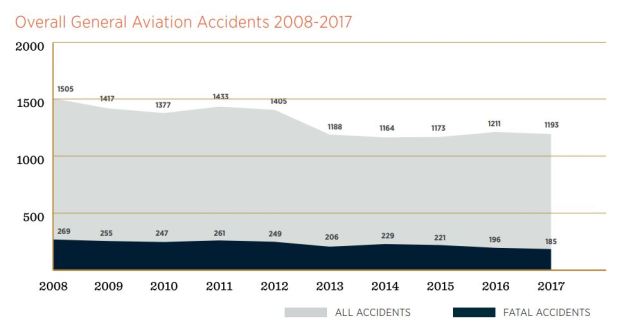

 I have transitioned to new roles 6 times in my nearly 30 year career. For younger professionals, that number will increase. The risk of failure becomes greater with each new organizational level you transition to.
 I was recently asked to provide my thoughts on the future of occupational safety and health. I have been considering this topic for some time and came up with 5 major themes that I think will be of significant impact to our field in the future. Those will be published in an upcoming addition of a popular safety periodical. More to follow on that…
 Uber self driving car accidents and the facebook data scraping scandal are the most recent indications of a significant risk in the technology industry: the lack of mature safety processes. The icons of the “hot industry” of the 21 century have yet to learn how to make safety. They still don’t get that they, like all leaders of human endeavors, are responsible for the safety of the work they do.
 The
The 

 For a behavioral based approach for fall protection safety, a great resource is
 I am an energetic, dedicated Environmental Health and Safety Professional that thrives on being exceptional. I enjoy promoting worker’s safety, developing common sense solutions to environmental compliance, and finding out of the box solutions for meeting complex EHS compliance. I recently attained my Associate Safety Professional certification and I am looking forward to attaining additional EHS certifications.
 For starters, I want to say that this list encompasses 10 career wise EHS certificates that are in demand by a wide range of employers. If you are looking for advancement in your EHS career pathway and you are seeking to be more diverse in choosing your industry, certificates are often a go-to mechanism for HR recruiters. It allows them to distinguish high performance candidates from the competitive crowd so, pursuing one can be beneficial to your career. Certificates also promote an idea that you are an individual that is growing professionally and that you want to be leader in your industry.
 The passing of two of the great aviation masters in the last few weeks started me thinking about what forges great people like them. The Aerospace Icons I am discussing here are
  It has become a basic tenet of Safety Professionals that employee involvement is critical to program success. The safety visionary Frank Bird was a very early proponent of employee involvement as a key to ownership of the safety process. He discusses this very well in his classic book:
  LeadingEHS.com