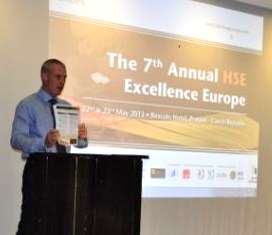
Are you looking for some new perspectives on HSE processes and systems? With those new perspectives come new ideas as well. Something to differentiate you and your organization from the pack. Innovation is more than just a way to pad your performance review though. It’s a requirement of our modern world. I have touched on disruptive innovation several times in posts on this blog. The reason is that I am watching these disruptions redefine industry after industry. Just ask UPS if they are concerned about Amazon experimenting with various schemes to deliver it’s products. Our trade is plied in these same industries. We too must accept the need to radically innovate in our systems and methods to support the same efforts our organisations are undergoing at the enterprise level. Competition is fierce and little tweaks can be the difference maker.
But where might you find these departures from the tried an true? There are proven methods to find innovative ideas and bring them to your industry. One of the best methods is to benchmark HSE Professionals in other countries. Differences in regulations, cultural norms, and engineering application methods can create vastly divergent approaches to HSE success. Through a friend and fellow HSE Professional, I recently made contact with a European organization that specializes in conducting professional development events for technical specialties like ours.
The event is The 8th Annual HSE Excellence Europe, May 20-22, in Vienna, Austria. I asked to see the agenda and was immediately taken by the quality of the speakers and the freshness of many of the topics. These are high-level HSE Professionals, from industry leading organizations, who are sharing the ideas and methods that they have used to be successful. HSE gold my friends! Three of the subjects particularly caught my eye as likely sources of innovation. These are:
A Strategic and Practical Approach to Managing HSE Risks, by Alastair Davey, Global Health and Safety Director, Sodexo.
The Five Keys to Achieving Total Wellbeing, Cesar Gamio, Chopra Center for Wellbeing.
Safety Leadership: From the Boardroom to the Frontline, Representatives from an Australian Mining Company
Follow the link above to get more detail on the contents of these presentations and to register for the event. All together there are 3 days of exciting presentations from HSE Leaders who are in the trenches driving continuous improvement for their organisations or in the public arena.
I am pleased to see two of the United States’ distinguished professionals on the list of speakers for this event. Darryl Hill, Global Director of Health & Safety, Johnson Controls and Neil Tonge, Global Director of EHS & Sustainability, Molsen Coors Brewing Company are representing our best efforts in North America. I am going to ask both of them for some comments on their presentations and the event for a blog post to be made in the next week or two.
My work as an executive in global businesses has allowed me to see firsthand the value of learning and collaborating with leaders from other cultures. Some of our best ideas were a blend of what works in each region. It is truly inspiring to develop a close working relationship with a leader from another land, and to find the common ground all HSE Professionals have around protecting people, planet and profit. HSE Excellence Europe is a great chance for you to experience that same sense of collaborative innovation for yourself and your organization.
If you’re in EHS Cop mode your job is about to be disrupted! A convergence of technologies is occurring that will have a profound impact on the future of our workplaces as EHS professionals and employees. Today I want to focus on several trends: cloud based Safety Management Software, Learning Management Systems, Optical Object Tracking Systems and Wearable Sensors. I’ll give some detail on each below but the most important point I am making is that these technologies, and likely others to follow, are going to change our profession. You had better be ready for it! Of critical importance to us as practitioners is understanding how to take advantage of the new capabilities and how we add value after they enter the workplace.
These technology tools will shortly be combined and utilized by organizations to obtain further efficiencies regarding time and labor (cost). Each of these tools will automate aspects of our current work tasks. Reporting, Inspecting/Observing and Training will be accomplished by computers. If these are the majority of the activities you are engaged in, you may be redundant. A fourth piece of technology pulls all this together into an easy to use interface. We know the technology as Siri, the iPhone app (further explanation below). Your boss will soon be asking his iPad how many recordables his plant has last year.
Same old story right? Technology makes another type of job obsolete… Not quite. EHS, at it’s core, is about the human condition. The biggest impact on the human condition is, well, humans! Only a human can have a truly meaningful and maximally influential impact on another human. One of the sources from which I have been finding new directions about leading people is from management leadership thought leader Harold Jarche. In a recent blog post titled Some Useful Models, Mr. Jarche made the following thought provoking statement:
Command and control will be replaced by influence and respect, in order to retain creative talent.
A computer, or any other piece of technology, cannot Lead people. Leading is the ability to articulate a vision, enable people to engage in it and create the desire in them to take action to see the vision become reality. In the recently published HBR post Why Good Managers Are So Rare, by Randall Beck and James Harter, the talents of a great Manager are identified. I believe a great manager is a great leader. The traits of such an impactful person are:
Motivation of employees to take action and engage them with a compelling mission and vision.
Assertiveness to drive outcomes even with resistance.
Accountability, for themselves and members of the group.
Relationships that create trust, open dialogue, and full transparency.
Making decisions that are based on productivity, not politics.
Note that machines are not capable of displaying the first 4 of these talents. Even their ability to make decisions requires a simple situation with predefined outcomes. It is our ability to connect with each other that has the most power to influence the human condition. Leaders find ways to engage those they lead in order to create an environment were all can participate. This inclusion drives motivation perform actions that achieve the group’s shared goals.
In the final analysis, the coming convergence of technologies will be a boon for our profession and the stakeholders we serve. It will allow an unprecidented level of focus on solutions that result in significant improvement in people’s lives, environmental protection and business sustainability. These systems will allow us to spend less time collecting, organizing and turning data into information, and more time accomplishing improvements and motivating people. To be successful in the work environment equipped with this new technology, we must be in leadership mode. It’s our ability to connect with, influence and provide vision for people that is the real value of what we do – with or without technology.
Deeper Dive on Technology
Safety Management Software (Decision Support Systems) are interactive software-based systems intended to help decision makers compile useful information from a combination of raw data, documents, and personal knowledge, or business models to identify and solve problems and make decisions. An example from the EHS function is the VelocityEHS or GenSuite programs for EHS. These systems act as data collections, warehousing and querying capabilities that allow users to make sense out of the data being produced by the EHS Processes of the organization. In short, these systems take raw data and provide detailed and specific information needed to make informed decisions. (4/30/19 update): This industry continues to innovate and grow. A helpful reference for implementing safety management software is available from NAEM: The 2017 EHS & Sustainability Software Buyer’s Guide
Learning Management Systems are software applications for the administration, documentation, tracking, reporting and delivery of e-learning education courses or training programs. They allow personnel in the work environment to take the courses at the time and pace that fits their schedule. They are fully automated systems that require only the student to present during the instruction. The current trend is the blending of the DSS and LMS systems, such as the PureSafety example above.
Optical Object Tracking software can track objects in pace and real time and identify and record what actions those objects are performing. The technology originated in the missile defense industry but was quickly repurposed for tracking player actions in sporting events. The NBA has become particularly interested in this technology. The video clip below demonstrates the program in operation for a basketball game.
The software as applied to sports uses layers of software to track the objects, record the their actions, classify the actions and convert the raw data into information. The information is in the form of statistics. An Israeli company called SportVu is the developer of this technology.
Wearable Sensors (Authors Note 4/30/19: this is an update to the original post) In the last five years sensor technology has become much smaller and powerful. As of early 2019, the market for wearable sensors used for tracking human movement and bio metrics continues to grow rapidly. Current products are offered that track such human conditions as body segment position/movement/physical stress, biometrics such as pulse, respiration, sleep quality, and mental states such as stress and cognitive load. Also in the category of wearables are exoskeletons intended to prevent human injury. Exoskeleton technology is rapidly advancing today but is still in what I would consider the “beta test” phase. Ford Motor Company is doing some in-depth evaluation of Exoskeletons. The segment below from The Verge summarizes it nicely.
Siri of the Future: a “Do Engine”. The effort to create an artificially intelligent electronic personal assistant has been underway for some time. The software Siri is composed of is already far more powerful that we realize. Siri like systems will evolve into Do engines. Do Engines are search engines that are capable of completing tasks in the physical environment. An example would be you telling future Siri to find the most protective hard hat at the cheapest price and order 10 for deliver to the office in one week.
Technology, Privacy and Ethics (Authors Note 4/30/19: this is an update to the original post)
This is not a new area of concern. Recent events in 2018 and 2019 have brought the subject of privacy to the forefront of discussion. Privacy from technologies is of paramount importance to all free societies and their citizens. I recently came across some work NIOSH did in early 2018 on the subject of ethical use of new technologies in the work environment: Wearable Sensors: An Ethical Framework for Decision-Making. They are making the case that central considerations in the use of a technology impacting personal privacy should center around the benefit to society and the minimization of harm to individuals. The case law is still fleshing out he particulars on this subject and will be for years to come (See: ACLU: The Supreme Court’s Groundbreaking Privacy Victory for the Digital Age) I suggest however that following NIOSH’s thoughts will provide an ethical and responsible path forward.
A professional associate and close friend of mine recently earned the honor of speaking at TEDx Lausanne. His topic was Evolving Fear into Function, which is a pretty provocative subject for a professional whose focus revolves around decreasing risk. My friend’s name is Andrew Sharman and we have had many interesting conversations about the future of our profession. His TEDx Talk has recently been published to YouTube: http://youtu.be/B7-DQFvD5ck. Before continuing with my post, please take a few minutes and watch Andrew’s fine presentation.
So after watching Andrew’s talk I found myself deep in thought about the EHS profession’s reputation around risk. How many times have you heard jokes about the “Safety Guy/Girl” being risk averse? It usually provides a good punchline, and while I am happy to see people enjoy a good laugh, I think it’s a huge misconception. In fact, I think it’s dead wrong! To truly do our job of protecting people, planet and profit, we run towards risk, not away from it. This is the same point Andrew is making in his presentation. Life is not about avoiding risk at all cost but rather it’s about developing the confidence to master the fear of failure. Once free of paralyzing fear, we are enabled to achieve goals previously thought unattainable. The value proposition for EHS Professionals, is our ability to take an inherently risky human endeavor and use our unique skill set to enable success without loss.
So how do we live up to the statements above? We start by stopping to say “No” and begin saying “here’s how we manage the risk to an acceptable level”. We engage employees and leaders in identifying actions that both decrease risk and increase the chance of success. We precisely define the risk problem, partner with our people to solve it, and enable the satisfaction of the operation’s needs. We lead the effort to shift our organization’s culture from blind risk taking to informed decision-making.
In the terms of our profession, we must become energetic advocates and facilitators of Risk Based Decision Making. RBDM is a decision-making process by which you systematically identify hazards, assess the degree of risk, and determine the best course of action to achieve the goal with an acceptable level of risk. The U.S. Department of Energy has come up with a slick acronym for their method of RBDM. They call it SAFER. The steps are:
Summarize the critical steps
Anticipate/discuss errors for each critical step and relevant error precursors.
Foresee probable and worst-case consequences during each critical step.
Evaluate controls or contingencies at each critical step to prevent, catch, and recover from errors and to reduce their consequences.
Review previous experience and lessons learned relevant to the specific task anc critical steps.
I’ll wrap up with a connection to this point from Andrew’s TED Talk: Thinking alone will not overcome fear, but action will. We must passionately lead our organization’s to evolve from fear of EHS actions to the embrace of functional practices that result in maximized organizational success regarding people, planet and profit.
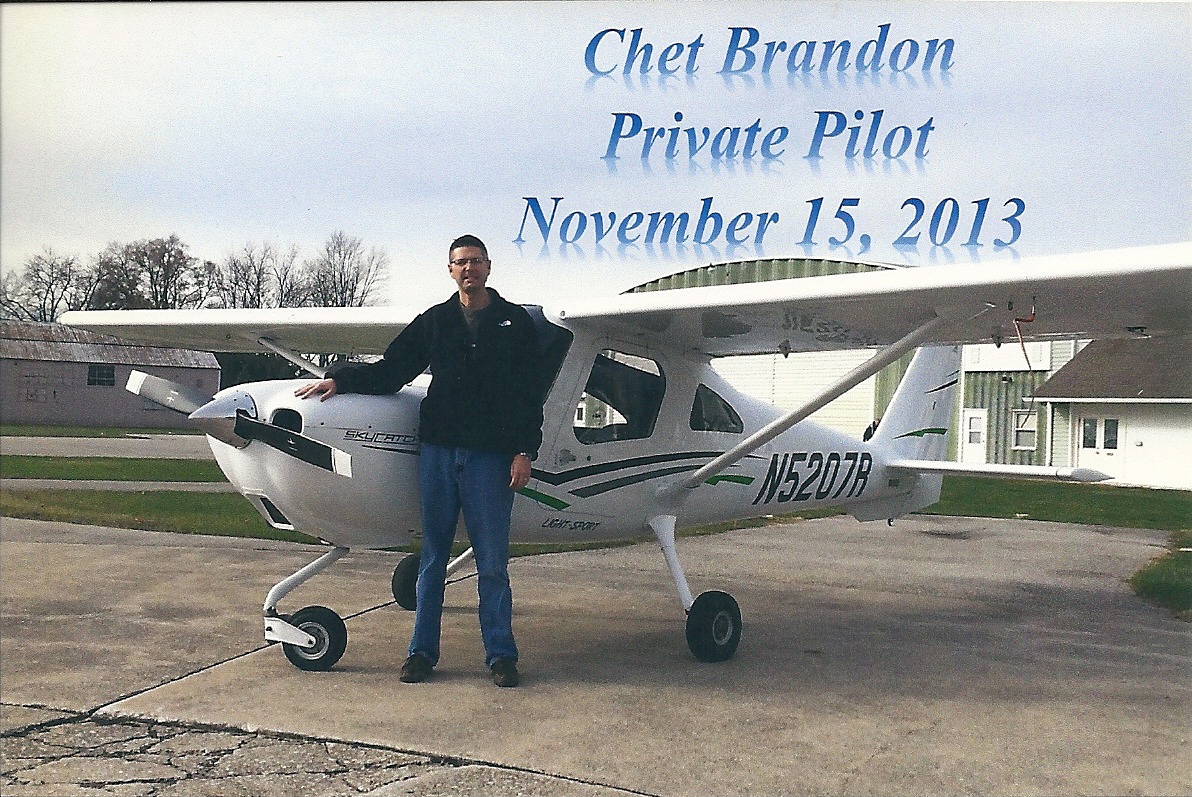
I recently completed flight training to become certified as a Private Pilot. This has been a life-long dream for me and I am so fortunate to have had the opportunity to pursue it. Before I go further I have to thank Nick Zink, my flight instructor at Suburban Aviation in Lambertville MI. Nick is a patient, highly knowledgable and friendly Certified Flight Instructor who helped me immensely. He is a passionate aviation professional who excels at bringing the best out of his students. I enthusiastically recommend him, and Suburban, to any aspiring aviators who are ready to get serious about flight training.
The feeling of soaring up and into the sky with your own hand and mind controlling the magical instrument that makes it happen is like no other. The thrill of spinning up the prop and lifting off the runway is a unique rush. Once I get airborne it’s as if I have left all my cares behind on the ground. Gravity pulls them away from me. My total focus in on flying the plane well. The first night flight was under a full moon and was perhaps the most serene and peaceful activity of my adult life.
I love the complexity that comes with flying safely and competently. It takes some serious knowledge, focus and physical skill to be a pilot. All can be learned but you have to dedicate yourself to it. I am sure I have much more to learn and sincerely appreciate gems of experience gained from pilots with more flight time. I am looking forward to my continued learning to be a good pilot.
With all that said, I wrote this blog post to comment on what else I learned from this experience. As an EHS professional I have built my career around expert knowledge of the entire spectrum of EHS subjects, some deeper that other of course. But it was during these flying lessons that I was in situations where I had to execute critical safety processes as part of an integrated set of tasks. In other words, I had to walk the talk…
First and foremost I learned that a significant part of flight safety for pilots is keen risk based decision-making. It is constantly emphasized through the training process. The process the FAA has developed to teach the concept is Aeronautical Decision Making or ADM. ADM is a systematic approach to the mental process used by pilots to consistently determine the best course of action in response to a given set of circumstances. It involves the identification, assessment and mitigation of risk factors in the pilot, aircraft, environment and external pressure areas of a specific flight situation.
The next thing I learned with the power of checklists. Yes, they take some time —deal with it! It’s a small investment in success. In aviation there is a checklist for everything. I quickly learned why. There is much to remember and any interruption creates the opportunity to miss an item that comes back to bite you later. A friend of mine recently showed me the preflight checklist for a B-52 on which he was the navigator. It’s over a hundred pages long! In aviation checklists are used primarily as verification tools. “Verification” refers to the confirmation of the condition of equipment or accuracy of documents consistent with the requirements of the governing documents.
The final takeaway I’ll highlight here is the value of preparation. It is incredibly important to know about your aircraft, airport procedures and proper upset condition procedures. In order to execute the actions correctly, and at the right time, you must do more than read about them. Hands on practice with repetition is a necessary.
I am going to wrap this post up. We will talk more about these and other concepts from aviation that may have application in the occupational environment. In the meantime, I’ll be in the wild blue yonder learning more.
A photo taken in the UCC South Charleston Plant by the famous photographer Ansel Adams.
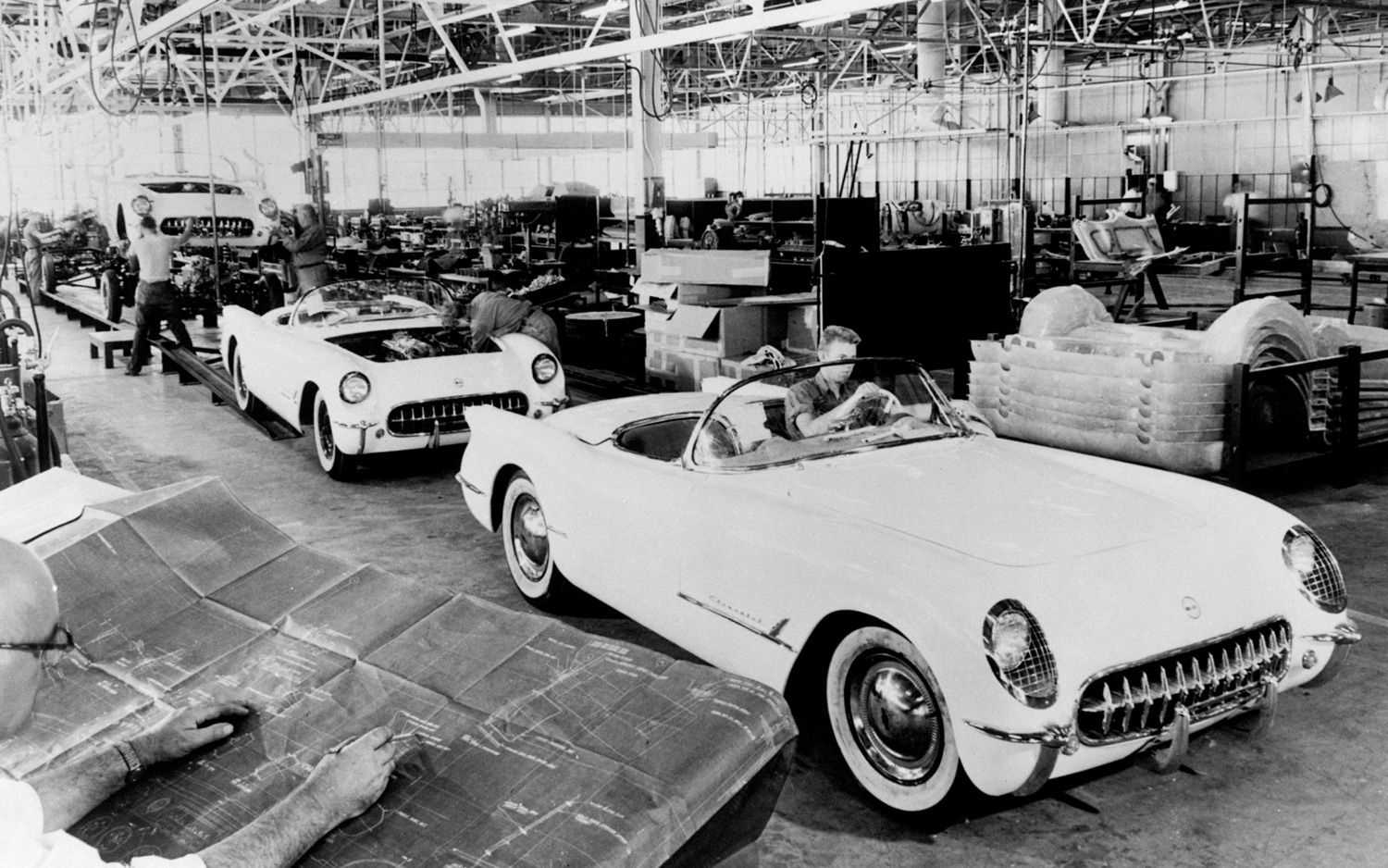
I have been very interested in Union Carbide Corporation (UCC) for a long time. As a child I saw their huge plants as meccas for the production of modern materials our society was/is built out of. My first job as an EHS Professional was with the organization that had been the Union Carbide Ferroalloys Division. It was previously known as the Electrometalurgical Company. ElectroMet, as it’s employees called it, was one of the two founding divisions of Union Carbide Corp (Linde Gas the other).
My early years were spent growing up in Charleston WV. This area was a center of operations for Union Carbide in it’s middle years. The area was an attraction because of the natural springs in the area useful for chemical production and the availability of hydroelectric energy used for smelting metals. I recall many car rides by the UCC South Charleston plant. To my child’s mind it looked like an alien world of pipes and vessels that made mysterious substances used for an untold number of final products. I recall a Star Trek episode about a refinery that has similar back drops (Where No Man Has Gone Before, Episode 3, Season 1). I guess in the beginning the South Charleston plant had a science fiction feel to it. It always captured my imagination. An odd turn of life that I started my professional career at a former unit of the company. This unforeseen path was also quite fortunate for a budding EHS Pro.
This is the first of what I think will be 10 chapters (posts) telling the story of Union Carbide with a slant towards EHS&S implications. It’s not going to be another one-sided view of Carbide as the irresponsible industrial behemoth out to ruin the environment for another quarter of earnings to please Wall Street. Although the company’s EHS legacy is deeply tainted by the horrific events at Bophal, Carbide’s story is much more complicated than that. For instance, UCC invented the organic chemicals industry in the United States while also discovering hundreds of important metallurgical agents used in creating most of the modern metal alloys that serve the human race today.
Join me in the chapters that follow to learn the whole story of Union Carbide, the Accidental Giant.
I was recently asked this question: where did I get my passion for EHS&S? This question comes up every now and then. Did it come from school? Was my Dad an EHS&S Pro? Did I want to be a Fireman when I was little? The last one is close…
I have thought quite a bit about this question. I can trace the origins of my intense interest in protecting people and the environment to three events early in my life. The Apollo 1 Command Module fire, the “Earthrise” picture taken during Apollo 8 and the TV show Emergency! .
Apollo 1 occurred in January of 1967. I was not yet on this earth. But my father had a book about the Apollo missions and when I was 5 I was fascinated by it. The book was Footprints on the Moon by John Barbour. I distinctly remember two pictures from it. The first was the burned out command module interior where the men sat. The other was the famous “Earthrise” picture which showed the people of earth our first view of our home from deep space.
“Fire in the cockpit!” It was an inferno that took 3 heroes lives in 18 seconds. Roger Chaffe, Ed White and Gus Grissom were training to go to the moon but never got the chance due to the hazards of oxygen, cabin pressurization and flammable materials. I just kept looking at the picture below thinking about these men. What did they feel when the fire was raging? Why did the engineers not anticipate the danger and fix it so they were safe? How did we ever expect to make it to the moon if the men weren’t safe practicing on the launch pad? It struck me how dangerous human endeavors can be and how serious the responsibilities of engineers and designers are. It also began to occur to me that there were people in the world who’s job it was to protect other people. I began to focus my attention on engineering subjects to learn about how people can control nature to achieve magnificent results like going to the moon.
The other picture in the book that captivated me was “Earthrise”. Perhaps in contrast to the failure that Apollo 1 was, it showed triumph over the difficulty of reaching the moon. The picture was taken by Astronaut William Andres of the Apollo 8 crew as the Earth rose from the horizon of the darkside of the moon on Dec 24th 1968. The picture showed the people of the Earth the contrast between our inviting, beautiful home and the cold, inhospitable environment of space. It showed us, for the first time, how truly special our Earth is. It was a critical moment in the environmental movement when we realized that Earth is it for us, we have no where else to go.
Finally, the third early influence that led me to the career I now enjoy was the 70’s TV show: Emergency!. It was about firemen in Los Angeles and the events they dealt with. The show was classic 70’s TV but I loved it. It was exciting and these guys were obviously heroes. They always knew how to make the rescue, had the equipment and the skills to pull it off. Plus, one of the minor characters name was Chet. Johnny and Roy, both paramedics, were the central characters and are pictured below. They were classic American heroes with the get-it-done in the clutch approach. I envied their ability to make the critical difference in another persons life at the time they needed it the most.
I was very young at this time and didn’t really know how these influences would effect me. I certainly didn’t connect them to a career choice. It would be after graduating high school and college when I would take these concepts and link them to a profession. I stumbled into EHS&S when a neighbor who watched me grow up, spotted my aptitude and connected me with an experienced professional in the field. I spent a day with them learning what EHS&S pros did and immediately realized this is what I was born to do.
I have been very satisfied with my career in EHS&S. While I don’t fly to the moon, or save people from certain death, or usually risk my own life, I know I have made a difference in the lives of the people I work with. I answered a first aid call for a coworker just the other day, rare for someone at my level, but saw the look in their eyes that they needed help and was glad I came to their aid. It’s that ability to help someone at that moment, or prevent that moment all together, that I find so rewarding as an Environmental, Health, Safety & Sustainability Professional in American Heavy Industry.
It has been said that the key to never having to work is to love what you do. I am there baby!
I ran across this article from Quartz digital magazine and it really got me thinking. The article is: Big data is leading scientists to ask bigger questions. The advent of effective distributed processing as open source software has created access to unprecedented amounts of low cost computational power. A product called Hadoop from Apache Software has significantly contributed to this new era. What are the bigger questions in EHS&S? If we could ask any question, and get a complete answer, what question would we ask?
So, it’s not as simple as one question. We know from working in our profession, that Environmental, Health, Safety and Sustainability are actually very separate bodies of knowledge. They are only connected by the industrial activities our society engages in. The big questions, with real potential for breakthrough if answered, across these functions may be different.
But first, what is Big Data? The term has been used to describe the complete collection of digitally accessible data being generated by our modern society. Not just numerical value data sets (envision excel spreadsheets), but also videos, tweets, pictures, web searches are all examples of the larger data universe humanity and our machines are now creating. Digital Republic published a good graphic illustrating the big picture of big data. To sum up, Big Data and the technology to interpret it, offer us the promise to understand our complex world (even universe) to a greater extend than ever before.
What are our most important and society benefiting questions? After thinking about it, I came up with two meeting the criteria. If you have others put them in a comment below! The first of mine is: Validating the belief that human activity is in fact changing the environment in a truly harmful way. This impacts the environmental and sustainability fields and the answer would allow us to continue the progress of society in a way that allows all species to thrive. The other high impact question from our field is: How do we accurately predict human behavior? The answer would allow the influencing of employee behavior to ensure a safer, healthy and environmentally responsible working environment. This answer would have huge impacts beyond EHS&S however as the methods would likely be transferable to a wide range of human endeavors.
The point I am making with this post is twofold: the computational power available to professionals has reached the point that we can now consider the large scale questions that hold the promise of transforming human existence, and we need to be ready with a clear understanding of our most significant problems and their world changing solutions.
I was presenting at an executive strategy meeting last week for the organization in which I lead EHS. During the presentation I had a thought that I want to expand on here: Safety Must be Made. In the discussion with the leadership group I was using this statement to communicate the concept that the people of the organization must take action continuously to ensure that the organizations activities are safe.
Safety does not occur automatically in nature. In fact, nature tends toward unsafe with elevated levels of chaos as the normal state. Chaos is by definition disordered and unpredictable. The lower the level of predictability, the more risk of occurrence of injurious or loss producing events. Safety is maximized in ordered and thus predictable conditions. This ordering must be constantly maintained. If left to nature’s whims, risk increases.
So how do we make safety? There are many aspects to this question but I want to focus this discussion on one: people taking action. I’ll use the analogy of an electrical generator. The generator must be in constant action to maintain the flow of electricity to create an electrical field. In this example, the electricity is the metaphor for safety and the action of the generator (rotor revolutions) represents employee actions. It is consumed as soon as it is made; safety cannot be stored. As long as the employees remain in action, the safety field is maintained.
Actions such as hazard reduction, behavior correction and system improvement are examples. Note that all these require people to make them occur. People Make Safety. The key to ensuring they continue to make safety in the work setting: the culture of the work group must have the basic assumption that safety is a core value. This means that the group self-reinforces the behaviors that maintain or improve safety. On the I/O Psy page of this blog is some great detail on Culture Transformation to Support EHS.
Summing up this post, Safety is a condition that must be constantly maintained. It is maintained by the people involved in the processes of the organization. The group’s culture must deeply support this constant effort. Safety does not simply exist, it is made and remade by each decision and resultant action taken by people working together.
I have noticed a new term that is often chanted in the business world: “Disruptive Innovation”. It seems to occur with frightening frequency in the technology sector. Apple famously disrupted the music recording industry with iTunes as an example. Can EHS be disrupted? If so how? Hypothetical discussion you say? I’ll bet that’s what the entrenched music industry people said…
Disruptive Innovation is the term coined by Clayton M. Christensen (renowned Harvard
Business Professor) to describe the impact of innovations that enable a new business model to prosper at the expense of existing models. Typically it is cheaper and allows a bigger group of consumers to obtain the product or service. It may also solve problems for customers or other stakeholders that the existing products or practices don’t . Frequently it is a new entrant into the market that is not encumbered by the need to focus on sustaining innovations to fend off other existing participants and does not have to worry about existing profit margins on upscale products.
This is an important theory because it can be used to understand the future of markets and thus set the stage for effective business strategy to result in continued business success. Companies that fail to understand this theory can end up realizing too late that their products, services, production method or business model has been replaced in the consumers decision making process . If they wait until the moment the market (consumers) signal them, it’s too late. The incumbents usually can’t make changes fast enough at that point. It’s also quite likely that they don’t have the financial resources to invest in such a transition.
What if EHS was disrupted? How would you serve your customers as an EHS Professional? How would you lead your company to take advantage of this new disruptive technology? For these reasons it’s important for EHS & Sustainability (EHS&S) professionals to understand the theory and remain vigilant for disruptive innovations affecting our markets.
I want to focus on one method/aspect in particular: find the pain points and deliver a simple and cheap answer. What are the pain points for our customers in the EHS world? I came up with the following list:
Existing training methods
The difficulty in complying (human behavior)
The cost of compliance
We have learned from the videos that it’s not usually technology that creates disruptive innovation, it’s alternative business models. What is the typical EHS Business Model? I’ll try a stab at it in a sentence or two:
EHS & Sustainability professionals serve their markets (internal and external) by being subject matter experts. They take specialized knowledge and attempt to deliver useful tools for the organization/customer to use. They attempt to influence the organization/customer to use these tools to improve their operations and activities.
I have simplified the mission and methods of our profession for the ease of this discussion. So what is an alternative business model? Here’s a couple I’ve been thinking of:
Crowd Sourced EHS – Essentially, it’s using the existing knowledge of the workforce to deliver EHS tools.
Outsourced expertise – a 1-800 EHS&S service that you call only when an issue or significant need arises. The EHS organization would have a large number of subscribers.
Free EHS&S service – The cost of EHS would be born buy sponsors who hope to sell their products to the organizations being serviced by the EHS&S organization.
It was not my goal in this post to develop these theories further. Perhaps in another post. My goal today was to get you thinking about disruptive innovation. How to watch out and prepare for it, and to attempt to do it. Those who are successful at disrupting a market leave an indelible mark on our world. Wouldn’t it be great to leave such a positive mark for EHS&S in our world’s great institutions?
I was perusing my Twitter feed yesterday and ran across a collection of articles from Fast Company recapping innovative solutions to environmental issues. It’s a good collection, I retweeted it, but thought it also worthy of some discussion time on my humble blog. I will say the author of the summary article has a rather negative view of the environmental protection progress as of 2012 that I don’t necessarily share. (For instance, the Washington Post, among many others, reported in the spring of 2012 that the US is leading the world in CO2 emissions reductions.) One article in the collection caught my attention in particular. It was titled: Fungi Discovered in the Amazon will Eat Your Plastic. The subject was originally published in the journal Applied and Environmental Biology, July, 2011. From the Fast Company article:
“The fungi, Pestalotiopsis microspora, is the first anyone has found to survive on a steady diet of polyurethane alone and–even more surprising–do this in an anaerobic (oxygen-free) environment that is close to the condition at the bottom of a landfill.”
Where I am going with this is that, depending on the byproduct of this organic process, we may see a similar evolution of the industrial process for recycling plastics or even using spent plastics as feedstock for fuel production. It would be a huge win indeed for the environment to make the reclaiming of plastics economically viable. It will be interesting to keep an eye on this discovery to see if a solution for our real-world problem presents itself.

 Are you looking for some new perspectives on HSE processes and systems? With those new perspectives come new ideas as well. Something to differentiate you and your organization from the pack. Innovation is more than just a way to pad your performance review though. It’s a requirement of our modern world. I have touched on disruptive innovation several times in posts on this blog. The reason is that I am watching these disruptions redefine industry after industry. Just ask UPS if they are concerned about Amazon experimenting with various schemes to deliver it’s products. Our trade is plied in these same industries. We too must accept the need to radically innovate in our systems and methods to support the same efforts our organisations are undergoing at the enterprise level. Competition is fierce and little tweaks can be the difference maker.







 LeadingEHS.com