
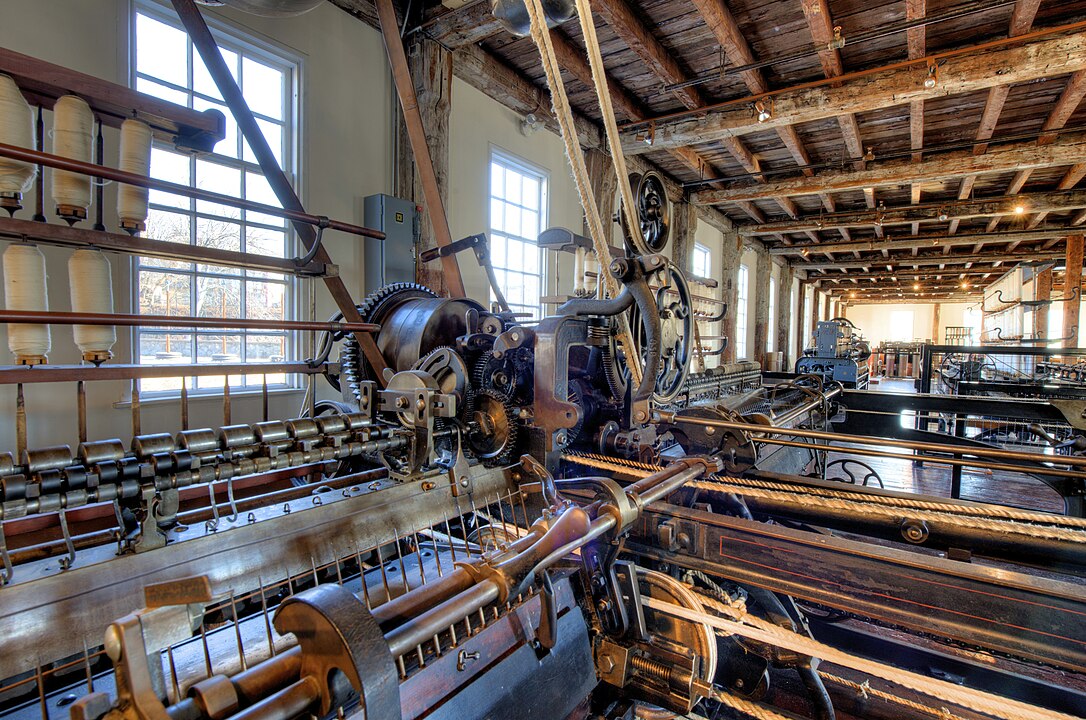
Photo Description: Slater Textile Mill in Rhode Island, started operation in 1793 utilizing water power. This is the spinning mule process, the heart of the mill. Textiles, pottery and lumber were some of the earliest American industries. Photo credit: Wikipedia. https://en.wikipedia.org/wiki/Slater_Mill
Lately, I’ve been revisiting Alexander Hamilton by Ron Chernow, focusing on Hamilton’s influential years as the first U.S. Treasury Secretary. What stands out most is how deeply his vision shaped the foundation of the American economic system—especially his push to develop a strong manufacturing base. Having spent my career in the modern industrial environment, I can’t help but see how many of today’s economic realities have roots in the principles Hamilton laid out more than two centuries ago. His belief in a diversified, innovation-driven economy helped set the stage for the American system to emerge just in time to lead the world into the modern industrial age. I thought I’d take a step back from my usual writing and dig into these ideas a bit more—both out of historical interest and professional curiosity.
Alexander Hamilton, as the Secretary of the Treasury, had a visionary and transformative perspective on the economic development of the young nation. His belief in the importance of a strong manufacturing base, supported by an active federal government, laid the foundation for America’s rise as an industrial power. Though controversial in his time, Hamilton’s ideas have had a lasting impact on the country’s economic structure and policy.
Foundations of a Visionary
Hamilton’s remarkable vision was shaped by the unique experiences and influences in his early life. Born in the Caribbean and raised in poverty, Hamilton witnessed firsthand the economic fragility of colonial societies dependent on foreign imports. As a young clerk for a trading firm on St. Croix, he gained practical knowledge of finance, bookkeeping, trade, and shipping—insights that gave him a sophisticated understanding of economic systems and global commerce. After coming to the American colonies and attending King’s College, he was immersed in Enlightenment thought, which emphasized reason, progress, and institutional strength.
His service as an aide to George Washington during the Revolutionary War further crystallized his views. Hamilton saw how the lack of a centralized economic system hindered the war effort—funding was inconsistent, supply chains unreliable, and cooperation between states was weak. These experiences convinced him that a strong, coordinated national government was essential to America’s survival and growth. Influenced by European mercantilist thought and Britain’s financial model, Hamilton envisioned an American economy that embraced industry and innovation while remaining politically independent and socially dynamic.
The Report on Manufactures
In 1791, Hamilton presented his Report on the Subject of Manufactures to Congress—a groundbreaking and visionary policy blueprint aimed at transforming the economic structure of the United States. In it, Hamilton challenged the prevailing belief that agriculture alone should remain the economic backbone of the country. Instead, he argued for a balanced, diversified economy that integrated industry alongside farming to ensure long-term prosperity, national security, and independence. The report made several key arguments and policy proposals, many of which would influence American economic development for generations.
- Economic Diversification: Hamilton believed a healthy national economy should not depend solely on agriculture. He argued that diversification—by developing domestic industry—would protect the country from the volatility of crop prices, poor harvests, and external market fluctuations. A robust manufacturing base would also provide resilience and flexibility, ensuring steady employment and economic output during times when agriculture might falter.
- National Security and Independence: A central theme in the report was economic self-sufficiency. Hamilton warned that over-reliance on foreign goods, particularly from Europe, made the United States vulnerable in times of conflict. By producing essential goods—such as textiles, metalworks, and tools—at home, the nation would safeguard its independence and be better prepared for wartime disruptions. He viewed industrial development as an extension of national defense policy.
- Utilization of Underemployed Labor: Hamilton highlighted that manufacturing could absorb segments of the population not fully utilized in agriculture, such as women, children, and those living in urban areas (Obviously the notation of employing children in industry is not acceptable in modern society. It was viewed differently in Hamilton’s time). He argued that this labor force could contribute meaningfully to production without displacing agricultural workers, thereby increasing national productivity without creating economic disruption.
- Promotion of Innovation and Technical Progress: The report asserted that manufacturing would stimulate technological advancement by encouraging the application of science and specialized skills to production processes. Hamilton understood that industry had the potential to drive continuous innovation, making the country more competitive and fostering the development of new tools, processes, and techniques.
- Mutual Reinforcement of Agriculture and Industry: Contrary to Jeffersonian fears, Hamilton insisted that manufacturing would not weaken agriculture but would actually enhance it. Farmers would benefit from a reliable domestic market for their raw materials and foodstuffs, while manufacturers would process those goods into value-added products. This synergy would reduce dependence on foreign trade and circulate wealth more widely across the economy.
- Active Role of Government: One of the most revolutionary aspects of Hamilton’s report was his argument for federal involvement in economic development. He proposed that the government could and should take deliberate action to support industry. This included direct subsidies (bounties), the implementation of protective tariffs to shield American firms from cheaper imports, investment in infrastructure (such as roads and canals), and the development of a central banking system to manage credit and currency. Hamilton believed that market forces alone were insufficient to foster a robust industrial base in a fledgling nation.
- Protection of Infant Industries: Hamilton argued that new American industries would struggle to compete against more established and efficient foreign producers, especially from Britain. He advocated for temporary protective tariffs to allow these “infant industries” the time and space to grow, innovate, and eventually become globally competitive. This idea would become a foundational principle of future U.S. industrial policy.
- Moral and Civic Benefits: Beyond economics, Hamilton suggested that manufacturing would contribute to the moral and civic development of citizens. A broader occupational structure, combined with the demands of industrial organization and technical training, would promote discipline, hard work, and upward mobility, fostering a more productive and civically engaged society.
- National Wealth and Power: Hamilton viewed manufacturing not just as a means of producing goods but as a pathway to national greatness. An economy built on a foundation of industry would generate revenue, enhance exports, stimulate internal markets, and allow for sustained growth. This economic strength, in turn, would translate into political power and international influence, securing America’s place among the leading nations of the world.
Taken together, these points formed a sophisticated, coherent argument for a new kind of American economy—one based not on the ideals of pastoral simplicity but on industrial dynamism, national self-sufficiency, and federal leadership. While many of these ideas were not immediately embraced by Congress, the report laid an intellectual and policy framework that would influence U.S. economic development for more than two centuries.
Immediate Reaction and Delayed Implementation
Despite its ambitious scope and long-term importance, the report was not well received by Congress at the time. Political opponents, particularly Thomas Jefferson and James Madison, favored a decentralized, agrarian republic and resisted the idea of a powerful federal government shaping economic life. As a result, many of Hamilton’s proposals—particularly subsidies for industry—were not enacted during his lifetime.
However, the intellectual influence of the report endured. Hamilton’s vision for a manufacturing-based economy planted the seeds for future economic policy and institutional development. His arguments for industrial development and federal involvement in economic affairs found new life in the decades that followed.
Influence on the American System
In the early 19th century, the ideas Hamilton articulated resurfaced in the form of the “American System,” championed by Henry Clay. This policy framework incorporated protective tariffs, a national bank, and federal funding for internal improvements—echoing Hamilton’s recommendations almost directly. Though operating under a different name and in a different political context, the American System represented a renewed embrace of Hamiltonian economics. It marked a shift in national thinking toward accepting a more proactive role for the federal government in guiding economic development.
Industrial Expansion and the 19th Century
During and after the Industrial Revolution, particularly in the post-Civil War era, the United States began to implement many of the policies Hamilton had proposed. Protective tariffs became a staple of economic policy, shielding developing industries from European competition. Federal investment in railroads, canals, and public education helped create the infrastructure and skilled workforce needed for industrial growth. Manufacturing boomed, transforming the U.S. into a global economic power by the late 19th century—just as Hamilton had predicted. His vision proved foundational in shaping the economic landscape of the modern nation.
Legacy in 20th-Century and Modern Policy
Hamilton’s influence extended well into the 20th century. During the Great Depression, New Deal programs drew on Hamiltonian principles by using federal power to stimulate economic recovery, support industry, and build infrastructure. Mid-century defense and technology investments, public funding of research, and innovation policies also echoed his belief that government should serve as an engine of economic development. His vision laid the intellectual groundwork for economic nationalism—the idea that the strength of a nation rests on a strategically guided and diversified economy.
Even in contemporary times, debates about infrastructure, industrial policy, and government involvement in the economy reflect Hamilton’s legacy. The Federal Reserve embodies his vision of centralized financial management, while federal support for science, education, and industry continues to align with his principles. Though not fully implemented in his lifetime, Hamilton’s Report on the Subject of Manufactures is now recognized as one of the most forward-thinking economic documents in American history.
How did he Conceive of Such a Complex System? Foundations in the Federalist Papers
Long before he formally outlined his industrial strategy as Treasury Secretary, Hamilton laid the intellectual groundwork for a strong national economy in the Federalist Papers. In essays such as Federalist No. 11 and No. 12, he emphasized the importance of centralized authority over commerce and taxation, arguing that a unified federal government could better negotiate trade, manage revenue collection, and promote national prosperity. He warned that fragmented state-level trade policies would weaken the country’s position on the world stage and foster internal conflict. This concern is echoed in Federalist Nos. 6 and 7, where Hamilton highlights the dangers of commercial rivalry among the states—warning that without a strong union, economic disputes could escalate into political instability or even violence. He believed that only a national government could ensure harmony in economic policy and prevent destructive competition. Hamilton’s vision of economic unity and strength is further developed in Federalist Nos. 30–36, where he defends the broad taxing powers of the federal government as essential to national security and infrastructure. While these essays do not directly propose industrial policy, they clearly reflect Hamilton’s belief that economic development required intentional, coordinated action at the federal level—an idea that would become the backbone of his later manufacturing proposals. In this sense, the Federalist Papers serve as the philosophical foundation for the economic blueprint he would later put into motion.
Conclusion
Alexander Hamilton’s economic vision was far ahead of its time. In a young republic wary of centralized power, he argued boldly for a manufacturing-based economy, supported by federal action and strategic planning. Though initially rejected, his ideas profoundly shaped the nation’s path toward industrialization, modernization, and global economic leadership. Hamilton’s legacy endures not only in the institutions he helped build—like the national bank and a robust financial system—but also in the very idea that government has a vital role in fostering national prosperity. His vision for American manufacturing was not merely economic—it was foundational to the identity and future strength of the United States.
Article Addendum: A Follow up Discussion on Tariffs
Hamilton’s economic plan famously advocated for the use of tariffs to protect America’s emerging industries—a strategy well suited to the realities of the late 18th century. At that time, the United States had virtually no established industrial base and little to no export market. Tariffs provided a necessary buffer, shielding fledgling manufacturers from overwhelming British competition while giving them time to develop capacity, technology, and a skilled workforce. In that historical moment, protectionism wasn’t just a policy choice—it was a developmental necessity. Hamilton understood that without government support, American industry would likely remain stunted under the shadow of more mature European economies.
However, applying the same logic to the 21st-century American economy is problematic. Today, the U.S. is home to some of the most advanced and globally integrated industries in the world, from aerospace and pharmaceuticals to semiconductors and precision manufacturing. These sectors generate a significant portion of their revenue from exports and rely heavily on complex international supply chains. In many cases, manufacturing processes are distributed across multiple countries—components may be designed in the U.S., fabricated in Asia, assembled in Mexico, and tested in Europe before returning to American markets. Broad tariffs in this environment don’t just target foreign competition; they impose added costs at multiple points in the production process, raising prices, reducing efficiency, and weakening global competitiveness.
Moreover, blanket tariffs can provoke retaliatory measures from trade partners, shrinking export markets and eroding relationships that American firms depend on. They can also discourage foreign direct investment in U.S. operations, which often brings not only capital but innovation and job creation. And perhaps most crucially, indiscriminate protectionism can slow down technological progress by insulating domestic firms from the pressures of global competition—pressures that often drive innovation, efficiency, and quality.
That said, the complexity of today’s economy does not mean tariffs are always inappropriate. There are legitimate strategic cases for targeted protection, particularly in industries critical to national security or in response to unfair trade practices by other nations. For example, measured tariffs can help stabilize sectors like steel, renewable energy, or microelectronics when global market distortions—such as state subsidies or dumping—undermine fair competition. In such cases, temporary protective measures, combined with long-term investment in innovation and workforce development, can be consistent with Hamiltonian principles.
While Hamilton’s tariff policy was critical in helping build the foundation of American industry, the modern economy demands a more nuanced approach—one that balances strategic support for key sectors with open market access, multilateral cooperation, and supply chain resilience. Protectionism in today’s globally interdependent world must be applied surgically, not ideologically. Hamilton’s core insight still holds: economic strength requires intentional policy. But the tools and context have evolved, and our strategies must evolve with them.

 LeadingEHS.com