
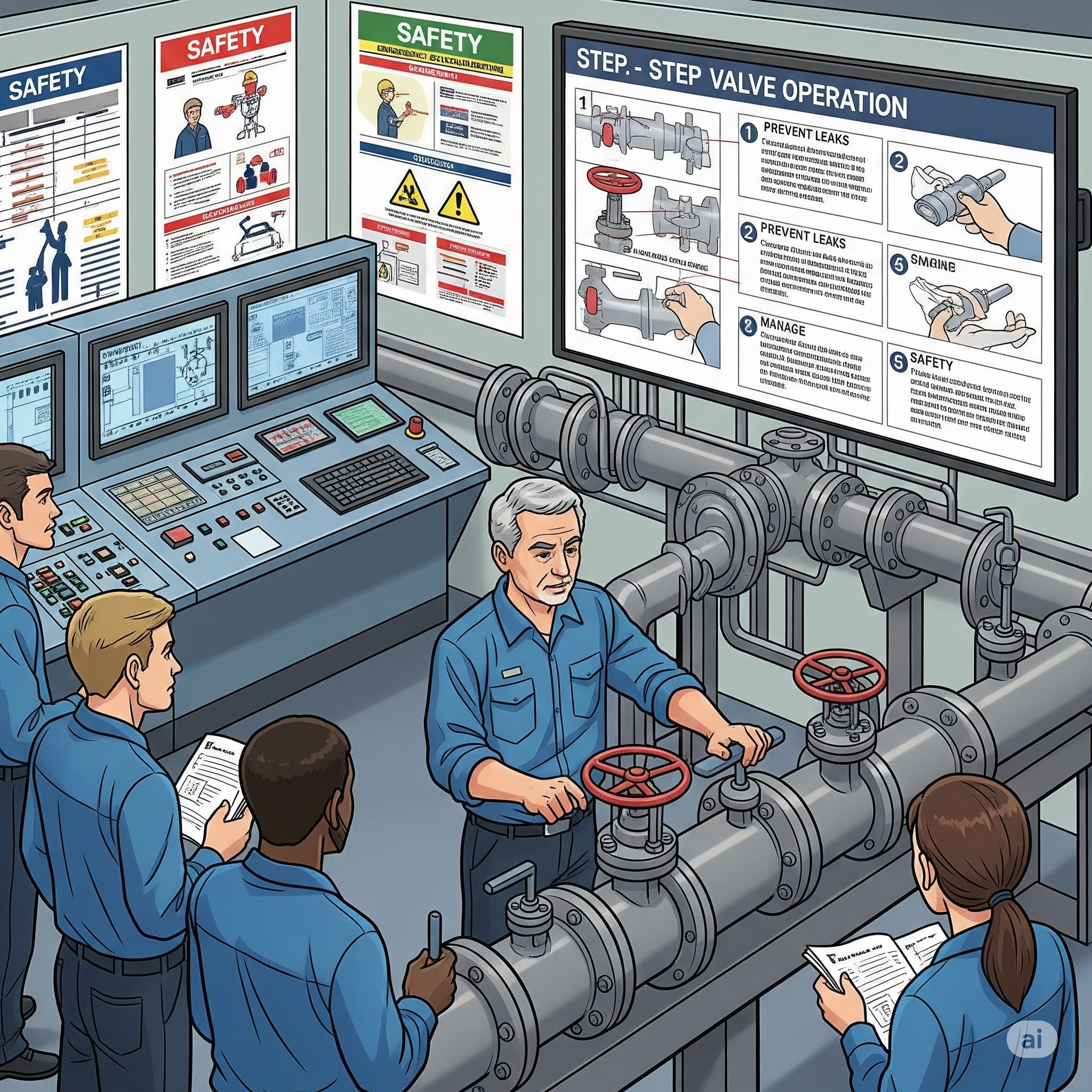
I have been developing ideas regarding improving spill and release events in chemical operations lately. People in these operations remain a central influence on the safety of the operation. Operators of the process units have the greatest influence over the operations. At the most basic level, operators must have habits that enhance safe operations. This article explores some key competencies of these critical personnel in the chemical plant.
In the intricate world of chemical manufacturing, where precision, safety, and efficiency are paramount, the role of a chemical plant operator stands as a critical cornerstone. Far from simply monitoring gauges or turning valves, these individuals are the vigilant guardians of complex processes, directly influencing everything from product quality to environmental integrity. While some tasks may appear routine, the mastery of fundamental actions—like meticulously verifying the correct valve, ensuring absolute closure, and maintaining constant vigilance during operations—is what truly separates a competent operator from a truly great one. This article delves into the core competencies and unwavering dedication that define what it truly means to be an indispensable chemical plant operator.
Proficient Manual Valve Operation: A Core Competency for Chemical Plant Operators
Operating manual valves is a fundamental and frequent task for chemical plant operators. While seemingly simple, improper valve manipulation can lead to significant safety incidents, environmental releases, production losses, and equipment damage. Proficient manual valve operation hinges on three critical actions: verifying the correct valve, ensuring full seating when closing, and never walking away from an open valve. This training text will expand on each of these concepts to provide a comprehensive understanding for all operators.
1. Verifying the Correct Valve: The Foundation of Safe Operation
Operating the wrong valve is a common root cause of incidents in chemical plants. The consequences can range from minor process upsets to catastrophic events. Therefore, rigorous verification protocols are paramount.
Why is it Critical?
- Process Interruption: Closing a critical flow path or opening an incorrect one can disrupt an entire process, leading to off-spec product or even shutdowns.
- Safety Hazards: Opening a valve to a high-pressure line when a low-pressure line was intended, or isolating the wrong safety device, can create immediate and severe safety risks (e.g., leaks of hazardous chemicals, pressure excursions).
- Environmental Releases: Misdirected flow can lead to spills or releases of regulated substances into the environment, resulting in regulatory fines and reputational damage.
- Equipment Damage: Introducing incompatible materials, over-pressurizing equipment, or creating cavitation can severely damage pumps, heat exchangers, and piping.
Detailed Verification Steps:
- Positive Identification (3-Way Verification): This is the cornerstone of correct valve identification. Every time you approach a valve for operation, perform the following:
- Tag Verification: Read the valve tag number and description. Verbally confirm it matches the Procedure, Work Order, or Operator Log instruction. Don’t rely solely on memory or location.
- Line Tracing: Physically trace the pipeline connected to the valve in both directions (upstream and downstream) as far as practical. Verify the pipe contents, direction of flow (if indicated), and connection points. This helps confirm you’re on the correct process line.
- Location Confirmation: Confirm the valve’s physical location matches diagrams, P&IDs (Piping and Instrumentation Diagrams), and your mental map of the unit. Look for surrounding equipment, landmarks, and other valves in the vicinity.
- Utilize P&IDs and Process Flow Diagrams (PFDs): Before going into the field, review the relevant P&IDs and PFDs for the area where you’ll be working. Understand the valve’s function, its upstream and downstream connections, and its relationship to other equipment. This pre-job briefing is crucial.
- Pre-Job Briefing and Communication: When working with a team, especially during complex operations, conduct a thorough pre-job briefing. Clearly communicate which valves will be operated, by whom, and the expected outcomes. Use consistent terminology and valve numbers.
- “Line of Sight” Principle: Whenever possible, maintain a clear line of sight to the valve you’re operating. If you have to turn away or your view is obstructed, re-verify before proceeding.
- Address Discrepancies Immediately: If there’s any discrepancy between the valve tag, line tracing, P&ID, or instructions, STOP. Don’t proceed until the discrepancy is resolved. This may involve consulting with a supervisor, another operator, or reviewing documentation. It’s always better to ask than to make a mistake.
- Avoid Assumptions: Never assume a valve’s function or connection based on its appearance or location alone. Always verify.
- Poor Lighting/Visibility: In dimly lit areas or areas with poor visibility, use a flashlight. Ensure valve tags are clean and legible.
2. Ensuring Valves Are Fully Seated When Closing: Achieving Positive Isolation
A common misconception is that “closed” means “closed.” For many valve types, especially gate and globe valves, a valve is only truly closed when it’s “full seated.” Failure to fully seat a valve can lead to leaks, bypassing, and incomplete isolation.
Why is it Critical?
- Incomplete Isolation: A partially closed valve will allow product to leak through, preventing effective isolation for maintenance, cleaning, or ensuring process integrity.
- Safety Risks: Leaks of hazardous materials can pose serious safety threats (e.g., toxic gas release, flammable liquid spills).
- Process Contamination/Bypassing: Unintended flow through a “closed” valve can contaminate product, bypass critical process steps, or lead to inefficient operations.
- Erosion and Damage: Continuous small leaks (often called “wire drawing”) through a partially seated valve can erode the valve seat and disc over time, leading to permanent damage and increased leakage.
- Loss of Containment: This can contribute to environmental incidents and regulatory non-compliance.
Detailed Seating Procedure:
- Feel the Resistance: As you close the valve, you’ll feel increasing resistance as the disc or wedge approaches the seat. This is normal.
- Gentle Snug Up: Once you feel significant resistance, apply a firm but gentle final turn to “snug up” the valve. Do NOT over-tighten or use excessive force, especially with smaller valves or those with fine threads. Over-tightening can:
- Damage the valve seat or disc.
- Strip the stem threads.
- Gasket deformation, leading to future leaks.
- Make it difficult to open the valve later.
- Back-Seating (Where Applicable): For some globe valves and specific gate valves, after fully closing the valve, it’s good practice to turn the handwheel a quarter to half turn back in the opening direction. This pulls the stem slightly back against a “back seat” in the bonnet, which helps to seal against stem packing leaks. Note: Not all valves are designed for back-seating, and excessive back-seating can sometimes unseat the main closure element. Refer to specific valve manufacturer guidelines or plant procedures.
- Verify Zero Flow/Pressure: After closing a valve for isolation, always verify that flow has stopped or pressure has dropped to zero on the downstream side, if safe and practical to do so (e.g., by observing a pressure gauge, flow meter, or listening for flow).
- “Closed” Indication: Visually confirm the valve position indicator (if present) shows “closed.” However, don’t rely solely on the indicator as it can sometimes be misaligned.
- Never Use a Cheater Bar (Unless Approved): Using wrenches or “cheater bars” to gain leverage on valve handwheels is generally prohibited unless specifically authorized by a procedure or supervisor for specific, large valves where extra leverage is safely required, and the valve is designed to withstand it. Excessive force can severely damage the valve.
- Report Leaks: If a valve doesn’t fully seat and continues to leak, or if you encounter excessive difficulty in seating it, stop and report the issue immediately for maintenance. Don’t try to force it.
3. Never Walking Away from an Open Valve: Maintaining Situational Awareness
Operating a valve is an active process that requires constant attention, especially when opening. Walking away from an open valve, even for a moment, can have serious consequences.
Why is it Critical?
- Uncontrolled Flow/Pressure: Leaving an opening valve unattended, especially during filling or pressure equalization, can lead to overfilling of tanks, over-pressurization of lines, or uncontrolled reactions.
- Spills and Releases: An unattended valve opening can quickly lead to spills, overflows, or releases of hazardous materials if the receiving vessel or line capacity is exceeded or if an unexpected condition arises.
- Process Upsets: Uncontrolled flow can destabilize an entire process, leading to off-spec product, emergency shutdowns, or even equipment damage.
- Safety Hazards: Uncontrolled flow can lead to explosions, fires, or exposure to hazardous chemicals if containment is lost.
- Missed Abnormalities: An operator present during valve opening can immediately detect and respond to abnormal conditions such as leaks, unusual noises, vibrations, or rapid pressure/level changes.
Detailed Guidelines for Opening Valves:
- “Open Slowly, Open Deliberately”: Unless a procedure specifically dictates rapid opening (e.g., for certain emergency valves), open valves slowly and deliberately. This allows:
- Controlled Flow/Pressure Equalization: Prevents hydraulic shock (water hammer) and allows pressures and temperatures to equalize gradually.
- Monitoring for Abnormalities: Gives you time to observe changes in pressure, flow, level, temperature, and listen for unusual sounds.
- Reaction Time: Provides time to react and close the valve if an unexpected problem arises.
- Constant Monitoring: Remain at the valve and continuously monitor the relevant process parameters (e.g., pressure gauges, level indicators, flow meters) as you open it. Listen for flow, watch for leaks, and feel for vibrations.
- Define Your “Walk-Away” Point: Only walk away from a manual valve once its operation is complete (fully open, fully closed, or set to a specific throttled position), you’ve verified its state, and confirmed the process is stable and reacting as expected.
- Communication: If you must leave a valve partially open for an extended period (e.g., during a slow fill), ensure you communicate this clearly to other operators and your supervisor. Use lockout/tagout procedures if the valve is critical for safety or maintenance.
- Never Leave a Partially Open Valve Unattended During Critical Operations: During critical operations like filling a tank, transferring hazardous materials, or bringing equipment online, stay with the valve until the operation is complete and the system is stable.
- Use Checklists and Procedures: For complex valve lineups or operations, always use written checklists and follow standard operating procedures (SOPs). Mark off each step as it’s completed, including valve position verification.
- Handover Protocols: During shift changes or breaks, ensure clear and detailed handover of any valves that are in an intermediate state or that require ongoing monitoring.
4. Never Use Safety Devices to Run the Process: Protect the Last Line of Defense
In chemical plants, emergency systems like high-high level switches, low-low flow trips, or relief valves are built to protect people, equipment, and the environment if something goes wrong. These devices are not meant to be part of normal daily operation. Using them that way puts the plant at risk and removes your safety backup.
Why is it Critical?
- Loss of Safety Margin: These devices are there to act when the process goes off track. If you’re relying on them during normal work, they’re no longer a true backup—and may not be there when you really need them.
- Operator Desensitization: If a safety device trips regularly, it starts to feel routine. That means you’re ignoring early warning signs and could miss a real problem.
- Mechanical Failure Risk: Emergency switches and shutdown systems are not built for frequent use. Repeated cycling can cause them to fail or stick, making them unreliable during an actual emergency.
- Poor Operational Control: If you’re waiting for a safety trip to stop a process, you’re not truly in control. It means you’re running too close to the edge instead of managing the process with proper tools.
- Regulatory Compliance: Standards like OSHA PSM, API 2350, and ISA 84 require that safety systems be used only as a final layer of protection—not as part of the operating plan. Misuse can lead to audits, fines, and serious safety issues.
Detailed Use Practices:
- Know the Difference Between Control and Safety Devices: Understand which instruments are for daily control (like level transmitters or flow meters) and which are there to stop emergencies. Don’t mix them up in your operations.
- Use Proper Operating Limits: Always stop processes—like tank filling—based on normal operating levels, not when the high-high trip activates. Stay within safe ranges well before safety systems kick in.
- Track Levels and Flow—Don’t Wait for Trips: Monitor tank level, flow rate, and fill time closely. Know how long a fill should take and when to stop it. The safety switch should never be what tells you you’ve gone too far.
- Review P&IDs and SOPs: Before starting a job, check P&IDs to see how the system is supposed to work. Procedures should never tell you to rely on a safety trip to complete an operation.
- Recognize Frequent Trips as a Problem: If safety devices are tripping often, report it. That’s a sign something is wrong with the process or procedure—it’s not “just how it works.”
- Speak Up About Unsafe Procedures: If you see or are asked to follow a practice that uses safety systems as a routine control method, stop and bring it up. It could prevent an incident.
- Test Safety Devices on a Schedule—Not During Operations: Safety systems should be tested in a controlled environment during maintenance or inspection. They’re not process control devices.
5. Procedure Use and Compliance: The Blueprint for Safe and Consistent Operation
Standard Operating Procedures (SOPs) are the backbone of safe, efficient, and compliant chemical plant operations. They encapsulate critical process safety information, best practices, and lessons learned. Proficient operators not only follow procedures but also understand their purpose and actively contribute to their continuous improvement.
Why is it Critical?
- Consistency and Predictability: Ensures tasks are performed uniformly across all shifts and operators, leading to predictable process outcomes and reducing variability.
- Error Reduction: Procedures are designed to minimize human error by providing clear, step-by-step instructions, highlighting critical points, and specifying safety precautions.
- Accident Prevention: Many incidents can be traced back to deviations from established procedures or the lack of adequate procedures. Adherence prevents known hazards from recurring.
- Training and Competency: Procedures serve as vital training tools for new operators and refreshers for experienced personnel, ensuring a baseline level of competency.
- Regulatory Compliance: Regulatory bodies (e.g., OSHA, EPA) often mandate written procedures for critical operations involving highly hazardous chemicals, making compliance essential.
- Troubleshooting and Reference: Provide a reliable reference for operators during abnormal conditions or when troubleshooting process upsets.
- Knowledge Transfer: Capture institutional knowledge, ensuring that critical operational experience isn’t lost due to personnel changes.
Detailed Guidelines for Procedure Use and Compliance:
- Always Use the Latest Approved Version: Before starting any task, verify that you’re using the most current, approved version of the procedure. Check dates or version numbers. Never rely on outdated copies or memory for critical operations.
- Pre-Job Briefing and Review:
- Read Through Before Starting: For any non-routine or critical task, read the entire procedure from beginning to end before commencing work. This allows you to understand the flow, anticipate challenges, and identify any prerequisites.
- Identify Critical Steps: Pay close attention to steps marked as “critical,” “caution,” “warning,” or “danger.” Understand why these steps are critical and what the potential consequences of error are.
- Verify Equipment and Conditions: Before touching any equipment, mentally (or physically, if safe) walk through the procedure and confirm that all necessary equipment is available, in proper working order, and that the process conditions (e.g., pressure, temperature, levels) are as specified.
- Step-by-Step Adherence:
- Execute Each Step as Written: Perform each step exactly as written in the procedure. Don’t skip steps, combine steps, or improvise, unless explicitly authorized through a Management of Change (MOC) process or immediate emergency response (which must be documented afterwards).
- “Stop-Think-Act-Review” (STAR Principle): For critical steps, pause before acting.
- Stop: Before performing the action.
- Think: What is the action? What is the expected outcome? What are the potential hazards?
- Act: Perform the action deliberately.
- Review: Verify the action was completed correctly and the expected outcome occurred.
- “Verify and Confirm”: After completing a step (especially valve operations, switch positions), visually or audibly confirm the action was successful before moving to the next step.
- Marking Procedures (Where Permitted): If procedures are designed for it, check off steps as they’re completed. This helps maintain place, especially in long or complex procedures, and provides an audit trail.
- Do Not Deviate Without Authorization: If a step cannot be performed as written, or if an unexpected condition arises, stop the job immediately. Don’t attempt a workaround. Contact your supervisor, and if necessary, initiate the Management of Change (MOC) process to review and update the procedure.
- Feedback and Improvement:
- Report Discrepancies: If you identify an error, omission, ambiguity, or inefficiency in a procedure, report it immediately through the established feedback mechanism. This is a critical part of continuous improvement.
- Participate in Reviews: Actively participate in periodic procedure reviews or updates when requested. Your frontline experience is invaluable in ensuring procedures are practical, accurate, and safe.
- Accessibility: Know where to find all relevant procedures, whether they’re hard copies in a control room, electronic files, or within a document management system. Ensure they’re readily accessible during operations.
- Training and Assessment: Understand that procedures are core to your training and competency. Actively engage in training sessions that use procedures and be prepared for assessments of your understanding and ability to follow them.
Conclusion: The Operator’s Role in Process Integrity
Proficient manual valve operation isn’t just about turning a wheel; it’s about understanding the process, anticipating potential issues, and maintaining constant vigilance. By diligently practicing these three key actions—verifying the correct valve every time, ensuring valves are full seated when closing, and never walking away from an open valve—along with strict procedure use and compliance, chemical plant operators significantly contribute to the safety, reliability, and efficiency of the entire facility. These practices are cornerstones of operational discipline and distinguish a proficient operator. Turning these crucial training points into ingrained habits is paramount, ensuring that safe and effective operation becomes second nature. Continuous training, unwavering adherence to procedures, and a steadfast commitment to safety are essential for mastering these fundamental skills.

 LeadingEHS.com