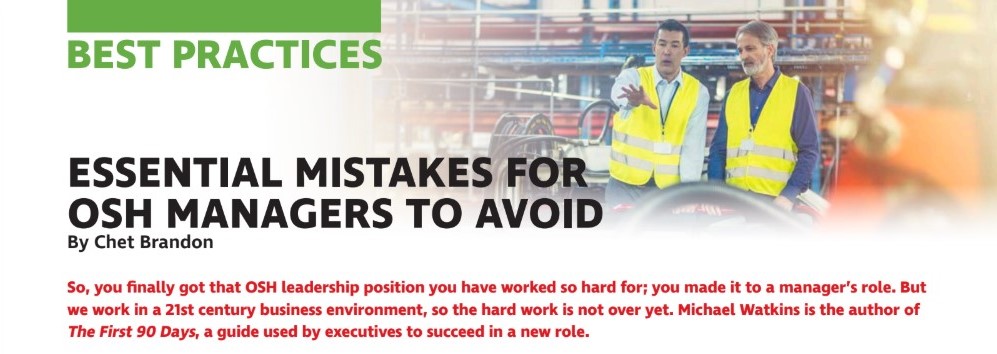
I recently revisited an article I wrote for ASSP’s Professional Safety Magazine titled Essential Mistakes for OSH Managers to Avoid, published in the July 2018 edition. While the core principles I discussed remain highly relevant today, the evolving landscape of our profession has introduced new challenges and opportunities.
The dynamic nature of environmental, health, safety, and sustainability (EHS&S) has significantly broadened the scope of our responsibilities. Issues such as climate change, social responsibility, technological advancements, and shifting regulatory expectations now intersect with traditional safety and health priorities. As a result, OSH managers are increasingly required to adapt, innovate, and lead in ways that were less prominent a few years ago. This expanded scope underscores the importance of revisiting foundational practices while staying attuned to emerging trends and expectations.
Reflecting on that article reminded me that avoiding key mistakes is just as critical now as it was then, but success in today’s rapidly changing environment also demands a proactive and strategic mindset. It’s a reminder of how much our profession continues to evolve—and how we must evolve with it.
“Societal expectations for constant connectivity and immediate responses have created a culture of urgency, further accelerating the pace of professional life. The urgency for a new EHS&S leader to quickly gain the support of their organization, demonstrate success, and drive meaningful change has never been greater.“
In this expanded role, new EHS&S leaders have a larger area of responsibility to quickly understand and impact. Along with the many areas of focus for the new leader that are identified in the 2018 article, other new activity focuses have emerged. These are:
- Data and AI Strategy
- Sustainability Strategy
- Relationship to the Enterprise Risk Management Team
- Organizational Occupational Medicine Capability
- Integration with Lean 6 Sigma
- Integration with the Annual Business Plan and Cap Ex
New Opportunities Bring New Challenges
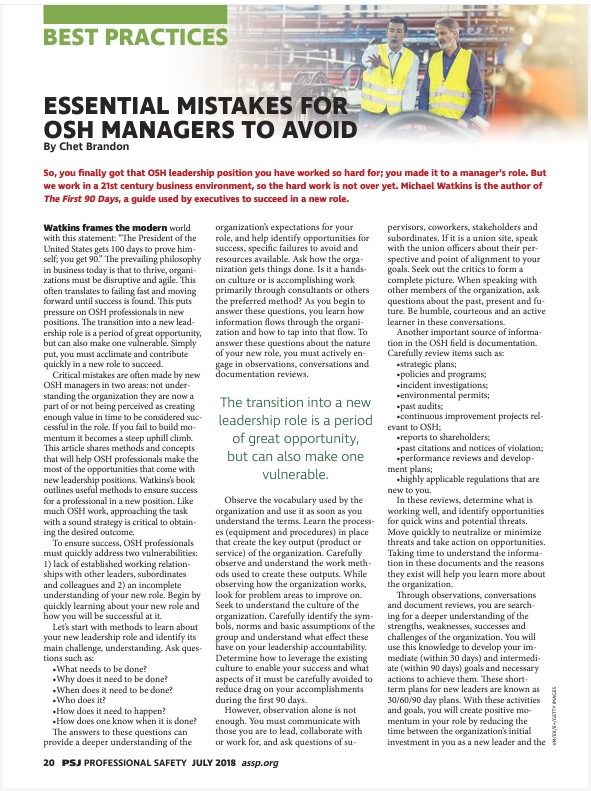
Now more than ever, new OSH managers often make critical mistakes: misunderstanding their organization or failing to show value quickly enough to succeed. Without momentum, the path becomes challenging. This article explores strategies to help OSH professionals thrive in leadership roles, drawing on Watkins’s book for practical methods to ensure success. As with most OSH tasks, a sound strategy is essential for achieving desired outcomes.
Comment on 2025 relevance:
In 2025, as workplace expectations evolve and organizations prioritize rapid adaptation, the ability to demonstrate immediate value and strategic impact will be even more critical for new OSH managers. he continued impact of technology and societal expectations on the pace of business operations has only increased the complexity of walking in to be a new leader.
In the workplace of today, advanced technology like AI, automation, and real-time communication tools have enabled business professionals to work faster, make data-driven decisions instantly, and collaborate globally without delays. Simultaneously, societal expectations for constant connectivity and immediate responses have created a culture of urgency, further accelerating the pace of professional life. The urgency for a new EHS&S leader to quickly gain the support of their organization, demonstrate success, and drive meaningful change has never been greater.
Below are six new topics to add the discussion in the 2018 article that will help you transition into your new role effectively and successfully in the hyper-accelerated environment of 2025 and beyond.
Data and AI Strategy
A newly promoted manager in an EHS&S role within a manufacturing organization should first understand the organization’s data and AI strategy and its relevance to safety and sustainability goals. For example, they should be aware of AI-driven predictive maintenance systems that analyze equipment data to anticipate failures, reducing downtime and preventing accidents. Similarly, data analytics might be used to monitor and optimize energy usage or track emissions, helping the company meet regulatory standards and sustainability targets. Knowing how these initiatives align with broader goals, such as achieving zero incidents or carbon neutrality, will help the manager contribute effectively.
Next, the manager must learn about the data governance and infrastructure relevant to EHS functions. For instance, they should understand how safety data is collected from sensors on equipment or wearable devices monitoring workers’ health and movements. Familiarity with systems like IoT-enabled safety platforms or AI-driven risk assessment tools is crucial for ensuring compliance and reducing workplace hazards. Additionally, they need to understand how data is integrated into dashboards or reporting tools for regulatory compliance and internal audits, such as tracking OSHA recordables or sustainability metrics.
Finally, the manager should explore the cultural and operational implications of AI and data in EHS. For example, AI might automate certain routine inspections, allowing teams to focus on higher-priority safety initiatives. However, this could raise concerns about job security among team members, requiring the manager to facilitate transparency and training for workers to adapt to new technologies. Furthermore, the manager should address ethical concerns, such as ensuring AI systems used for monitoring employee behavior respect privacy boundaries. Building a culture that embraces these technologies as tools to enhance safety and sustainability, rather than threats, will be key to fostering trust and innovation in the workplace.
Sustainability Strategy
A newly promoted manager in an EHS&S role should focus on understanding the core sustainability goals and compliance requirements of the organization. This includes familiarizing themselves with specific environmental targets, such as reducing carbon emissions by a certain percentage, achieving zero waste in manufacturing, or meeting water conservation benchmarks. They should review relevant regulatory frameworks, such as EPA standards or ISO 14001 certifications, to ensure compliance. For example, if the organization aims to lower emissions, the manager should examine processes like energy use in production and emissions monitoring systems to identify how EHS practices contribute to achieving this goal.
The manager should also prioritize learning about the key tools, technologies, and teams driving the sustainability strategy. This might involve understanding the role of environmental monitoring systems that track air or water quality or AI tools that optimize energy consumption. They should connect with internal stakeholders, such as the sustainability or facilities teams, to learn how initiatives like renewable energy integration, waste recycling programs, or lifecycle analysis are managed. For instance, the manager might explore how IoT sensors are used to detect leaks or monitor hazardous waste storage, ensuring that these tools align with the broader sustainability efforts.
Lastly, the manager must assess the cultural and operational aspects of sustainability within their department and the broader organization. This includes identifying existing behaviors and gaps in knowledge among their team that could hinder progress toward sustainability goals. For example, they might discover that workers need additional training on safely handling eco-friendly materials or that operational processes lack clear protocols for minimizing waste. By addressing these gaps and fostering collaboration, the manager can begin laying the groundwork for a proactive culture that integrates sustainability into daily EHS practices, setting the stage for long-term success.
Relationship to the Enterprise Risk Management Team
The integration of the Environmental, Health, and Safety (EHS) process into an organization’s broader risk management framework is crucial because it ensures a holistic approach to identifying, assessing, and mitigating risks that could impact employees, the environment, and the organization’s operational continuity. EHS risks often overlap with other business risks, such as legal compliance, reputational damage, and financial liabilities. By aligning the EHS process with the risk management process, organizations can prioritize resources effectively, create synergy between departments, and foster a safety-oriented culture that supports organizational goals. This relationship is critical for identifying emerging risks proactively and maintaining regulatory compliance, reducing incidents, and ensuring long-term sustainability.
To establish the most effective relationship, the newly promoted EHS&S manager should focus on integrating EHS considerations into the organization’s overall risk assessment methodology. This involves collaborating with key stakeholders, such as operations, legal, and finance teams, to ensure that EHS risks are considered alongside other business risks. Building strong relationships across departments and communicating the value of EHS in mitigating broader organizational risks is essential. Additionally, implementing shared metrics, joint training programs, and transparent reporting mechanisms can create alignment and promote accountability. By fostering this collaboration, the EHS manager can position EHS as a strategic function that contributes to organizational resilience and success.
The EHS&S leader also has a valuable opportunity to contribute to the organization’s enterprise risk management (ERM) committee by aligning EHS and sustainability goals with broader risk management strategies. By sharing insights into environmental, health, and safety risks—such as compliance violations, operational disruptions, or climate-related vulnerabilities—they can help the committee identify and prioritize risks that impact both the organization’s financial and operational stability. For example, addressing potential liabilities from hazardous material handling or integrating sustainability metrics into risk assessments can enhance decision-making. This collaboration also enables the EHS leader to advocate for proactive measures, such as adopting safer technologies or advancing sustainability initiatives, which not only mitigate risks but also create long-term value for the organization. Engaging with the ERM committee positions the EHS leader as a strategic partner, driving resilience and sustainability across the enterprise. This interaction also gives the EHS&S team, and the new leader, visibility to the Board of Directors.
Organizational Occupational Medicine Capability
A newly promoted manager in an EHS&S role should first understand the scope and structure of the organization’s occupational medicine capability and its integration into workplace health and safety initiatives. This includes learning about the services provided, such as pre-employment health screenings, injury management, ergonomics programs, and chronic condition monitoring. For example, in a manufacturing setting, they should examine how the occupational medicine team supports workers exposed to physical hazards like repetitive motion, noise, or chemical exposure. Understanding protocols for managing workplace injuries, such as return-to-work programs and compliance with regulations like OSHA’s injury and illness recordkeeping requirements, is essential for aligning EHS practices with organizational goals.
Additionally, the manager should explore collaborative opportunities and data utilization within occupational medicine programs to enhance EHS efforts. For instance, they can analyze injury and illness trends from occupational health data to identify high-risk areas or recurring safety issues. Partnering with occupational health professionals to implement proactive measures, such as conducting respiratory protection fit tests or offering wellness initiatives to reduce fatigue, can significantly improve worker well-being and safety. By engaging with the occupational medicine capability, the manager can strengthen their team’s ability to address workplace health risks comprehensively, fostering a safer and healthier environment while contributing to overall productivity. A newly promoted EHS leader should also focus on accessing the new organization’s existing Total Worker Health (TWH) resources and partnerships, such as wellness programs, occupational medicine teams, and external consultants, to identify opportunities for collaboration and enhanced injury reduction initiatives, as well as their interest in going deeper into the philosophy.
The Lean Six-Sigma Processes of the Organization
A newly promoted manager should first familiarize themselves with the structure and tools of the organization’s Lean Six Sigma program to identify opportunities for rapid improvements in EHS processes. They should understand core methodologies, such as DMAIC (Define, Measure, Analyze, Improve, Control), and how these can be applied to EHS challenges. For example, during the “Define” phase, the manager might work with teams to clearly outline safety risks associated with a particular process. In the “Measure” and “Analyze” phases, they could use tools like control charts or Pareto analysis to identify trends in incident reports or near-miss data. This structured approach enables the manager to focus on high-priority areas, such as reducing machine-related injuries or enhancing waste segregation practices, for immediate impact.
Additionally, the manager should explore opportunities for cross-functional collaboration and process mapping as part of Lean Six Sigma initiatives. By participating in value stream mapping sessions, they can identify bottlenecks or inefficiencies in EHS workflows, such as delays in incident reporting or gaps in personal protective equipment (PPE) distribution. Rapid improvement events (Kaizen workshops) can then be organized to address these issues, implementing quick, actionable changes like redesigning a more efficient PPE inventory system or creating standardized inspection checklists for high-risk areas. By leveraging Lean Six Sigma tools and techniques, the manager can demonstrate their ability to drive meaningful EHS improvements quickly, earning trust and building credibility in their new role.
Integration into the Strategic Plan and Capital Expense Plan
A newly promoted EHS&S manager should first gain a clear understanding of the Annual Business Planning (ABP) and Capital Expenditure (CapEx) processes within their new organization. This includes learning how budgets are allocated, how EHS projects are prioritized, and the criteria used to evaluate potential investments. For example, they should review past CapEx projects related to EHS, such as the installation of advanced ventilation systems or the acquisition of automated safety equipment. Understanding these processes will help the manager identify opportunities to propose projects that align with organizational goals, such as compliance with new regulations or achieving sustainability targets, and secure funding for initiatives like upgrading spill containment systems or enhancing fire suppression infrastructure.
Additionally, the manager should focus on how to present a strong business case for EHS-related improvements during the ABP and CapEx cycles. This includes quantifying the return on investment (ROI) for proposed projects by demonstrating cost savings from reduced injuries, lower regulatory fines, or enhanced operational efficiency. For example, they might highlight how installing machine guarding systems can significantly reduce injury rates and associated workers’ compensation costs. Alternatively, they could propose investment in a real-time emissions monitoring system, emphasizing its role in ensuring compliance and avoiding potential penalties. Understanding and participation in the capital approval and project over site process is another important opportunity to maximize the new leaders impact, and knowledge of the future of the organization. By understanding how to navigate these processes and align their proposals with organizational priorities, the manager can drive rapid improvements in EHS&S performance while contributing to the broader business strategy.
Summary of the Updated Challenges and Opportunities
As a newly promoted EHS&S leader, there are numerous opportunities to drive rapid improvements by leveraging key organizational processes. By understanding the integration of EHS with Lean Six Sigma, the leader can apply methodologies like DMAIC to reduce safety risks, streamline operations, and enhance compliance. Familiarity with the organization’s Annual Business Planning and CapEx processes allows the leader to secure funding for high-impact projects such as improving hazard control systems or investing in advanced monitoring technologies. Engaging with the organization’s Total Worker Health initiatives presents an opportunity to address both physical and mental health risks, fostering a holistic approach to safety. Additionally, by working closely with the occupational medicine and enterprise risk management teams, the leader can integrate health strategies with risk assessments, proactively mitigating potential safety incidents. Through these actions, the EHS leader can align safety and sustainability goals with the broader business strategy, creating measurable improvements in the workplace.
As technological innovations in 2024 and 2025 continue to reshape industries, EHS&S leaders face the challenge of staying ahead of emerging tools and systems, such as AI-driven safety monitoring and real-time environmental data analytics, while also seizing the opportunity to integrate these technologies into their strategies for injury reduction, compliance, and sustainability. By embracing these advancements, the EHS&S leader can enhance decision-making, improve risk management, and optimize operational safety, positioning the organization for success in an increasingly tech-driven landscape.
Closing Thought
Leadership in the future will be defined by how well we can integrate innovation into strategy, resulting in successful outcomes. Those who harness the power of change will not just lead—they will thrive.

 LeadingEHS.com
Pingback: Essential Mistakes for EHS&S Leaders to Avoid – 2025 Update – EHS Safety News America Blog 🇺🇸
Pingback: AI as a Strategic Partner: Building a Digital Twin to Advance Safety and Sustainability | LeadingEHS.com